GOSPEL >> Consecration
SDAH 305
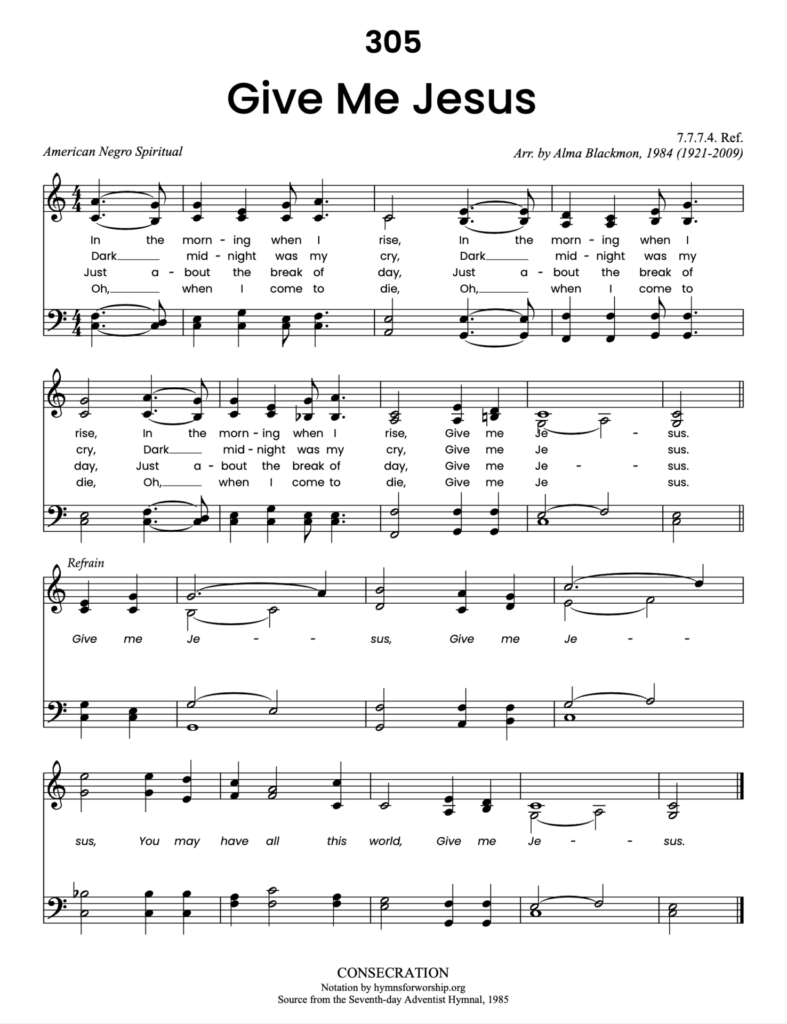
In the morning, when I rise
In the morning, when I rise
In the morning, when I rise,
Give me Jesus.
Get the hymn sheet in other keys here
For Worship Leaders
Make each hymn more meaningful with these helpful tools: Short, ready-to-use hymn introductions for church bulletins, multiple ways to introduce a hymn based on your worship theme and in-depth history and insights to enrich your song service.
Hymn Spotlight: Give Me Jesus
This beloved spiritual was popularized by the Fisk Jubilee Singers, a courageous group of African American students from Fisk University who toured post-Civil War America and Europe, raising funds and introducing the world to the rich legacy of Negro spirituals. “Give Me Jesus” was one of the 128 songs included in the 1880 volume The Story of the Jubilee Singers, With Their Songs, a powerful testimony of faith amid hardship. The hymn’s repeated plea—“Give me Jesus”—captures the essence of Matthew 16:26, reminding us that no worldly gain can compare to knowing Christ. Set in a moving arrangement by Alma Blackmon, its simplicity and soul-stirring message remain a call to choose Jesus above all else.
📖 Reference: Feel free to share but please cite hymnsforworship.org when reproducing.
Introductions for Sabbath School Song Service (based on specific lesson quarterlies):
The Fisk Jubilee Singers were the first to carry Negro spirituals to the world after the Civil War. These 12 dedicated musicians made several successful concert tours, singing the songs of the freed people and raising money for Fisk University. The goal of their first tour was to raise the then huge amount of $20,000 for their school, which was founded in 1865 in Nashville, Tennessee, for Blacks. They sang it in concert halls and churches in Europe an dAmerica; their audiences included the president of the United States and the queen of England. In three years they raised $100000! In the year 1880 a book about their experiences was published by J.B.T. Marsh entitled The Story of the Jubilee Singers, With Their Songs. It included 128 spirituals and an account of the singer’s most recent trip to Germany. (This was a revision of two previous volumes.)
“Give Me Jesus” was one of the numbers in the book. (See the reproduction of a slightly different melody line, on page 332.) It has the same message as the old gospel song, “Take the World, but Give Me Jesus,” SDAH 329. The refrain echoes the words of Jesus: “What is man profited, if he shall gain the whole world, and lose his own soul?” (Matt. 16:26).
The musical arrangement is by Alma Blackmon (1921- ;see SDAH 69), who also arranged SDAH 138, “Rise Up, Shepherd, and Follow,” and SDAH 580, “This Little Light of Mine.”
📖 Reference: Companion to the Seventh-day Adventist Hymnal by Wayne Hooper and Edward E. White. Review and Herald Publishing Association, 1988.
Stanza:
R – Matthew 16:26

Text
1
In the morning, when I rise
In the morning, when I rise
In the morning, when I rise
Give me Jesus
Refrain.
Give me Jesus,
Give me Jesus.
You may have all this world,
Give me Jesus.
2
Dark mid-night was my cry,
Dark mid-night was my cry,
Dark midnight was my cry,
Give me Jesus.
3
Just about the break of day,
Just about the break of day,
Just about the break of day,
Give me Jesus.
4
Oh, when I come to die,
Oh, when I come to die,
Oh, when I come to die,
Give me Jesus.

Hymn Info
Biblical Information
(r) Matt 16:26
Text Source
American Negro Spiritual
Copyright Information
Arrangement copyright 1984 by Alma Blackmon
Metrical Number
7.7.7.4.Ref.
Arranger
Alma Blackmon, 1984 (1921-2009
In the Morning When I Rise
The original title commonly used for this hymn are actually the first few words of the initial stanza — ‘In the morning when I rise.’ According to Odum and Johnson (1925), many slave songs contained the metaphor of ‘morning’ and that as a rule, ‘morning signified to the Negro the time for going to heaven and for the resurrection.’…
Needless to say, ‘Give Me Jesus,’ including other songs, was rejected by the editors of the Slave Songs, because they felt it was a ‘fake’ spiritual.
This basically indicates that the songs sounded too similar with ‘white hymns’ and that while it involves the spirit and experiences of enslaved Africans, the style of the hymn was like that found in many white American hymn books…
RELATED POSTS

Watch
Visit Zernan Diaz’ bio here
Explore more hymns: