WORSHIP >> CLOSE OF WORSHIP
SDAH 67
O Lord, now let Your servant
Depart in heav’nly peace,
For I have seen the glory
Of Your redeeming grace:
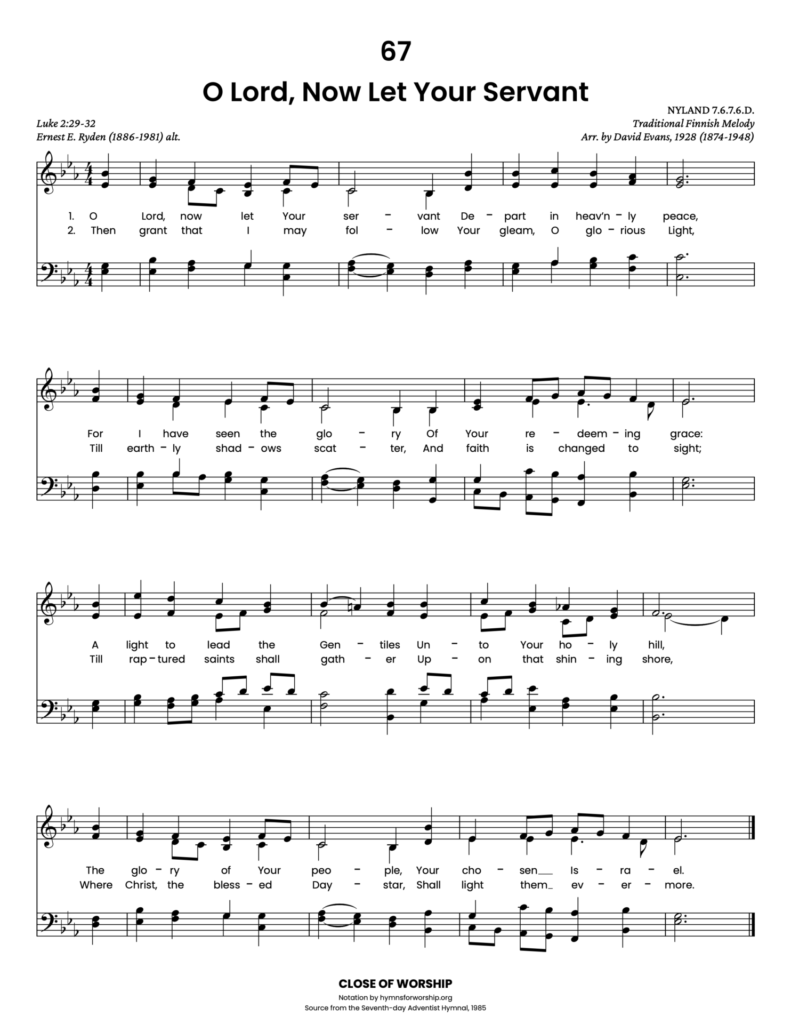
Get the hymn sheet in other keys here
For Worship Leaders
Make each hymn more meaningful with these helpful tools: Short, ready-to-use hymn introductions for church bulletins, multiple ways to introduce a hymn based on your worship theme and in-depth history and insights to enrich your song service.
Hymn Spotlight: O Lord, Now Let Your Servant
Inspired by Simeon’s prayer in Luke 2:29-32, this hymn by Ernest Edwin Ryden (1886–1981) reflects the deep faith of one who has seen God’s salvation. Known in Latin as Nunc Dimittis, this passage has long been sung as a closing prayer in worship. Ryden’s hymn was first published in The Hymnal (1925) by the Lutheran Church, Augustana Synod, and later adapted with modernized language.
The tune NYLAND, a Finnish folk melody, first appeared in Finland’s Evangelical Lutheran Church Chorale Book(1909). It was introduced to English congregations through the Revised Church Hymnary (1927), where it was harmonized by David Evans.
As we sing this hymn, may we, like Simeon, find peace and assurance in knowing that God’s promises are fulfilled in Christ.
📖 Reference: Feel free to share but please cite hymnsforworship.org when reproducing.
Introductions for Sabbath School Song Service (based on specific lesson quarterlies):
In 1924 Ernest Edwin Ryden (1886-1981; see SDAH 37) wrote this hymn, based on Simeon’s prayer in Luke 2:29-32: “Lord, now lettest thou thy servant depart in peace, according to thy word; for mine eyes have seen thy salvation, which thou hast prepared before the face of all people; a light to lighten the Gentiles, and the glory of thy people Israel.” No. 837 in the Scripture Readings section of SDAH is the Jerusalem Bible version of this prayer, commonly known throughout Christendom by its first two Latin words, “Nunc Dimittis.”
Ryden’s hymn was first published in The Hymnal, 1925, by the Lutheran Church, Augustana Synod. Alterations have been made to change “thee” and “thou” to “you” and “your.”
The Finnish tune NYLAND appeared in the 1909 edition of Finland’s Evangelical Lutheran Church Chorale Book. A recent version of that book states that NYLAND is a folk tune first sung near Kuortane, a small village in south Ostrobothnia, Finland. (The tune is sometimes called KUORTANE.) The harmonization SDAH uses was made by David Evans (1874-1948; see Biographies), musical editor of Revised Church Hymnary, 1927. He used the tune in that book, introducing it for the first time to English congregations. The name Nyland (a province in Finland) was given it by Millar Patrick, a coeditor of Revised Church Hymnary, 1927.
Stanza:
1 – Luke 2:29-32
2 – 2 Corinthians 5:17
1 Peter 1:19

Text
1
O Lord, now let Your servant
Depart in heav’nly peace,
For I have seen the glory
Of Your redeeming grace:
A light to lead the Gentiles
Unto Your holy hill,
The glory of Your people,
Your chosen Israel.
2
Then grant that I may follow Your gleam,
O glorious Light,
Till earthly shadows scatter,
And faith is changed to sight;
Till raptured saints shall gather
Upon that shining shore,
Where Christ, the blessed Day star,
Shall light them evermore.

Hymn Info
Biblical Reference
(a) Luke 2:29-32 (b) 2 Cor 5:17; 1 Pet 1:19
Author
Ernest E. Ryden (1886-1981)
Copyright
Words copyright by Board of Publication, Lutheran Church in America. Music from Revised Church Hymnary 1927 by permission of Oxfor University Press
Hymn Tune
NYLAND
Metrical Number
7.6.7.6.D.
Arranger
David Evans, 1928 (1874-1948)
Tune Source
Traditional Finnish Melody
Theme
CLOSE OF WORHIP
Explore more hymns: