WORSHIP >> Adoration & Praise
SDAH 36
O Thou in whose presence my soul takes delight,
On whom in affliction I call,
My comfort by day and my song in the night,
My hope, my salvation, my all!
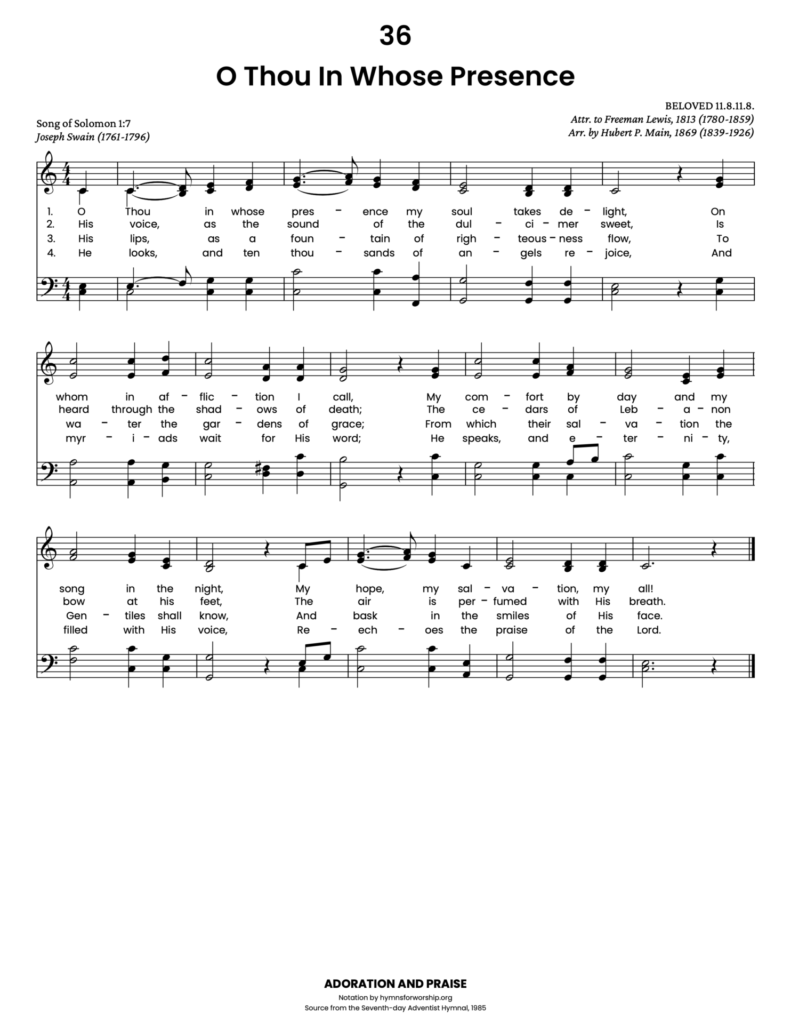
Get the hymn sheet in other keys here
For Worship Leaders
Make each hymn more meaningful with these helpful tools: Short, ready-to-use hymn introductions for church bulletins, multiple ways to introduce a hymn based on your worship theme and in-depth history and insights to enrich your song service.
Hymn Spotlight: O Thou in Whose Presence
A hymn of deep devotion and longing, O Thou in Whose Presence was originally part of a nine-stanza poem by Joseph Swain (1761–1796), first published in his Redemption, a Poem in Five Parts (1791). Rooted in Song of Solomon, the hymn expresses the soul’s yearning for Christ, describing Him in His grace and power.
Swain, an engraver turned preacher, had a dramatic spiritual transformation after reading the Bible in 1782. Baptized by Dr. John Rippon, he became a beloved Baptist minister in Walworth, London, where his congregation grew rapidly. Despite poor health, he left a lasting legacy in hymnody, compiling over 300 hymns before his passing at age 35.
The tune BELOVED (also called DULCIMER) was composed in 1813 by Freeman Lewis (1780–1859), a Pennsylvania surveyor and musician. It may have originated from a folk melody, with a striking resemblance to a theme in Haydn’s Symphony No. 103. The flowing, expressive melody was later arranged in 1869 by Hubert Platt Main, a prolific hymn tune composer and editor.
As we sing today, may our hearts seek Christ’s presence, finding in Him our Shepherd, Refuge, and Friend.
📖 Reference: Feel free to share but please cite hymnsforworship.org when reproducing.
Introductions for Sabbath School Song Service (based on specific lesson quarterlies):
These words are part of a long poem of nine stanzas of eight lines each, written by Joseph Swain. It was first published in Swains’s Redemption, a Poem in Five Parts, 1791. In his Experimental Essays on Divine Subjects in verse, 1834, it is entitled “A Description of Christ by His Graces and Power. From Solomon’s Song.”
Joseph Swain was born in Bermingham in 1761. His parents died while he was still young, so he was apprenticed to an engraver; he completed his apprenticeship in London under his elder brother. His poetic talent led him into undesirable company, but his conscience was working, and he bought a Bible in 1872. Reading it, he was convinced he should change his careless and frivolous ways, and he began to use his talent by writing hymns for his own use. He heard Dr. Rippon (see SDAH 509) preach as well as others, but decided to follow Rippon and was baptized by him on May 11, 1783. He held prayer and testimony meetings in his own home, and the experience here gained led to his being called to preach on Sundays in Baptist congregations in 1791. Ordained on February 8, 1792, he became the leader of a church of 27 members in Walworth, southeast London. He was so successful that the church building was enlarged three times and the membership increased to more than 200 within four years. He rarely enjoyed good health, and passed to his rest on April 14, 1796. In addition to the two volumes mentioned previously, he also wrote Walworth Hymns, 1792, which contained 129 of his hymns, plus a supplement in 1794 containing 192 hymns.
The tune BELOVED, or DULCIMER, was composed in 1813 by Freeman Lewis (1780-1859), of Uniontown, Pennsylvania. He was a surveyor as well as a musician. The tune appears to be derived from an old folk song. The melody of the first line is almost identical with that employed by Haydn in his Drum Roll Symphony No. 103 in E-flat major, second movement, andante; one note in the latter is a half step higher. The tune was arranged in 1869 by Hubert Platt Main, born August 17, 1839, the son of a singing schoolteacher. Main became associated with music publishers and helped Philip Philipps (see SDAH 610) compile the Methodist Episcopal Hymn and Tune Book, 1866. He was employed by William B. Bradbury (see Biographies) in 1867 and stayed all his life with this firm, which later became Biglow and Main, and then the Hope Publishing company. Main composed more than 1000 songs, hymn tunes, and anthems, and edited many collections for use in church and Sunday school, both hymnal and gospel songbooks. He died October 7, 1925, at Newark, New Jersey.
He also arranged SDAH 325 and 621, ELLESDIE, and SDAH 456.
Stanza:
1 – Isaiah 42:1
2 – Song of Solomon 2:8
3 – Song of Solomon 5:13

Text
1
O Thou in whose presence my soul takes delight,
On whom in affliction I call,
My comfort by day and my song in the night,
My hope, my salvation, my all!
2
His voice, as the sound of the dulcimer sweet,
Is heard through the shadows of death;
The cedars of Lebanon bow at His feet,
The air is perfumed with His breath.
3
His lips, as a fountain of righteousness flow,
To water the gardens of grace;
From which their salvation the Gentiles shall know,
And bask in the smiles of His face.
4
He looks, and ten thousands of angels rejoice,
And myriads wait for His word;
He speaks, and eternity, filled with His voice,
Re-echoes the praise of the Lord.

Hymn Info
Author
Joseph Swain (1761-1796)
Hymn Tune
BELOVED
Metrical Number
11.8.11.8.
Composer
Attrib. to Freeman Lewis (1780-1859)
Arranger
Hubert P. Main (1839-1926)
Year Composed
1813 / 1869
Theme
ADORATION AND PRAISE
Explore more hymns: