Resources Mentioned
1. The Morning Trumpet for the Tabernacle Choir and Orchestra – TTBB (Mack Wilberg)
2. The Morning Trumpet – SATB (Mark Hayes)
3. The Morning Trumpet -SATB (Lloyd Larson)
4. The Morning Trumpet – SSA (Ken Berg)
5. O When Shall I See Jesus; Morning Trumpet (Irene Bennett)
6. Millenial Musings (JV Himes & Josiah Litch)
7. The Sacred Harp (BF White)
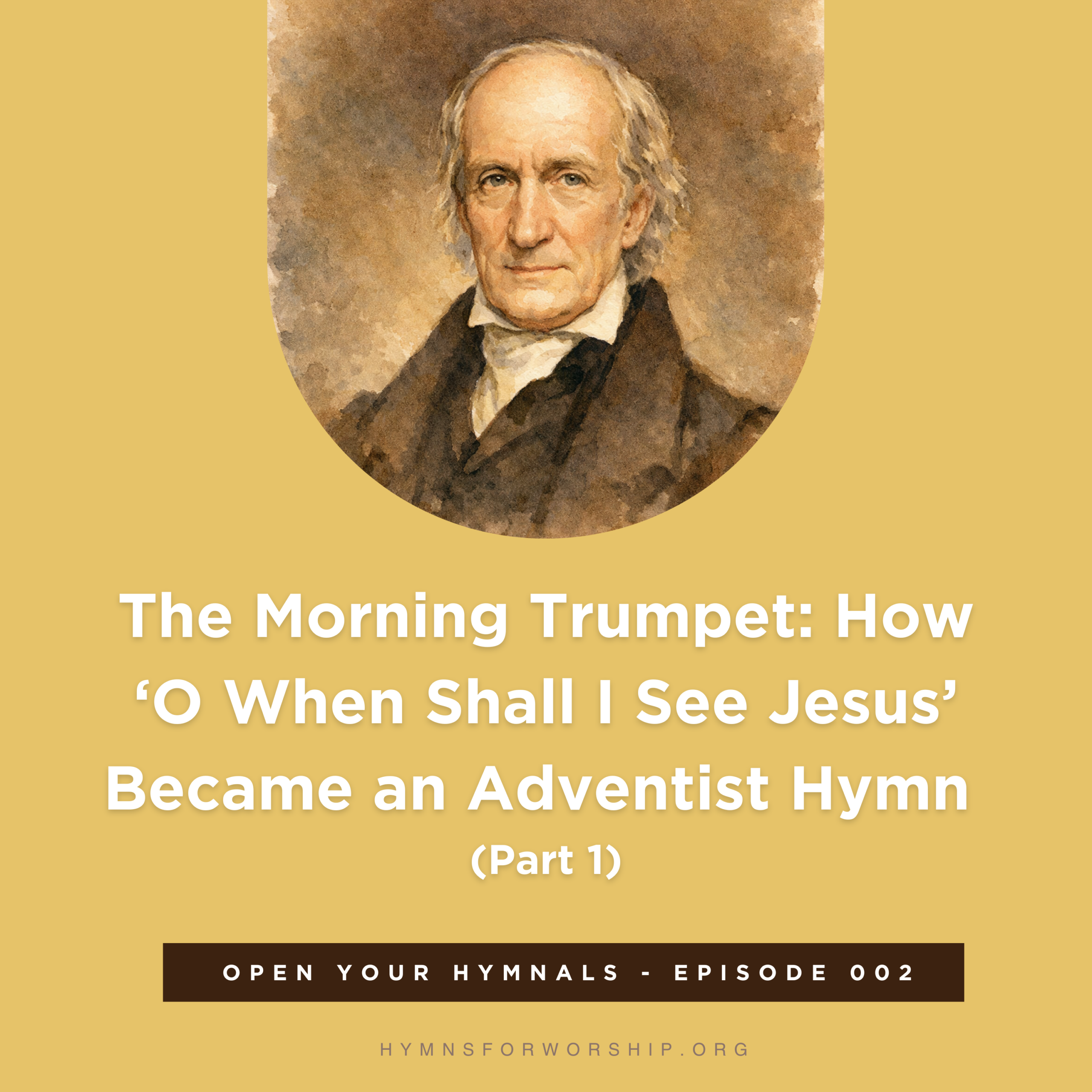
“The most important hymnwriter among Baptists in America in the eighteenth century was John Leland.” That’s a line from David W. Music and Paul A. Richardson’s book, “I Will Sing the Wondrous Story”: A History of Baptist Hymnody in North America (2008).
But John Leland—the original author of “O When Shall I See Jesus”—wasn’t only a hymn writer. He was also one of the leading Baptist ministers and evangelists of his day. And beyond preaching, he became widely known for championing religious liberty: the rights of individuals—and the conviction that church and state should remain separate. He fought so persistently for these principles that he became a key figure in the so-called Virginia experience, where James Madison and Thomas Jefferson became important allies.
Leland went on to become a pivotal supporter of James Madison and helped secure Baptist backing for Madison’s election to the First Congress—where Madison drafted what would become the First Amendment of the Bill of Rights.
In today’s episode, we’ll talk about the remarkable life of John Leland, how his hymn “O When Shall I See Jesus” came about, and how this Baptist hymn eventually made its way into the Seventh-day Adventist Hymnal.
My Early Memories of ‘O When Shall I See Jesus”
Are you familiar with the hymn “O When Shall I See Jesus”? (insert music)
I first learned this hymn when I was in elementary school. Back then, I didn’t even know it was a hymn. It was a children’s choir arrangement, and I still remember rehearsing it over and over for a vespers program at my school. After that, I never sang it—or heard it—again.
Years later, when I was much older and working on a graduate paper on hymns at the Center for Adventist Research, I came across it again. To my surprise, the tune and the words were still familiar.
Another memory I have of this hymn goes back to my days training as a medical missionary at Wildwood. Very early one morning—before the sun was even up—the boys decided to walk around campus singing this hymn at the top of their lungs, over and over. And for the rest of the day, many students and faculty experienced LSS, or “last song syndrome.” We were humming the tune mindlessly while we worked, while we waited in line for food, and even during class. I remember we’d catch ourselves mid-phrase and just laugh, realizing our minds had been completely conditioned by that early-morning serenade.
And honestly, the melody itself is fascinating. You don’t hear many hymns in a minor key—but paired with a text full of questions about when Jesus is coming, it fits. Then you add the syncopation and that distinct Americana flavor—so rooted in early American folk song—and it’s no wonder it sticks.
To this day, it’s still one of my favorite hymns.
Who is John Leland?
From last week’s episode, I mentioned that the majority of hymns are made through matching—matching a tune with a text—since they are usually separate entities, created at different times by different people. Hymnal editors are the usual matchmakers, but sometimes the writer already has a specific tune in mind and writes for that tune—or vice versa.
In this case, “O When Shall I See Jesus” was penned by John Leland, and later a hymnal editor discovered it and added not only his own tune, but also took the liberty of adding a refrain and changing some of the words to fit the music. But more on that later.
Our person of interest is the hymn author John Leland, born in Grafton, Massachusetts, on May 14, 1754.
In his earliest memory of religion, he was only three when a preacher came to their home to baptize him and his siblings—and he panicked. He ran as fast as he could down a little hill, fell on his nose, and ended up with a bloody face. His maid caught him and scrubbed the blood off, but the moment stayed with him: even as a child, he felt baptism was something being done to him, not something he chose.
By age five, Leland could already read and was quick at learning, but his teachers dismissed him because of his rough manners and later kicked him out of school. His father tried apprenticing him to whoever would take him—even a minister and a doctor—but none of it fit. Leland had other ambitions: he wanted to become a lawyer. But with no library at home, he educated himself mostly with one book—the Bible. He later said it became his best companion, and as he read it, he felt a growing conviction that he was spiritually lost—and that conscience alone wasn’t enough to reform him.
In the summer of 1772, John Leland was walking home from one of his “frolicks”—some kind of evening diversion—when he was suddenly gripped by conviction. He said it felt as though a voice from above spoke to him: “You are not about the work which you have got to do.” From that moment, he couldn’t shake the sense that his life was meant for something more.
In today’s wording, “You are not about the work which you have got to do” can be rephrased as: “You’re not doing what you’re supposed to be doing.” Leland understood it as a wake-up call. In the days that followed, the pleasures that used to attract him lost their sweetness. To test it, he went to a party—but everything felt disgusting, and he left early. On the walk home with another friend, Leland realized he could talk about only one thing: God and religion.
Soon after, he heard about a visiting preacher in Grafton, Massachusetts—Elhanan Winchester—known for preaching serious gospel truth. Leland went to the meetings, and one night he saw a girl he knew from the party scene go forward and testify about her conversion. That surprised—and sobered—him.
He kept attending meetings, and the conviction deepened until, shortly after his twentieth birthday, he was baptized.
After Leland’s baptism, he still wasn’t sure what he would do with his life. His mother believed he could be a preacher, but he had so many doubts. Even though others thought he was good at preaching, he personally felt agitated by it. At one point, he even feared that the verses he would quote in a sermon were being provided by the Devil and not by Christ. It was pure mental torment.
He spent much time in prayer, agonizing over what the Lord would have him do. In his writings, he said the Holy Spirit moved him to become a preacher. And once he received that conviction, he began preaching immediately, starting in the towns near him. His journals contain a faithful account of the places he preached, reaching up to hundreds of preaching appointments in a year.
O When Shall I See Jesus
John Leland, while an astute preacher, also wrote hymn texts. He wasn’t nearly as prolific in hymn writing as he was in preaching, but he did write about ten hymn texts. Hymnologists often note that, among those, there is one that truly stands out: “O When Shall I See Jesus.”
Clark Kimberling, a mathematician and musician, wrote in the Canterbury Dictionary of Hymnology that this hymn is “among the most widely published of Leland’s hymns, maintaining a presence in hymnals throughout the 20th century as well as in anthem arrangements.” Speaking of arrangements, many living composers today—such as Ken Berg, Mark Hayes, Lloyd Larson, and Mack Wilberg—have written wonderful anthems based on this hymn, which I’ve linked in the show notes.
While this hymn became especially popular in the 20th century, it’s important to note that it first gained major traction when it was included in one of the most influential singing books in America at the time.
The Sacred Harp is a historically important shape-note tunebook, first printed in 1844. It was used in singing schools to teach the rudiments of music, but more than that, it provided harmony parts for congregational and community singing. Out of this book developed a distinct tradition called Sacred Harp singing—an a cappella style where singers arrange themselves in a hollow square, with rows of chairs or pews on each side assigned to the four parts: treble, alto, tenor, and bass. The treble and tenor sections are usually mixed, with men and women singing the notes an octave apart.
There is no single leader or conductor; instead, participants take turns leading. Leading is done in an open-palm style, standing in the middle of the square facing the tenors.
Benjamin Franklin White is best known as the main compiler of The Sacred Harp. White was a singing-school master, composer, and writer—and at one point, a major.
When he came upon Leland’s hymn text, he knew exactly what kind of melody to match to it. But instead of preserving Leland’s original text as-is, he altered the text significantly so it would fit the tune he composed. A more detailed analysis of how he broke down and reshaped the text is in a blog article on Hymns for Worship—the link will be in the show notes.
One of the key ways White contributed to the final form of this hymn was by adding the repetitive phrase, “and shall hear the trumpet sound in that morning,” to bring unity to each stanza. He also added a chorus. Interestingly, because of this repeated line, some people assumed it was adapted from a Negro spiritual. Kimberling clarified that this assumption likely came about because another researcher found a slave song with a similar idea: “You may bury me in the East, you may bury me in the West, but I’ll hear the trumpet sound, in-a that morning.”
And so the hymn develops into the version many of us recognize: the “Morning Trumpet” form, with the repeated line “and shall hear the trumpet sound in that morning” and the well-known chorus “O, shout ‘glory!’” The word trumpet isn’t in the earliest version, but it becomes central in the later version that White popularized.
I’d like to talk about how this hymn became part of SDA hymnody. But before we do that, here’s Sofia Tsatalbasidis and Thomas Mayhew singing this hymn. A few things to note: listen for that line that repeats—“and shall hear the trumpet sound in that morning”—and count how many times it’s sung.
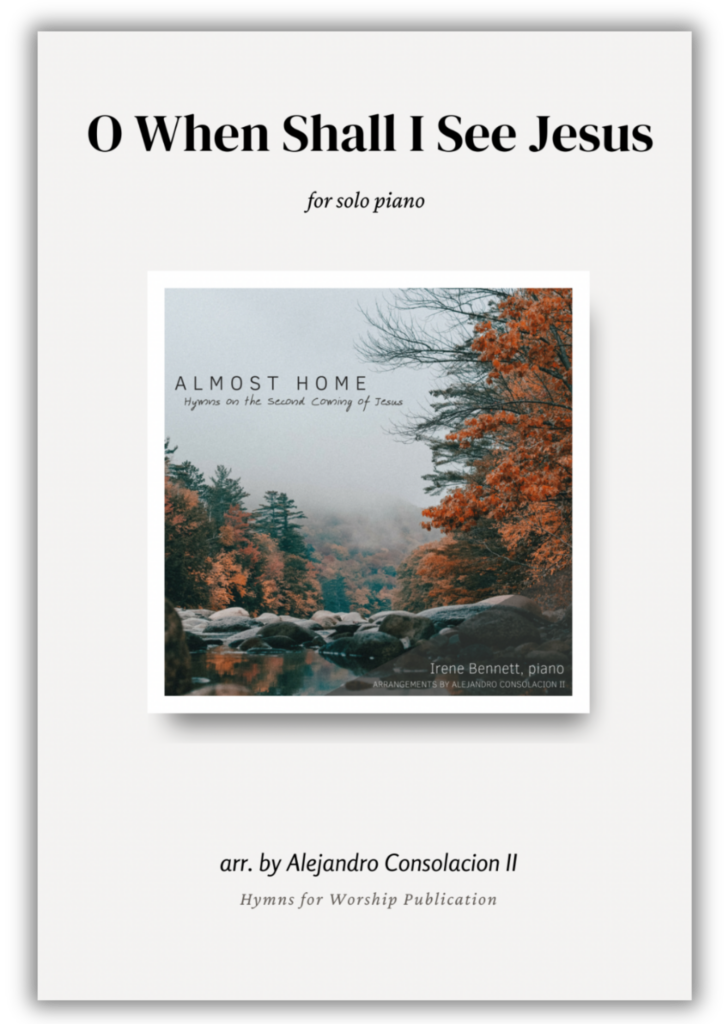
This is an 8-page arrangement for solo piano based on the hymn tune THE MORNING TRUMPET. This well-loved hymn appears in many hymnals and has been especially familiar through various Seventh-day Adventist hymn publications across the years. Alejandro Consolacion II was commissioned by the Hymns for Worship team to arrange this piece, and he powerfully captures the heartbeat of early Adventism—the urgency of Christ’s soon return, the pioneers’ deep longing as they waited, and the ache of disappointment when He did not come as expected. Barbara Irene Bennett, creator of Hymns for Worship, performs on the piano.
Joshua Himes and William Miller
When we talk about early Adventist hymnody, it’s easy to assume it all started inside Adventism. But a lot of it actually came in through a moment of urgency. One of the clearest snapshots of that urgency is a conversation between Joshua V. Himes and William Miller in Boston in December 1839, after Miller’s lecture series at the Chardon Street Chapel.
Himes basically pressed him with a blunt question: “Do you really believe what you’re preaching?” And when Miller said yes, Himes pushed it further: if Jesus is truly coming soon, then this message can’t stay in small circles. It has to go public—cities, big audiences, wide distribution.
That’s where Himes’ “publicist brain” kicks in. According to the Encyclopedia of Seventh-day Adventists, he became Miller’s booking agent and promoter—scaling the message through print, organized conferences, and eventually camp meetings—turning what could have stayed local into a national movement.
And here’s where hymnody comes in: Himes didn’t just promote preaching—he promoted singing. The ESDA article notes that he published a Millerite songbook called The Millennial Harp in 1842. Around the same time, print ads describe another collection, Millennial Musings, compiled by J. V. Himes and Josiah Litch—sometimes even bound together with the Harp.
And that’s where this hymn shows up: Millennial Musings, Hymn No. 26. If you want to see it for yourself, it’s available digitally—I’ve linked it in the show notes.
Now, when you compare that version with what we have in the current SDA Hymnal, the differences jump out. In Millennial Musings, the hymn appears as text only—no refrain, and no tune name given. It matches the older “straight hymn” form commonly attributed to John Leland.
But the form that eventually lands in our hymnal is the version shaped a little later in The Sacred Harp in 1844—the one with the refrain and the tune that most of us recognize. In the Seventh-day Adventist Hymnal, that’s #448, “O, When Shall I See Jesus,” attributed to John Leland and paired with B. F. White’s tune THE MORNING TRUMPET. And because this hymn already appeared in Millerite hymnody, it’s categorized in our hymnal as an Early Advent hymn.
So that’s where we’ll pause for today. This is the end of Part 1—the backstory: how this hymn traveled through the Baptist hymnody, to the Millerite repertoire and into the Seventh-day Adventist Hymnal.
In Part 2, we’ll do a deeper dive into the text itself—what it’s saying, why it resonates so strongly with Adventist hope, and how we can apply it practically in our lives. And I’ll also walk you through how the piano arrangement from Almost Home interprets that longing, urgency, and hope in sound.
Until next time—open your hymnals, and let’s keep singing with understanding.
Explore more hymns: