CHRISTIAN LIFE >> Christian Warfare
SDAH 607
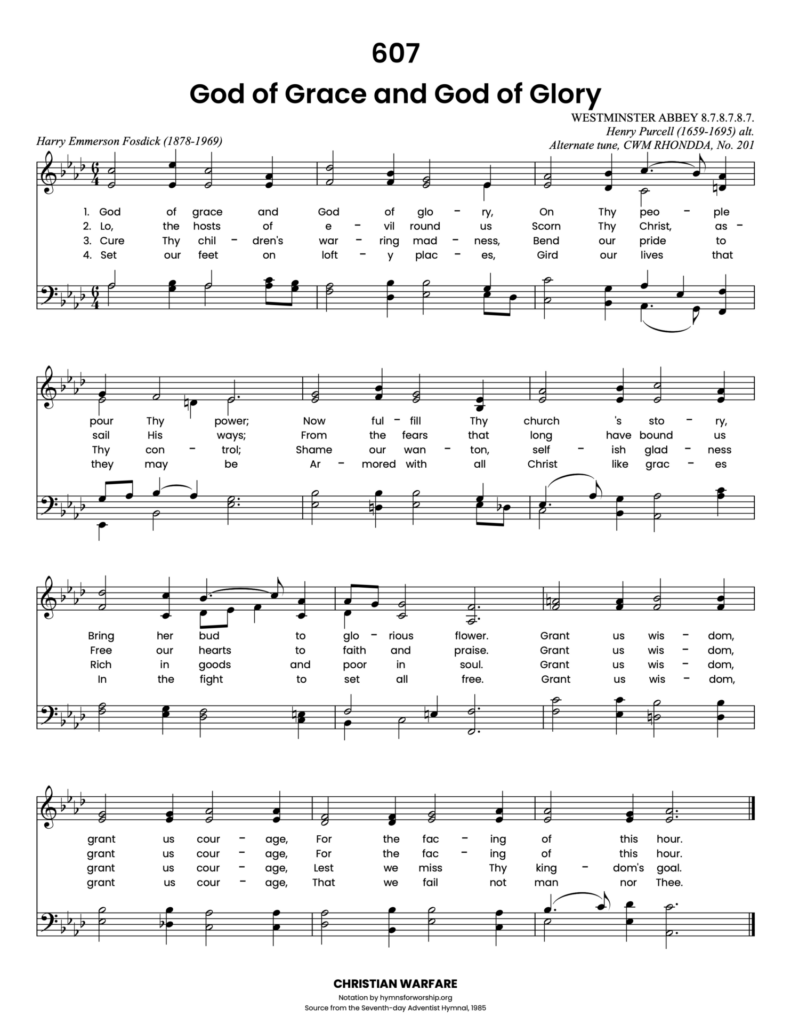
God of grace and God of glory,
On Thy people pour Thy power;
Now fulfill Thy church’s story,
Bring her bud to glorious flower.
Get the hymn sheet in other keys here
For Worship Leaders
Make each hymn more meaningful with these helpful tools: Short, ready-to-use hymn introductions for church bulletins, multiple ways to introduce a hymn based on your worship theme and in-depth history and insights to enrich your song service.
📖 Reference: Feel free to share but please cite hymnsforworship.org when reproducing.
Introductions for Sabbath School Song Service (based on specific lesson quarterlies):
Harry Emerson Fosdick, one of America’s great preachers, was born University, Union Theological Seminary, and Columbia University, and May 24, 1878, in Buffalo, New York. He studied at Colgate was ordained a Baptist minister in 1903. After pastoring the First Baptist Church. Montclair, New Jersey, and serving for a time as chaplain to American troops in World War I, he became pastor at First Presbyterian Church, New York City, in 1919. But his strong feelings about ecumenism led to his resignation, and John D. Rockefeller, Jr., asked him to pastor the prestigious Park Avenue Baptist Church. He refused because of the requirement of baptism by immersion, but Rockefeller regarded him so highly that he built for him a new church on Riverside Drive. It was to have no baptism requirement but would be open to all people as an ecumenical church.
While on vacation at Boothbay Harbor, Maine, Fosdick wrote these words of challenge; they were sung at the opening service in the new church, and later at its dedication February 8, 1931. In one sermon, before the church was finished, Fosdick said, “It could be wicked for us to have that new church-wicked! Whether it is going to be wicked or not depends on what we do with it. We must justify the possession of that magnificent equipment by the service that comes out of it.” This kind of self-analysis might profitably be applied to every church in every kind of “new equipment” situation. Notice Fosdick’s strong feelings in stanza 3: “Shame our wanton, selfish gladness, rich in goods and poor in soul.”
In addition to teaching theology and homiletics at Union Theological Seminary, Fosdick conducted the National Vespers radio broadcast from 1926 to 1946 and was the author of some 30 inspirational books. He died at Bronxville, New York, October 5, 1969.
Henry Purcell was born in 1659 in Westminster, London. Educated by his father and uncle, he became a chorister in the Chapel Royal. In 1673, at age 14, he was apprenticed to an organ builder, John Hingston, who enjoyed a great reputation as builder of small, or “regal,” organs. In those days, the builder of organs had a greater status than the organ performer. For two years Purcell composed and copied music, and tuned the organ in Westminster Abbey. Then he succeeded Matthew Locke as “composer to the King’s violins.” In 1679, at the young age of 20, he became organist at Westminster Abbey, receiving 10 pounds a year in salary! He was director of music for the coronation of James II in 1685 and again of William and Mary in 1689. He wrote a great volume of music for the church, organ works, theater pieces, solo works, and royal odes. Unfortunately, his creative output was cut short by death, at the early age of 36, on November 21, 1695.
WESTMINSTER ABBEY is named for the great cathedral in London where the composer was organist; later he was buried there with full honors. The tune is from the “Alleluias” in his anthem “O God, Thou Art My God,” which was published by William Boyce in Cathedral Music, 1760. It did not achieve popularity until matched with the text “Blessed City, Heavenly Salem” and sung at the weddings of Princess Margaret in 1960 and Prince Charles in 1981.
📖 Reference: Companion to the Seventh-day Adventist Hymnal by Wayne Hooper and Edward E. White. Review and Herald Publishing Association, 1988.

Text
1
God of grace and God of glory,
On Thy people pour Thy power;
Now fulfill Thy church’s story,
Bring her bud to glorious flower.
Grant us wisdom, grant us courage,
For the facing of this hour.
2
Lo, the hosts of evil round us
Scorn Thy Christ, assail His ways;
From the fears that long have bound us
Free our hearts to faith and praise.
Grant us wisdom, grant us courage,
For the facing of this hour.
3
Cure Thy children’s warring madness,
Bend our pride to Thy control;
Shame our wanton selfish gladness
Rich in goods and poor in soul.
Grant us wisdom, grant us courage,
Lest we miss Thy kingdom’s goal.
4
Set our feet on lofty places,
Gird our lives that they may be
Armored with all Christ-like graces
In the fight to set all free.
Grant us wisdom, grant us courage,
That we fail not man nor Thee.

Hymn Info
Biblical Reference
(a) 1 Pet 5:10 (b) 2 Tim 3:13
Author
Harry Emmerson Fosdick (1878-1969)
Copyright
Words from The New Church Hymnal. Copyright 1937 Fleming H. Revell Co. Renewed 1965.
Hymn Tune
WESTMINSTER ABBEY
Metrical Number
8.7.8.7.8.7.
Composer
Henry Purcell (1659-1695) alt.
Alternate Tune
CWM RHONDDA, SDAH 201
Theme
CHRISTIAN WARFARE
Recommended Reading
The general idea when it comes to hymns is that there is a close bond between the author and the composer. That the author writes a hymn and the composer invents a tune to suit it, and then provides the harmony to accompany the tune. However, such wasn’t always the case.
Many hymns actually worked vice versa wherein authors would write verses according to existing tunes. Hundreds of hymns are sung from borrowed tunes, such as secular songs, chants, and even classical works. That being said, I went ahead and researched which hymns in the SDA Hymnal were originally classical works.