CHRISTIAN LIFE >> Guidance
SDAH 537
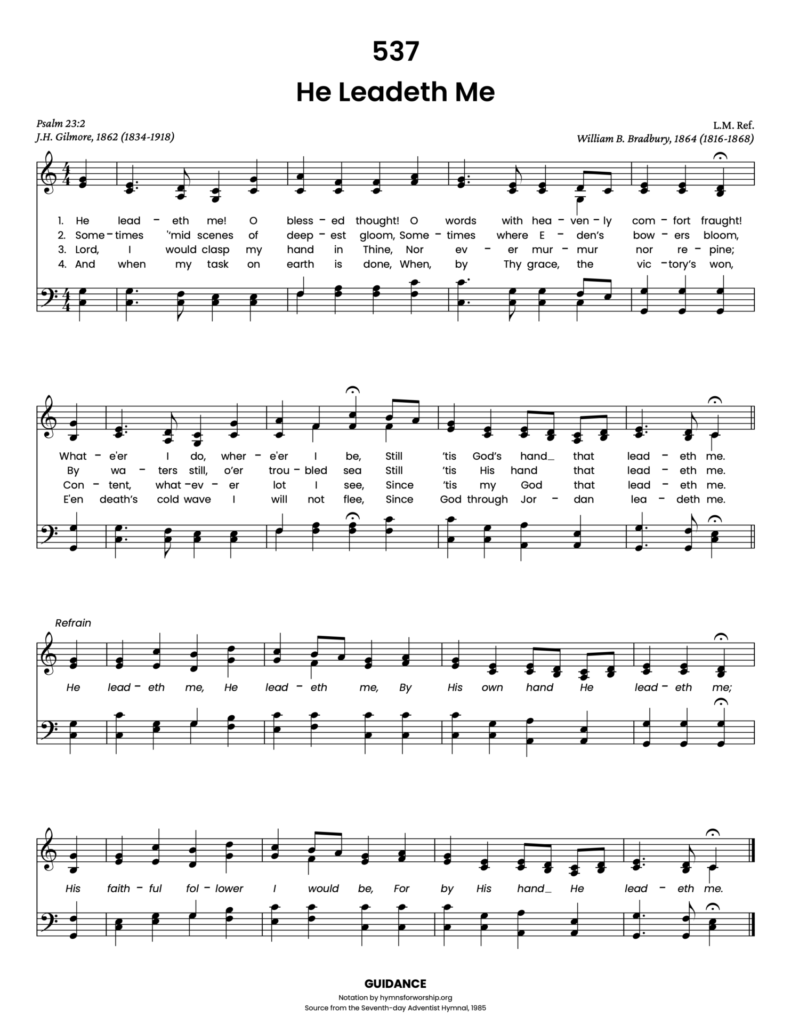
He leadeth me: O blessed thought!
O words with heavenly comfort fraught!
Whate’er I do, where’er I be,
still ’tis God’s hand that leadeth me.
This hymn appears in:
Get the hymn sheet in other keys here
For Worship Leaders
Make each hymn more meaningful with these helpful tools: Short, ready-to-use hymn introductions for church bulletins, multiple ways to introduce a hymn based on your worship theme and in-depth history and insights to enrich your song service.
📖 Reference: Feel free to share but please cite hymnsforworship.org when reproducing.
Introductions for Sabbath School Song Service (based on specific lesson quarterlies):
In the spring of 1862 Joseph Henry Gilmore, a Baptist minister, visited the city of Philadelphia. He was invited to address the midweek prayer meeting at the First Baptist Church. He spoke there of God’s leadership, using part of the Shepherd Psalm as a basis for his talk. He was so impressed by the simple words “He leadeth me” that he continued to discuss this theme at the home of his host, Deacon Wattson of Arch Street, Philadelphia. His mind was so full of the thought of God’s guidance in every phase of life that there and then he wrote these four stanzas in pencil, and passed them on to his wife without comment. Without telling her husband, she sent the poem to a religious periodical, The Watchman and Reflector, in Boston. It appeared in print in the December 4, 1862, issue, still without his knowledge. Three years later Gilmore was to preach in the Baptist church in Rochester, New York. Taking up a hymnbook and opening it at random, he was astonished to find his own poem set to music. He did not recognize nor acknowledge his authorship of the refrain until his wife’s death some years later, when he discovered his original manuscript among her papers, complete with a refrain, but of two lines only.
The words are a very free paraphrase of part of the Shepherd Psalm: “He leadeth me beside the still waters. Though I walk through the valley of the shadow of death, I will fear no evil: for thou art with me” (Ps. 23:2, 4).
Gilmore was born in Boston on April 29, 1834, and educated at Brown University and Newton Theological Seminary. He was ordained into the Baptist ministry in 1862 and served at Fisherville, New Hampshire, for a year. Then he was private secretary to his father, the governor of New Hampshire, but after one year he began pastoring the Baptist church in Rochester, New York. In 1868 he was appointed professor of logic and English literature at the University of Rochester; he held that position until he retired in 1911. He died at Rochester on July 23, 1918.
The tune, sometimes called HE LEADETH ME, or AUGHTON, composed by William Batchelder Bradbury (1816-1868; see Biographies),
and published in his The Golden Censer, 1864. He had noticed Gilmore’s hymn in The Watchman and Reflector, enlarged the refrain, and wrote his tune to fit the words.
📖 Reference: Companion to the Seventh-day Adventist Hymnal by Wayne Hooper and Edward E. White. Review and Herald Publishing Association, 1988.

Text
1
He leadeth me: O blessed thought!
O words with heavenly comfort fraught!
Whate’er I do, where’er I be,
Still ’tis God’s hand that leadeth me.
Refrain
He leadeth me, He leadeth me,
By His own hand He leadeth me;
His faithful follower I would be,
For by His hand He leadeth me.
2
Sometimes ‘mid scenes of deepest gloom,
Sometimes where Eden’s bowers bloom,
By waters still, o’er troubled sea,
Still ’tis His hand that leadeth me.
3
Lord, I would clasp my hand in Thine,
Nor ever murmur nor repine;
Content, whatever lot I see,
Since ’tis my God that leadeth me.
4
And when my task on earth is done,
When by Thy grace, the victory’s won,
E’en death’s cold wave I will not flee,
Since God through Jordan leadeth me.

Hymn Info
Biblical Reference
Ps 23:2, 4
Author
J.H. Gilmore (1834-1918)
Year Published
1862
Metrical Number
L.M.Ref.
Composer
William J. Bradbury (1816-1868)
Year Composed
1864
Theme
GUIDANCE