JESUS CHRIST >> RESURRECTION & ASCENSION
SDAH 172
The strife is o’er, the battle done;
Now is the victor’s triumph won!
Now be the song of praise begun. Alleluia!
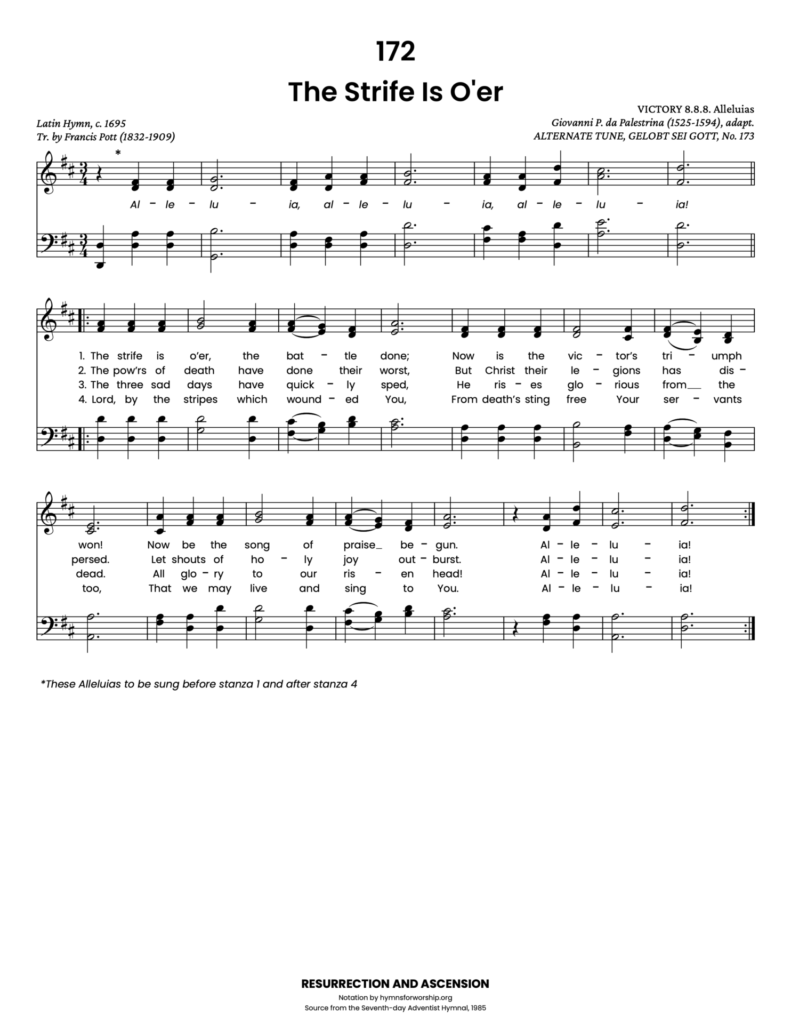
Get the hymn sheet in other keys here
For Worship Leaders
Make each hymn more meaningful with these helpful tools: Short, ready-to-use hymn introductions for church bulletins, multiple ways to introduce a hymn based on your worship theme and in-depth history and insights to enrich your song service.
Hymn Spotlight: The Strife Is O’er
Based on a 17th-century Latin hymn and translated by Francis Pott in 1861, “The Strife Is O’er” proclaims the triumph of Jesus over the grave. With each stanza ending in jubilant “Alleluias,” it emphasizes the victory Christ has won for us. The tune VICTORY, adapted from Palestrina and harmonized by William Monk, underscores the grandeur of the Resurrection message. Let this hymn remind us that Jesus’ resurrection secures our hope and assures us of the final triumph of good over evil.
📖 Reference: Feel free to share but please cite hymnsforworship.org when reproducing.
Introductions for Sabbath School Song Service (based on specific lesson quarterlies):
This anonymous Latin hymn’s first appearance was in a Jesuit book, Symphonia Sirenium Selectarum (Symphony of Selected Siren Songs), Cologne, 1695. Pott’s translation 166 years later was in his Hymns Fitted to the Order of Common Prayer, 1861.
Francis Pott was born on December 29, 1832, at Southwark, London, and attended Brasenose College, Oxford. Ordained in 1856, he served the Church of England in three cities before becoming rector of Northill, Bedfordshire, in 1866. He continued in that position 25 years till his retirement because of increasing deafness, in 1891. He then devoted his energies to translation of Latin and Syriac hymns, study, and research. He was a member of the first committee that worked to produce England’s most successful hymnal, Hymns Ancient and Modern, 1861. He died at Speldhurst, near Tunbridge Wells, Kent, on October 26, 1909.
In 1591, Palestrina wrote a musical setting of “Gloria Patri et Filio” (Glory to the Father and to the Son), for his Magnificat Tertii Toni. William H. Monk (see SDAH 50) made a free adaptation of the melody, reharmonized it, and added the “alleluias” for inclusion in the first edition of Hymns Ancient and Modern, 1861, of which he was musical editor. The tune name VICTORY comes from Christ’s victory over death and the tomb, as expressed in the text.
Giovanni Pierluigi, now best known by the name of his birthplace, was born about 1525 in Palestrina, near Rome, Italy. At age 19 he was appointed organist-choirmaster in the cathedral there. In 1550 when his bishop became Pope Julius III, Palestrina was taken with him to Rome, where he spent the remainder of his life directing papal choirs and composing more than 90 Masses and more than 200 motets for the church, and madrigals for the Roman society. During the Council of Trent (1545–1563), in the discussions of church music, the polyphonic (many sounds) music of Palestrina was given as the highest example of what the music of the church should be. His works are universally considered to be the finest in the pure, devotional polyphonic style. A full edition of his music was published in 33 volumes by Breitkopf and Hartel, 1862–1903. He wrote music for the Catholic Church in a stately, noble style to counteract the success that his contemporary, Martin Luther, was having in bringing back congregational singing by including the use of popular folk songs. Palestrina died at Rome on February 2, 1594, and was buried in St. Peter’s Cathedral.
Stanza:
2 – Luke 22:53
3 – Luke 24:6
5 – 1 Corinthians 15:55
Revelation 19:1

Text
Alleluia, alleluia, alleluia!
1
The strife is o’er, the battle done;
Now is the victor’s triumph won!
Now be the song of praise begun. Alleluia!
2
The pow’rs of death have done their worst,
But Christ their legions has dispersed.
Let shouts of holy joy outburst. Alleluia!
3
The three sad days have quickly sped,
He rises glorious from the dead.
All glory to our risen head! Alleluia!
4
Lord, by the stripes which wounded You,
From death’s sting free Your servants too,
That we may live and sing to You. Alleluia!

Hymn Info
Biblical Reference
(b) Luke 22:53 (c) Luke 24:6 (e) 1 Cor. 15:55; Rev.19:1
Text Source
Latin hymn, c. 1695
Translator
Francis Pott (1832-1909)
Hymn Tune
VICTORY
Metrical Number
8.8.8. Alleluias
Composer
Giovanni P. da Palestrina (1525-1594), adapt.
Alternate Tune
SDAH 173
Note
These Alleluias to be sung before stanza 1 and after stanza 4
Theme
RESURRECTION AND ASCENSION
Recommended Reading
The general idea when it comes to hymns is that there is a close bond between the author and the composer. That the author writes a hymn and the composer invents a tune to suit it, and then provides the harmony to accompany the tune. However, such wasn’t always the case.
Many hymns actually worked vice versa wherein authors would write verses according to existing tunes. Hundreds of hymns are sung from borrowed tunes, such as secular songs, chants, and even classical works. That being said, I went ahead and researched which hymns in the SDA Hymnal were originally classical works.