Jesus Christ >> Sufferings & Death
SDAH 163
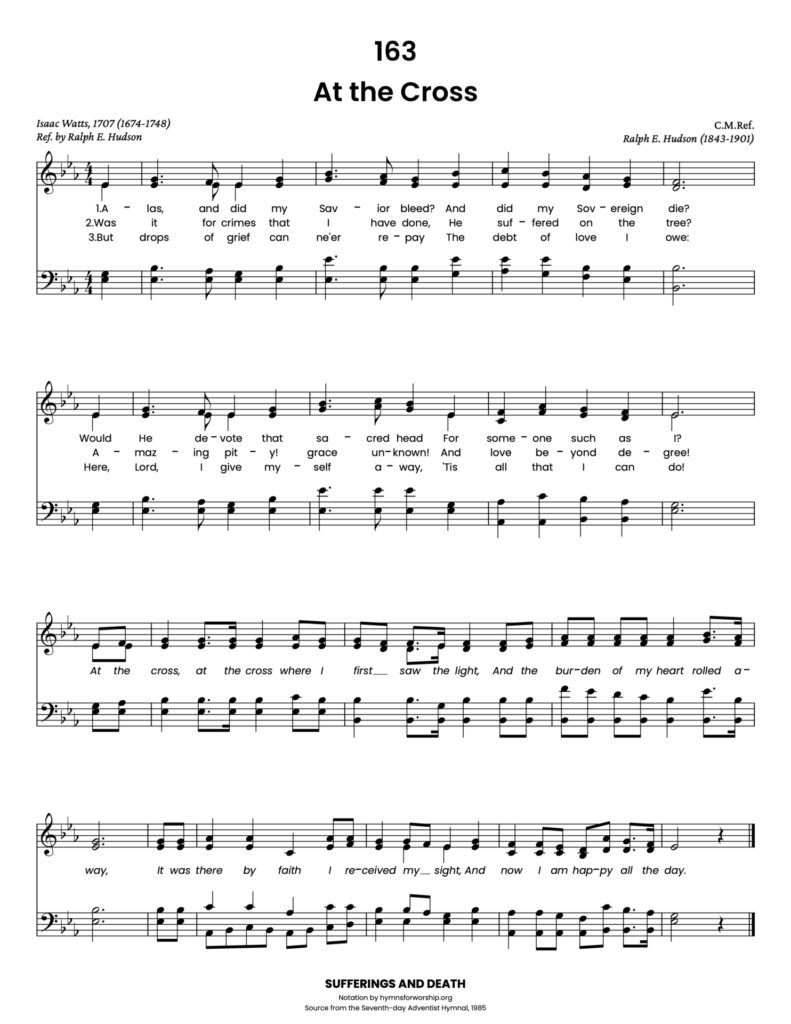
At the cross, at the cross,
where I first saw the light,
and the burden of my heart rolled away;
it was there by faith I received my sight,
and now I am happy all the day!
Get the hymn sheet in other keys here
For Worship Leaders
Make each hymn more meaningful with these helpful tools: Short, ready-to-use hymn introductions for church bulletins, multiple ways to introduce a hymn based on your worship theme and in-depth history and insights to enrich your song service.
Hymn Spotlight: At the Cross
Isaac Watts penned the original text of this hymn in 1707 under the title “Godly Sorrow Arising from the Sufferings of Christ.” Ralph Hudson added the now-familiar refrain in the late 1800s, adapting it from a Civil War-era melody—“Take Me Home”—giving it new life as a beloved gospel hymn. The opening line, “Alas! and did my Savior bleed,” sets a tone of humble astonishment. Watts’ words emphasize the personal cost of redemption, while Hudson’s refrain shifts to joyous praise: “At the cross… it was there by faith I received my sight.” This hymn bridges repentance and joy, reminding us that true conviction leads to deeper appreciation of God’s mercy.
📖 Reference: Feel free to share but please cite hymnsforworship.org when reproducing.
Introductions for Sabbath School Song Service (based on specific lesson quarterlies):
Christ died on the cross to redeem us from our doom caused by sin. His death enables us to realize how God loves us so much. It is at the cross where we first saw the light that brought us the hope of our salvation. (Lesson 1, 2nd Quarter 2021 – At The Tree, Wednesday, 3/31/2021)
Isaac Watts (1674-1748; see Biographies) wrote six stanzas of this hymn in 1707 under the title “Godly sorrow Arising From the Sufferings of Christ.” Through the years, editors have made a number of alterations. The final line of stanza 1 was “For such a worm as I.”
Watts’s membership in the Independent Church gave rise to the mistaken impression that he was a Unitarian. However, he shows his clear belief on this point in the third line of his fourth stanza, which originally was “When God, the mighty Maker, died,” thus identifying Jesus as very God.
The words of the refrain were added by Ralph Hudson when he wrote the tune for the text. It was first published in Songs of Peace, Love, and Joy, 1885. Until recently it was thought that the refrain was a camp meeting chorus that Hudson borrowed. In the July 1980 issue of The Hymn, Ernest K. Emurian presents evidence of its true source. From the Library of Congress he obtained a copy of a Civil War song entitled “Take Me Home,” ascribed to one “Raymond,” the short form of “Eugene Raymond,” the pen name used by the “Bard of the Confederacy, “John Hill Hewitt (1801-1890).The song was first published as an anonymous poem with music in New York in 1853 by W. L. Bloomfield. Hewitt then composed a Southern edition and published it in Augusta, Georgia, 1864. So it is evident that Hudson adapted what was probably a very popular song and used it with only a couple of note changes for the refrain of this hymn.
Ralph E. Hudson was born July 9, 1843, at Napoleon, Ohio, but soon the family moved to Pennsylvania. In 1861 he enlisted in the Army and served as a nurse in the Civil War. Later he taught music at Mount Vernon College, Alliance, Ohio, and became active as singer, composer, and publisher of songbooks. He was licensed to preach in the Methodist Church, and devoted a good portion of his time to evangelistic and temperance work. One of his books was The Temperance Songster. He died at Cleveland, Ohio, June 14,1901. Fanny Crosby (see Biographies) said her “soul flooded with a celestial light” at the time of her conversion, when this hymn was sung.
Stanza:
1 – John 19:30
Psalm 22:6
2 – 1 Peter 2:24

Text
1
Alas! and did my Savior bleed,
And did my Sovereign die?
Would He devote that sacred head
For someone such as I?
Refrain
At the cross, at the cross,
Where I first saw the light,
And the burden of my heart rolled away;
It was there by faith I received my sight,
And now I am happy all the day!
2
Was it for crimes that I have done,
He suffered on the tree?
Amazing pity! Grace unknown!
And love beyond degree!
3
But drops of grief can ne’er repay
The debt of love I owe:
Here, Lord, I give myself away;
’Tis all that I can do!

Hymn Info
Biblical Reference
(a) John 19:30, Ps 22:6 (b) 1 Pet 2:24
Author
Isaac Watts (1674-1748); Ref. by Ralph E. Hudson
Year Published
1707
Metrical Number
C.M. Ref.
Composer
Ralph E. Hudson (1843-1901)
Alternate Tune
Without refrain, MARTYRDOM, SDAH 113
Watch
Explore more hymns: