WORSHIP >> Morning WORSHIP
SDAH 43
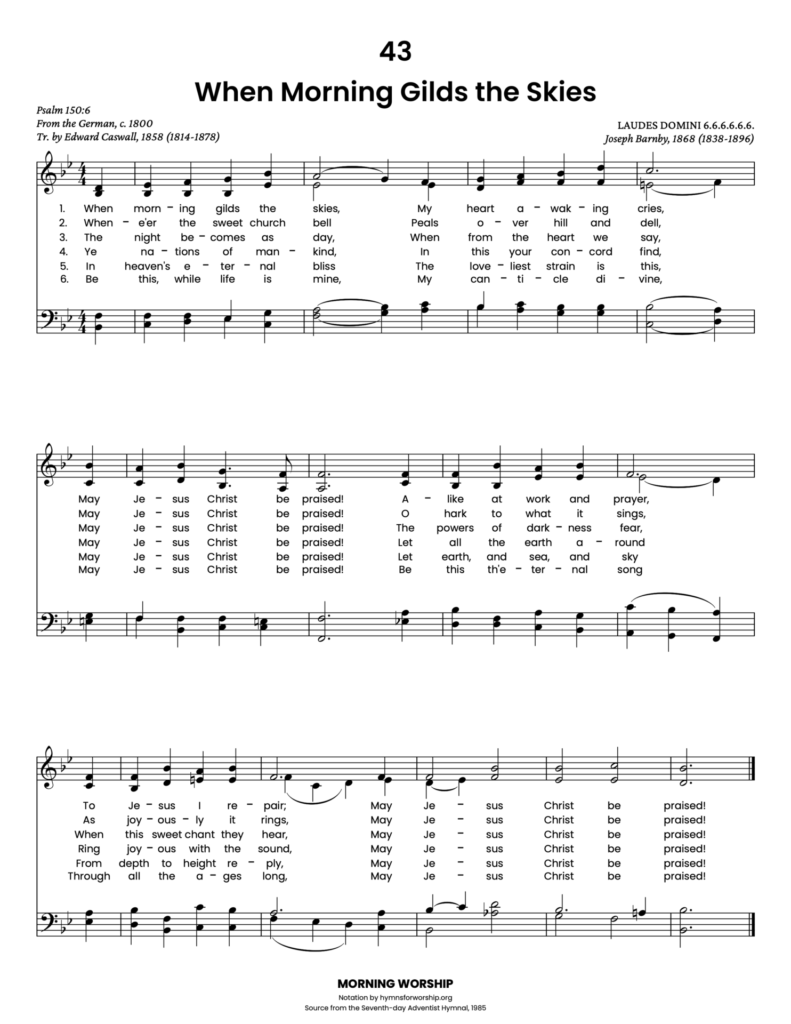
When morning gilds the skies my heart awaking cries,
May Jesus Christ be praised!
Alike at work and prayer, to Jesus I repair:
May Jesus Christ be praised!
Get the hymn sheet in other keys here
For Worship Leaders
Make each hymn more meaningful with these helpful tools: Short, ready-to-use hymn introductions for church bulletins, multiple ways to introduce a hymn based on your worship theme and in-depth history and insights to enrich your song service.
Hymn Spotlight: When Morning Gilds the Skies
This joyful morning hymn comes from a German text dating back to the early 1800s and first appeared in a hymnal in Würzburg in 1828. It celebrates the praise of Christ at all times—from the early morning light to life’s final breath.
Edward Caswall (1814–1878) translated and expanded the hymn in the mid-19th century, giving us the refrain that echoes through every verse: May Jesus Christ be praised! His love for hymnody led to nearly 200 faithful translationsof Latin hymns, many still sung today.
The uplifting melody, LAUDES DOMINI, was composed in 1868 by Sir Joseph Barnby (1838–1896) specifically for this text. The frequent upward motion of the tune perfectly matches the hymn’s theme of exultation and devotion.
May this hymn inspire our hearts to praise Jesus from morning till night!
📖 Reference: Feel free to share but please cite hymnsforworship.org when reproducing.
Introductions for Sabbath School Song Service (based on specific lesson quarterlies):
A German hymn dating from the early 1800s was printed in 1828 in the katholisches Gesangbuch (Catholic Hymnbook) in Wurzburg beginning with the words “Beim frühen Morgenlicht” (“In the early light of the morning”). Edward Caswall translated six stanzas in 1854, which appeared in Catholic Hymns, and then added another eight stanzas in 1958. The complete 14, or rather 28 stanzas of two lines each, followed by the refrain “May Jesus Christ be praised,” were printed in his Mosque of Mary, SDAH’s first two stanzas correspond to Caswall’s first four couplets, except for the slight change in the third couplet, which reads:
The sacred minster bell,
It peals o’er hill and dell;
All Scripture references are taken from the Psalms.
The tune LAUDES DOMINI (Praise the Lord) was composed especially for these words by Sir Joseph Barnby (1838-1896; see Biographies) and was first published in 1868, although he himself did not give names to any of the tunes he composed. The many phrased that have an upward progression are very appropriate for the joyous, exultant words.
Edward Caswall was born on July 15, 1814, at his father’s vicarage at Yately in Hamshire, near Reading, Berkshire. He went to Marlborough School and in 1832 to Oxford, graduating with a B.A. in 1836 and an M.A. in 1838. Ordained deacon in the Church of England in 1838 and priest the nest year, he served brief curacies in Somerset, London, and Hertfordshire. In 1840 he was appointed curate at Stratford-sub-castle, near Salisbury, Wiltshire, where he remained until his resignation in 1846. He was interested in the Oxford movement and its Roman Catholic ritual, and was greatly influenced by John Henry Newman’s writings. He and his wife visited Rome in 1847, and on January 18 of that year he was received into the Roman Catholic Church, his wife following the next week. He had an independent income, and they moved to Torquay in Devonshire. His wife died in 1849, and Caswall went to the Oratory of St. Philip Neri in Edgbaston, Birmingham, where he worked with Newman, becoming deacon and then priest in his new communion. He spent the rest of his life there, caring for the sick, the poor, and little children. He is remembered for his almost 200 translations of Latin Hymns, which are very faithful to the original and pure in their rhythm, making them suitable for congregational singing. He died at Edgbaston on January 2, 1978, and was buried by his friend and mentor Cardinal Newman at Redwall, near Bromsgrove, Worcestershire.
Stanza:
4 – Psalm 150:6

Text
1
When morning gilds the skies my heart awaking cries,
May Jesus Christ be praised!
Alike at work and prayer, to Jesus I repair:
May Jesus Christ be praised!
2
Whene’er the sweet church bell peals over hill and dell,
May Jesus Christ praised!
O hark to what it sings, as joyously it rings,
May Jesus Christ be praised!
3
The night becomes as day when from the heart we say:
May Jesus Christ be praised!
The powers of darkness fear when this sweet chant they hear:
May Jesus Christ be praised!
4
Ye nations of mankind, in this your concord find,
May Jesus Christ praised!
Let all the earth around ring joyous with the sound,
May Jesus Christ praised!
5
In heaven’s eternal bliss the loveliest strain is this,
May Jesus Christ praised!
Let earth, and sea and sky from depth to height reply,
May Jesus Christ praised!
6
Be this, while life is mine, my canticle divine:
May Jesus Christ be praised!
Be this th’eternal song through all the ages long,
May Jesus Christ be praised!

Hymn Info
Biblical Reference
(d) Ps 150:6
Translator
Edward Caswall, 1858 (1814-1878)
Text Source
From the German
Year Published
1800
Hymn Tune
LAUDES DOMINI
Metrical Number
6.6.6.6.6.6.
Composer
Joseph Barnby (1838-1896)
Year Composed
1868
Theme
MORNING WORSHIP