EARLY ADVENT
SDAH 449
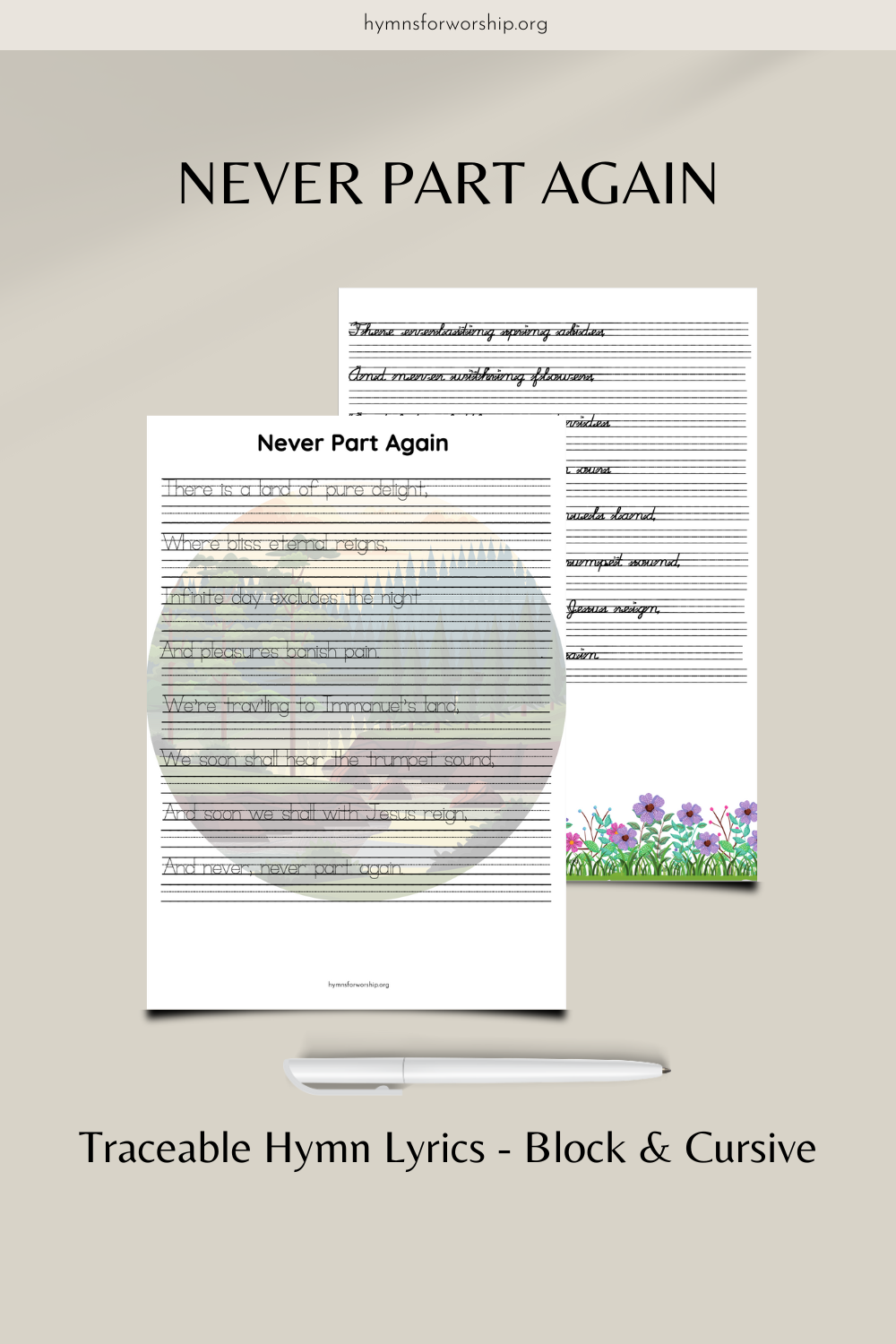
There is a land of pure delight,
Where bliss eternal reigns,
Infinite day excludes the night
And pleasures banish pain.
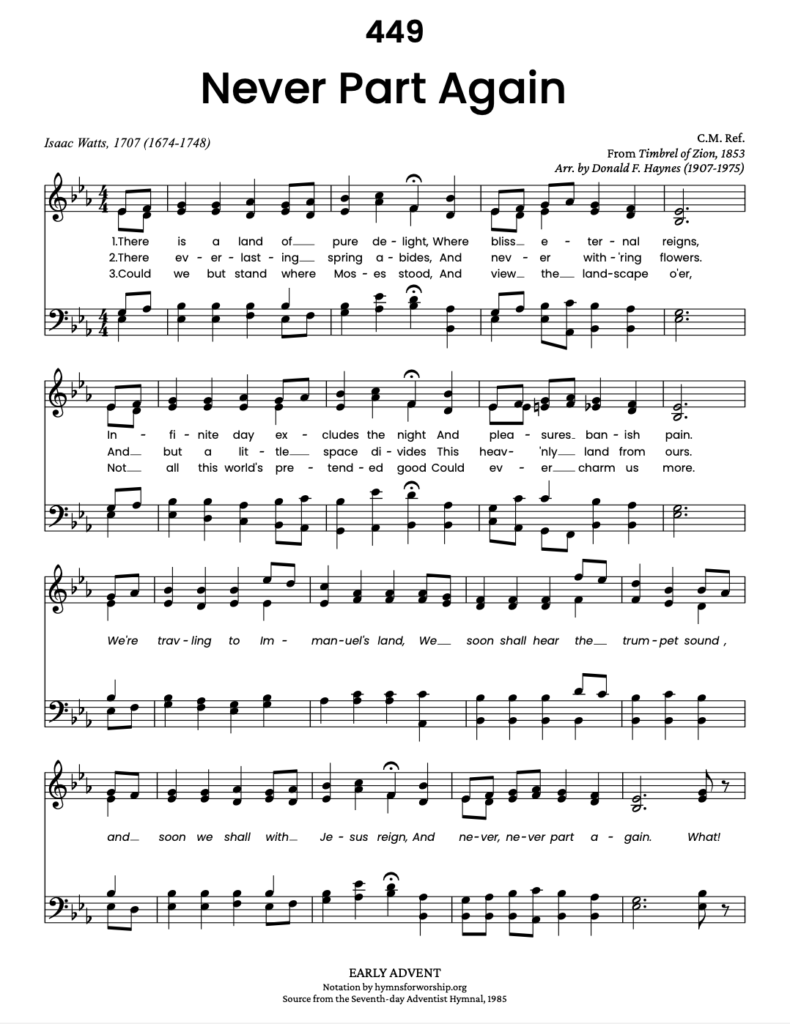
Get the hymn sheet in other keys here
For Worship Leaders
Make each hymn more meaningful with these helpful tools: Short, ready-to-use hymn introductions for church bulletins, multiple ways to introduce a hymn based on your worship theme and in-depth history and insights to enrich your song service.
Hymn Spotlight: Never Part Again
Isaac Watts penned this hymn in 1707 as “A Prospect of Heaven Makes Death Easy,” using the Jordan River as a symbol of life’s final passage. The later camp meeting refrain, “What! Never part again?” added in the mid-1800s, helped make it one of the most enduring and beloved Adventist songs—sung at camp meetings, General Conference sessions, and countless farewells. The arrangement by Donald Frederick Haynes preserves the vigor and joy that generations have treasured in proclaiming that in the heavenly Canaan, partings will be no more.
📖 Reference: Feel free to share but please cite hymnsforworship.org when reproducing.
Introductions for Sabbath School Song Service (based on specific lesson quarterlies):
This hymn, first published in Isaac Watts’s (1674-1748; see Biographies), Hymns and Spiritual Songs, 1707, carried the heading “A Prospect of Heaven Makes Death Easy.” It is one of his earliest compositions, and in varied forms has found its way into hundreds of hymnbooks around the world. He was sitting at his window in Southampton in 1706, gazing across Southampton Water toward Netley on the opposite shore. The pleasant meadows that lay before him suggested the beauties of the heavenly land, and inspired him to write the six stanzas of this hymn, which uses the figure of the Jordan River as a symbol of death. That river must be crossed to reach the Promised Land.
The catchy, singable refrain was added much later, and undoubtedly accounts for the great popularity of this hymn. The “What! Never part again?” refrain first appeared in Musical Gems: A Collection of Hymns and Tunes Adapted to All Occasions of Social Devotion, 1849 (the same year James White published his first little hymnbook). Ellen Jane Lorenz, in Glory, Hallelujah! The Story of the Campmeeting Spiritual, tells of finding the refrain of this camp meeting song in 20 different books from 1846 to a twentieth- Salvation Army songbook, with a variety of “mother” hymns. It was sung at the popular farewell services. This practice has continued to this day in Seventh-day Adventist camp meetings and at General Conference sessions. At the 1985 General Conference session in New Orleans, it was sung with a 250-voice choir, 125-piece orchestra, and about 40,000 people participating!
Donald Frederick Haynes, the arranger, used as a basis the version found in Timbrel of Zion, 1853 (see reproduction on page 446). In this case, the “mother” hymn is “Jerusalem, My Happy Home” (SDAH 420). Haynes was born April 2, 1907, in Camden, New Jersey. His father was Carlyle B. Haynes, well known as a writer and for his work in large evangelistic campaigns and pastoral and administrative assignments in North and South America. So Donald grew up closely involved with the work of the Seventh-day Adventist Church. He was educated at Greater New York Academy and Atlantic Union College, and graduated from the Theological Seminary and also from the George Peabody College for Teachers. His versatility and creativity resulted in many lines of service to the church he loved: pastor in many areas of the United States; youth work in Battle Creek; directing large choral groups; assisting with music in evangelistic meetings with John Shuler and Robert Boothby; and Bible school manager of the Bible Auditorium of the Air, New York (later to become the television ministry Faith for Today). As a result of a tragic leg amputation and later a stroke, his final years in Glendale, California, were spent as an invalid, much of the time in great pain. He died August 5, 1975.
His life was filled with music, for he was a gifted singer, composer, organist, and violinist. A number of his 200 compositions were published by G. Schirmer. He loved male-voice singing, and arranged hundreds of hymns for men’s groups. A letter from his daughter, Dona Schultz, of Glendale, California, shares this memory: “When I was only 2 years old [about 1935 or 1936], Dad and Granddad traveled to San Francisco for a General Confer- ence gathering and they sang [this hymn] antiphonally from respective balconies. One would sing, ‘What! Never part again?’ then the other would respond, ‘No, never part again.’ I have heard generations of people tell me how that was the highlight of their experience at camp meeting and/or General Conference. It seems to be one of the old legendary favorites that has weathered time.”
📖 Reference: Companion to the Seventh-day Adventist Hymnal by Wayne Hooper and Edward E. White. Review and Herald Publishing Association, 1988.
Stanza:
1 – Revelation 22:5
3 – Deuteronomy 3:27
R – Revelation 20:4

Text
1
There is a land of pure delight,
Where bliss eternal reigns,
Infinite day excludes the night
And pleasures banish pain.
Refrain
We’re trav’ling to Immanuel’s land,
We soon shall hear the trumpet sound,
And soon we shall with Jesus reign,
And never, never part again.
What! Never part again? No, never part again,
What! Never part again? No, never part again,
And soon we shall with Jesus reign,
And never, never part again.
2
There everlasting spring abides,
And never with’ring flowers,
And but a little space divides
This heav’nly land from ours.
3
Could we but stand where Moses stood,
And view the landscape o’er,
Not all this world’s pretended good
Could ever charm us more.

Hymn Info
Biblical Reference
(a) Rev 22:5 (c) Deut 3:27 (r) Rev 20:4
Author
Isaac Watts (1674-1748)
Year Published
1707
Copyright
Arrangement used by permission of Dona Haynes Schultz
Metrical Number
C.M.Ref.
Arranged
Donald F. Haynes
Tune Source
from Timbrel of Zion, 1853
Recommended Reading
Miller gained a huge following which came to be called, the ‘Millerites.’ Great Tent meetings were set up, and the progressing movement saw the need to provide new hymns. Sure, they had songs that they were singing from the churches they belonged to, but none that supported the distinct messages that was being preached such as the judgment, second advent, reward of the saints and the midnight cry. As a result, hymns were compiled and the first Millerite hymnal was born.
Explore more hymns: