CHRISTIAN LIFE >> MEDITATION AND PRAYER
SDAH 492
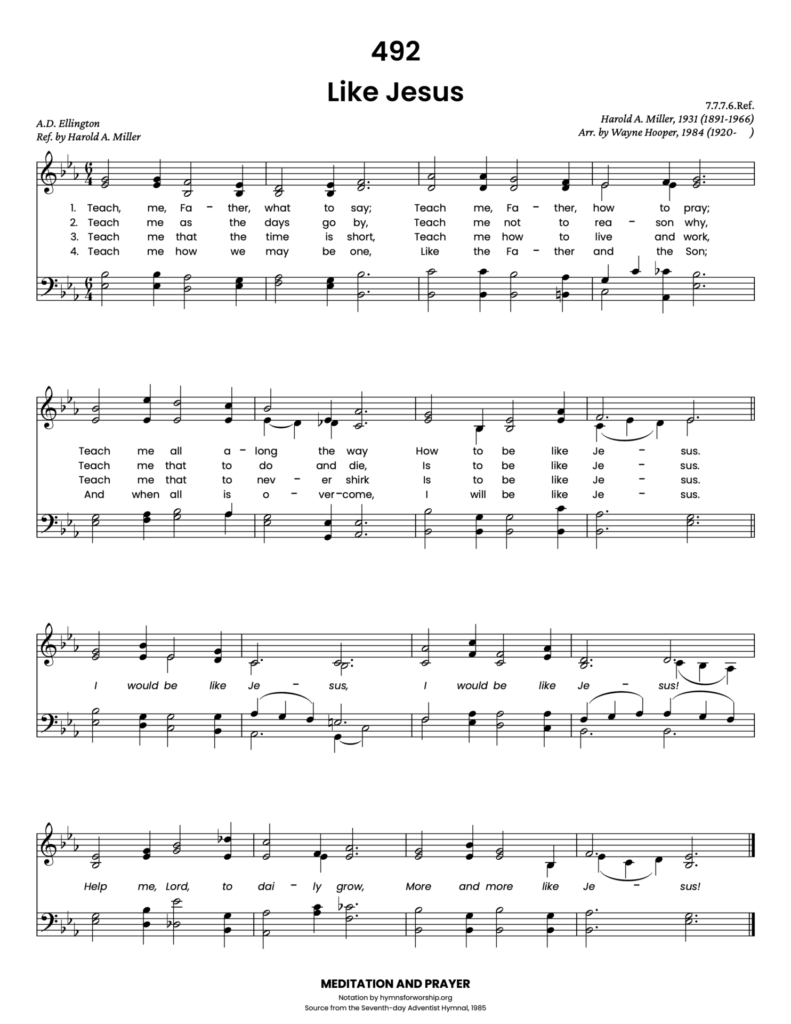
Teach, me, Father, what to say;
Teach me, Father, how to pray;
Teach me all along the way
How to be like Jesus.
Get the hymn sheet in other keys here
For Worship Leaders
Make each hymn more meaningful with these helpful tools: Short, ready-to-use hymn introductions for church bulletins, multiple ways to introduce a hymn based on your worship theme and in-depth history and insights to enrich your song service.
Hymn Spotlight: Like Jesus
This hymn is a heartfelt prayer for Christlikeness in our daily lives, echoing the hope of 1 John 3:2 that when Jesus returns, “we shall be like Him.” The fourth stanza draws from Christ’s own prayer in John 17:21, pleading for unity among believers so that the world may believe in Him. Written by A. D. Ellington, with the refrain and original music composed by Harold A. Miller in 1931, it first appeared in the Junior Song Book. Wayne Hooper later arranged it into the four-part harmony familiar today. Miller, a devoted Seventh-day Adventist music educator, composed over 200 hymns and songs during his 37 years of service in SDA schools, creating music to bless and build up the church he loved. This hymn remains a gentle yet profound reminder that true holiness flows from a heart surrendered to be like Jesus.
📖 Reference: Feel free to share but please cite hymnsforworship.org when reproducing.
Introductions for Sabbath School Song Service (based on specific lesson quarterlies):
The he heart of this hymn is a prayer that we might be more like Jesus in our lives now, in order to fulfill the expectation expressed in 1 John 3:2: “Beloved, now are we the sons of God, and it doth not yet appear what we shall be: but we know that, when he shall appear, we shall be like him; for we shall see him as he is.” The key as to how this can be accomplished is found in the request of the fourth stanza, based on Jesus’ prayer in John 17:21: “That they all may be one; as thou, Father, art in me, and I in thee, that they also may be one in us; that the world may believe that thou hast sent me.”
No information is available about A. D. Ellington, who wrote the stanzas. Harold Miller added the refrain in 1931 when he wrote the original music, printed in the Junior Song Book (later renamed Missionary Volunteer Songs), 1931. At the heading it was dedicated “to my friend, LeRoy E. Froom” (see SDAH 690). The latter served for many years in the Ministerial Department of the General Conference. Miller’s music was a solo for low voice, with a rather sophisticated piano accompaniment that was difficult to play at sight because of many ledger lines below the staff. Wayne Hooper (1920-2017) has made this simple arrangement in four-part harmony, which preserves all the harmonic progressions of the original.
Harold Amadeus Miller was born in 1891 at Tonawanda, New York. During his early childhood his parents were Seventh-day Adventists, but due to many activities occurring on Friday evenings in which their two older sons were involved, they gradually drifted away from the church. Miller’s father was a musician and piano teacher; he instructed Harold, who early showed a marked interest in and a talent for music. In fact, during his father’s absence for study in Vienna, Austria, 16-year-old Harold taught his father’s senior piano pupils.
The family moved to Syracuse, New York, to reestablish connections with the Seventh-day Adventist Church; there the Miller boys became acquainted with students from the South Lancaster Academy, Massachusetts (now Atlantic Union College). Here Harold Miller read of Mozart’s dislike for his middle name, Gottlieb, and of his decision to change it to Amadeus, which is the Latin form of the original German, meaning “God-loved.” Harold’s middle name was Gottlieb also (it came from an uncle), and he disliked it, too. He decided to follow Mozart’s lead and henceforth became H. A., instead of H. G., Miller. He was baptized at the academy and joined the church at Syracuse.
Miller was invited to become head of the music department at Mount Vernon Academy, Ohio, where he remained from 1916 to 1929. Then he served as music teacher, choir leader, and music director, at Washington Missionary College, Maryland (now Columbia Union College); Southern Junior College, Tennessee (now Southern College); Union College, Nebraska; and Pacific Union College, California. His years of service at these SDA educational institutions totalled 37. His tunes, dedicated to teachers, students, and friends who were interested in his compositions, were written solely as a contribution to the work and progress of the church he loved and served.
Of his more than 200 published hymns and songs, there were 10 in the 1941 Church Hymnal. But because a survey of pastors revealed that they were being used very little, all were deleted by the committee working on SDAH. The committee did decide to use this beautiful song by Professor Miller.
📖 Reference: Companion to the Seventh-day Adventist Hymnal by Wayne Hooper and Edward E. White. Review and Herald Publishing Association, 1988.
Stanza:
1 – Romans 8:26
3 – Ecclesiastes 9:10
4 – John 17:21
R – 1 John 3:2

Text
1
Teach, me, Father, what to say;
Teach me, Father, how to pray;
Teach me all along the way
How to be like Jesus.
Refrain:
I would be like Jesus,
I would be like Jesus!
Help me, Lord, to daily grow
More and more like Jesus!
2
Teach me as the days go by,
Teach me not to reason why,
Teach me that to do and die,
Is to be like Jesus.
3
Teach me that the time is short,
Teach me how to live and work,
Teach me that to never shirk
Is to be like Jesus.
4
Teach me how we may be one,
Like the Father and the Son;
And when all is overcome,
I will be like Jesus.

Hymn Info
Biblical Reference
(a) Rom 8:26 (c) Eccl 9:10 (d) John 17:21 (r) 1 John 3:2
Author
A.D. Ellington; Ref. by Harold A. Miller
Copyright
Copyright 1909. Renewed 1937 the Rodeheaver Co. (A Div. of Word Inc.). All rights reserved. International copyright secured. Used by permission.
Metrical Number
7.7.7.6.Ref.
Composer
Harold A. Miller (1891-1966)
Arranged
Wayne Hooper, 1984 (1920-2007)
Year Composed
1931
Explore more hymns: