CHRISTIAN LIFE >> FAITH & TRUST
SDAH 514
Lord of our life, and God of our salvation,
Star of our night, and hope of every nation,
Hear and receive Thy church’s supplication,
Lord God Almighty.
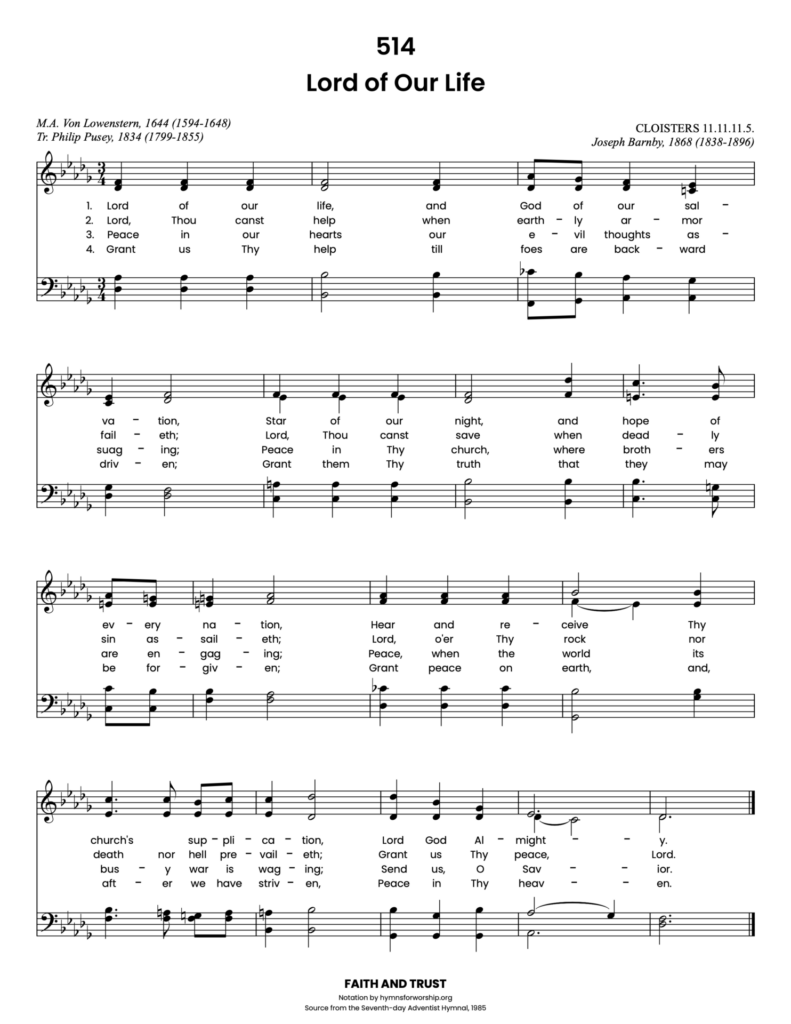
Get the hymn sheet in other keys here
For Worship Leaders
Make each hymn more meaningful with these helpful tools: Short, ready-to-use hymn introductions for church bulletins, multiple ways to introduce a hymn based on your worship theme and in-depth history and insights to enrich your song service.
Hymn Spotlight: Lord of Our Life
Originally written in 1644 by Matthäus Apelles von Löwenstern as a four-stanza “Song for spiritual and temporal peace,” this hymn rose from the turmoil of the Thirty Years’ War, offering a prayer for God’s protection and lasting peace. Nearly two centuries later, in 1834, Philip Pusey freely paraphrased the German text into a five-stanza English hymn, applying its longing for renewal to the Church of England, which he believed was “enfeebled within and assailed from without, but on the verge of a great awakening.” Löwenstern—court musician, poet, treasurer, and adviser to German nobility—wrote around thirty hymns with his own melodies, while Pusey, an Oxford-educated landowner and public servant, became known for his work in agriculture, literature, and civic leadership. The tune CLOISTERS, composed in 1868 by Joseph Barnby, brings solemn strength to the hymn’s plea that Christ, the Lord of the Church, calm our fears, defend His people, and grant peace in troubled times.
📖 Reference: Feel free to share but please cite hymnsforworship.org when reproducing.
Introductions for Sabbath School Song Service (based on specific lesson quarterlies):
Matthaus Apelles von Lowenstern wrote a hymn of four stanzas of 4 lines each, entitled “Sapphie Ode: For spiritual and temporal peace,” in 1644. It reflects the conditions during the Thirty Years’ War, which was virtually a religious war between Catholics and Protestants and lasted from 1618 to 1648. The words are a prayer for God to send peace on earth. In 1834 the hymn was freely paraphrased, using the German text as a basis, by Philip Pusey into five stanzas of four lines each. Pusey made it refer to the Church of England, which was “enfeebled within and assailed from without, but on the verge, nevertheless, of a great awakening,” as he wrote to his more famous brother, Dr. Edward Bouverie Pusey (1800-1882). The hymn was first printed in Alexander R. Reinagle’s (see SDAH 238) Psalms and Hymn Tunes, 1840.
Lowenstern was born in Neustadt, Silesia, on April 20 1594. He showed musical ability early in life. In 1625 he was appointed music director and treasurer at Bernstadt, for Duke Heinrich Wenzel of Munsterberg; later he became duke’s financial secretary and adviser. Later still he served both Ferdinand II and Ferdinand III. As well as an administrator, he was musician and poet and wrote 30 original hymns with melodies of his own. He died at Breslau on April 11, 1648.
Pusey was born on the family estate at Pusey, a small village near Oxford on June 25, 1799; he was educated at Eton Oxford. He left the university without taking a degree, however, and traveled in Europe. In 1828 he inherited the family estate and devoted his time to agriculture and public service. He wrote extensively on agriculture and was one of the founders of the Royal Agriculture Society, being elected its first president in 1840. He was also a member of Parliament, a Fellow of the Royal Society, and one of the founders of the London Library. He died on Oxford on July 9, 1855. CLOISTERS was especially written in 1868 for these words by Joseph Barnby (1838-1896; see Biographies).
📖 Reference: Companion to the Seventh-day Adventist Hymnal by Wayne Hooper and Edward E. White. Review and Herald Publishing Association, 1988.
Stanza:
1 – Psalm 79:9
2 – Matthew 16:18
3 – John 16:33

Text
1
Lord of our life, and God of our salvation,
Star of our night, and hope of every nation,
Hear and receive Thy church’s supplication,
Lord God Almighty.
2
Lord, Thou canst help when earthly armor faileth;
Lord, Thou canst save when deadly sin assaileth;
Lord, o’er Thy rock nor death nor hell prevaileth;
Grant us Thy peace, Lord
3
Peace in our hearts our evil thoughts assuaging;
Peace in Thy church, where brothers are engaging;
Peace, when the world its busy war is waging;
Send us, O Savior.
4
Grant us Thy help till foes are backward driven;
Grant them Thy truth that they may be forgiven;
Grant peace on earth, and, after we have striven,
Peace in Thy heaven.

Hymn Info
Biblical Reference
(a) Ps 79:9 (b) Matt 16:18 (c) John 16:33
Author
M.A. Von Lowenstern (1594-1648)
Translator
Philip Pusey, 1834 (1799-1855)
Hymn Tune
CLOISTERS
Metrical Number
11.11.11.5.
Composer
Joseph Barnby (1838-1896)
Year Composed
1868
Explore more hymns: