CHRISTIAN LIFE >> PILGRIMAGE
SDAH 622
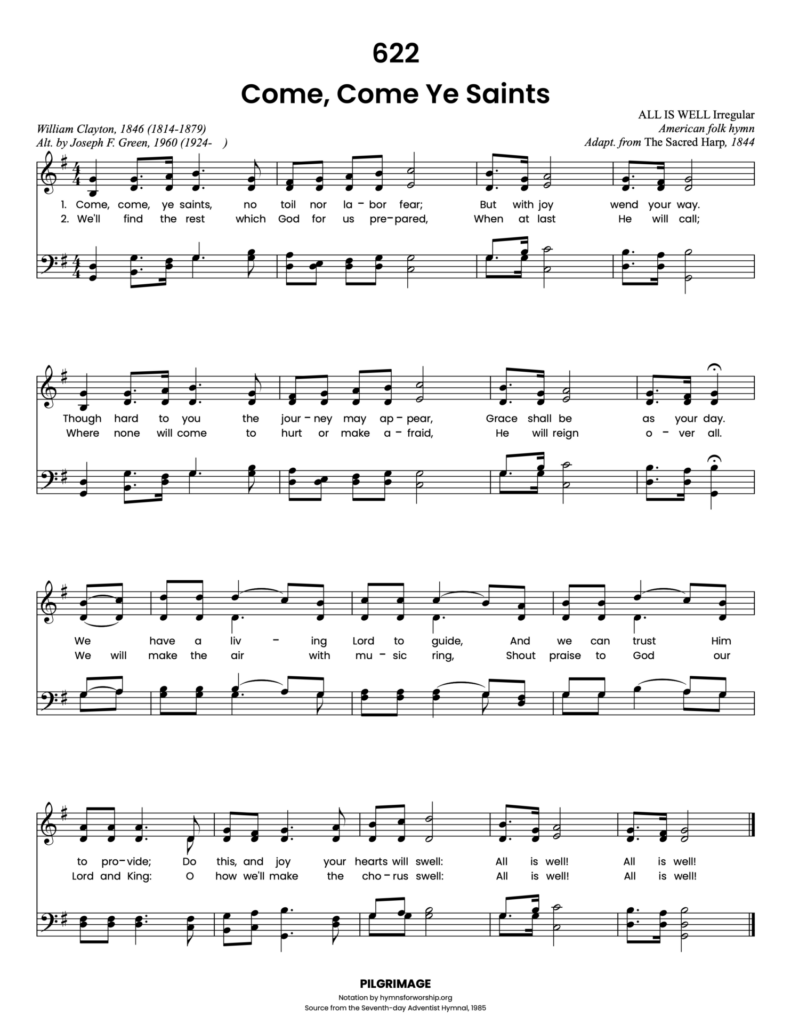
Come, come, ye saints, no toil nor labor fear;
But with joy wend your way.
Though hard to you the journey may appear,
Grace shall be as your day.
Get the hymn sheet in other keys here
For Worship Leaders
Make each hymn more meaningful with these helpful tools: Short, ready-to-use hymn introductions for church bulletins, multiple ways to introduce a hymn based on your worship theme and in-depth history and insights to enrich your song service.
📖 Reference: Feel free to share but please cite hymnsforworship.org when reproducing.
Introductions for Sabbath School Song Service (based on specific lesson quarterlies):
This stirring hymn made famous by the Mormon Tabernacle Choir, was written while Clayton was accompanying Brigham Young on a journey from the Mormon base at Nauvoo, Illinois, to winter quarters. An entry in his journal, dated April 15, 1846, gives the only reference to the writing of this hymn: “This morning I composed a new song-‘All Is Well.’ The following story is from the Mormon Relief Society Magazine. 1921: “President Young, feeling great anxiety because there were murmurings in the camp of Israel, called Elder William Clayton ” aside and said, ‘Brother Clayton, I want you to write a hymn that the people can sing at their campfires in the evening; something that will give them succor and support, and help them to fight the many troubles and trials of the journey.’ Elder Clayton withdrew from the camp and in two hours returned with the hymn. His personal testimony is to the effect that ‘it was written under the favor and inspiration of the Lord.'”
Another story relates how Clayton received a letter from his wife, Diantha, who was pregnant and remained at home. She gave him the good news that they now had a son, and closed with “All is well.”
These were also the closing words of a song in The Sacred Harp, 1844, that was familiar at that time:
What’s this that steals, that steals upon my frame! Is it death? is it death?
That soon will quench, will quench this mortal flame. Is it death? is it death?
If this be death, I soon shall be. From every pain and sorrow free,
I shall the King of glory see. All is well! All is well!
So his new hymn was composed to fit this meter, retaining that closing reassuring line for each stanza.
His original had four stanzas, the third of which started out:
We’ll find a place which God for us prepared, Far away in the west,
Where none shall come to hurt or make afraid; There the saints will be blessed.
This, of course, refers to the movement westward by the Mormons to Utah in 1846. The SDAH version consists of two stanzas of the three in the Baptist Hymnal, 1975, which is an adaptation of Clayton’s poem made by “We’ll make the air with music ring,” is Clayton’s original.
William Clayton was born July 17, 1814, in Penwortham, England. At age 23 he became an ardent convert to Mormonism. He closed his private business, was ordained and set apart as a missionary, and was successful in raising up a “branch” of 240 members in Manchester before he came to in America in 1840. His ability was soon recognized; moving to the Nauvoo, Illinois, headquarters of the group, he became secretary to the prophet, Joseph Smith; recorder of the Nauvoo Temple; and treasurer of the city. After the prophet was killed, Clayton was one of the original pioneers who made the difficult journey to the West to find a new home. There he held various offices with distinction and skill. He had played in the Nauvoo Brass Band, and in Salt Lake City he played second violin in the Theater Orchestra. Another of his hymns, “When First the Glorious Light of Truth,” is very precious to the Mormon people. He died December 4, 1879.
Joseph Franklin Green, born June 6, 1924, in Waco, Texas, the son of a Baptist minister, was educated at Texas Wesleyan College (B.S.), Baylor University (M.A.), and Southwestern Baptist Theological Seminary (Th. D.). After three years in the Army (1943-1946), he was ordained a Baptist minister and served pastorates in Texas and Colorado before taking up editorial work at Broadman Press. He has written several books and hymn and anthem texts.
The probable first appearance of the tune ALL IS WELL was in Revival Melodies, Boston, 1842, where it is credited to “C. Dingley.” In 1844, Baptist singing-school teacher B. F. White made some revisions and included it in his Sacred Harp (see comments at SDAH 363) with the text about death mentioned above. A version of the tune with “There is a land, a better land than this” is found in the Seventh-day Adventist Hymns and Tunes, 1886. (See reproductions of both on pages 572 and 573.)
Since there are some measures with three beats in this basically 4/4 tune, the committee elected to omit the time signature, letting the quarter note have its integrity throughout.
📖 Reference: Companion to the Seventh-day Adventist Hymnal by Wayne Hooper and Edward E. White. Review and Herald Publishing Association, 1988.
Stanza:
1 – 2 Corinthians 7:4
Isaiah 58:11
2 – Isaiah 11:9
Psalm 103:19

Text
1
Come, come, ye saints, no toil nor labor fear;
But with joy wend your way.
Though hard to you the journey may appear,
Grace shall be as your day.
We have a living lord to guide,
And we can trust Him to provide;
Do this, and joy your hearts will swell:
All is well! All is well!
2
We’ll find the rest which God for us prepared,
When at last He will call;
Where none will come to hurt or make afraid,
He will reign over all.
We will make the air with music ring,
Shout praise to God our Lord and King:
O how we’ll make the chorus swell:
All is well! All is well!

Hymn Info
Biblical Reference
(a) 2 Cor 7:4; Isa 58:11 (b) Isa 11:9; Ps 103:19
Author
William Clayton (1814-1879)
Altered
Joseph F. Green, 1960 (1924-)
Year Published
1846
Copyright
Words copyright 1960 by Broadman Press. All rights reserved. Used by permission.
Hymn Tune
ALL IS WELL
Metrical Number
Irregular
Tune Source
American folk hymn
Adapted
from the Sacred Harp, 1844
Explore more hymns: