JESUS CHRIST >> SUFFERINGS & DEATH
SDAH 164
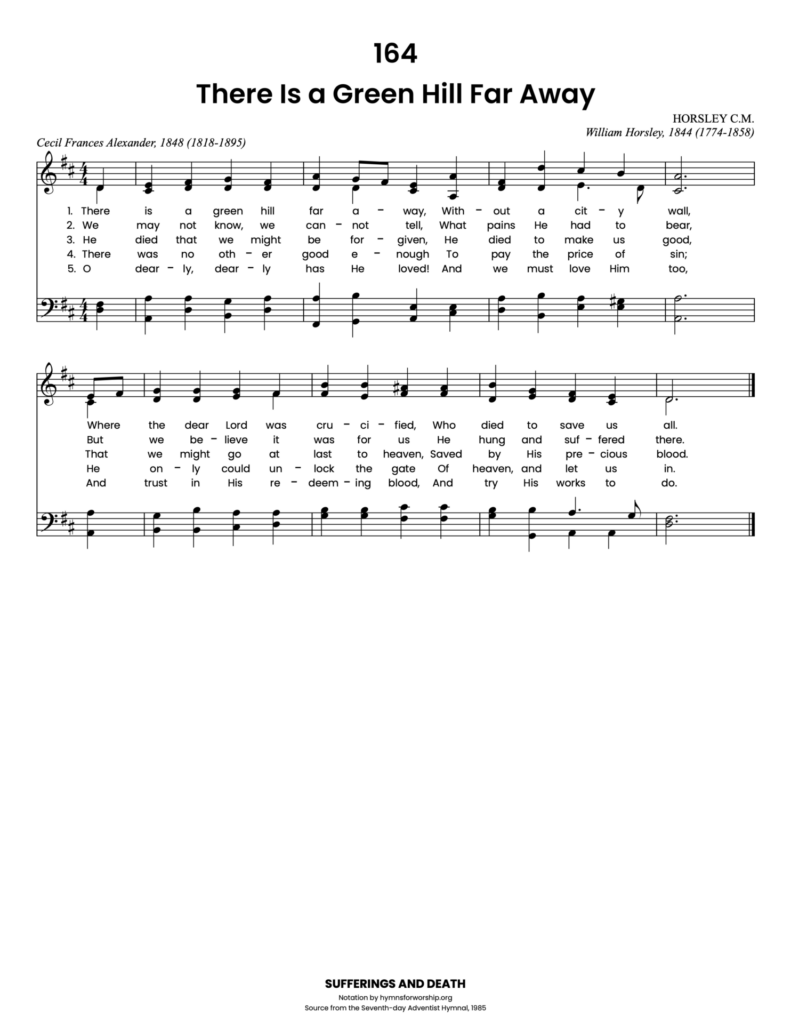
There is a green hill far away,
Without a city wall,
Where the dear Lord was crucified,
Who died to save us all.
Get the hymn sheet in other keys here
For Worship Leaders
Make each hymn more meaningful with these helpful tools: Short, ready-to-use hymn introductions for church bulletins, multiple ways to introduce a hymn based on your worship theme and in-depth history and insights to enrich your song service.
Hymn Spotlight: There Is a Green Hill Far Away
This gentle and poetic hymn by Cecil Frances Alexander was written to explain the Apostles’ Creed to children—specifically the phrase, “suffered under Pontius Pilate, was crucified, dead, and buried.” As she passed by a grassy hill near Londonderry, she pictured Calvary and penned this hymn to convey Christ’s love and sacrifice in words even a child could understand. The tune HORSLEY, written for an orphan girls’ choir in the 1840s, matches the hymn’s tender simplicity. It’s a song that brings us close to the cross—not with graphic detail, but with quiet reverence. As we sing, may we remember not just where Christ died, but why—and what that means for our salvation.
📖 Reference: Feel free to share but please cite hymnsforworship.org when reproducing.
Introductions for Sabbath School Song Service (based on specific lesson quarterlies):
Cecil Frances Alexander, née Humphreys (1818-1895; see SDAH 93), used to drive into Londonderry past a grass-covered hill that reminded her of the hill of Calvary, which was probably a small hillock outside old Jerusalem. She had decided to make the Apostles’ Creed comprehensible to children, so she rewrote each article in simple language and published it in her Hymns for Little Children,1848. With the picture of this hill in mind, perhaps, she simplified and amplified article 4 of the creed, which reads: “Suffered under Pontius Pilate, was crucified, dead, and buried.” However, even in her simple language there was ambiguity, for the second line, which quotes from Hebrews 13:12, “without the gate,” prompted a small child to ask her what was meant by a hill not having a city wall; the child did not understand that without in this case meant “outside,” so she changed it to that. Alexander also wrote SDAH 93, “All Things Bright and Beautiful”; SDAH 149, “Once in Royal David’s City”; and SDAH 285, “Jesus Calls Us.”
HORSLEY is named after the composer. It appeared first in William Horsley’s Twenty-four Psalm Tunes and Eight Chants, 1844, but it first carried this name in the Appendix to Hymns Ancient and Modern, 1868. William Horsley was born in London on November 15, 1774, and studied music and composition. In 1794 he was appointed organist at Ely Chapel, Holborn; in 1798 he was assistant organist at the Royal Asylum for Female Orphans in Lambeth. From 1802 to 1812 he was organist there, during which time he composed this tune for the girls. He was one of the founders of the London Philharmonic Society and became an intimate friend of Mendelssohn’s. He received a B.Mus. from Oxford in 1800 and died in Kennington, London, June 12, 1858.
Stanza:
1 – 1 Corinthians 5:15
3 – Ephesians 4:32
5 – John 3:16
1 Peter 1:18

Text
1
There is a green hill far away,
Without a city wall,
Where the dear Lord was crucified,
Who died to save us all.
2
We may not know, we cannot tell,
What pains He had to bear,
But we believe it was for us
He hung and suffered there.
3
He died that we might be forgiven,
He died to make us good,
That we might go at last to heaven,
Saved by His precious blood.
4
There was no other good enough
To pay the price of sin;
He only could unlock the gate
Of heaven, and let us in.
5
O dearly, dearly has He loved!
And we must love Him too,
And trust in His redeeming blood,
And try His works to do.

Hymn Info
Biblical Reference
(a) 1 Cor 5:15 (c) Eph 4:32 (e) John 3:16; 1 Pet 1:18
Author
Cecil Frances Alexander (1818-1895)
Year Published
1848
Hymn Tune
HORSLEY
Metrical Number
C.M.
Composer
William Horsley (1774-1858)
Tune Source
1844
Explore more hymns: