Resources Mentioned
- Guide Me, O Thou Great Jehovah (Bryn Terfel)
- The Three Angels’ Messages and the Mission of the Church (Ted Wilson)
- Driven by a Dream (Oliver Jacques)
- Symphony No. 9 in D minor, Op. 123 “Choral” : IVc-j Presto. ‘O Freunde nicht…’ (Ludwig van Beethoven)
- Finlandia, Op. 26 (Gustav Holst / Jean Sibelius)
- SDAH 415: Christ the Lord, All Power Possessing (C. Mervyn Maxwell)
- SDAH 201: Christ Is Coming (John MacDuff)
- SDAH 538: Guide Me O Thou Great Jehovah (WIlliam Williams)
- Beyond the Barren Land: Finding Faith & Hope In “Guide Me, O Thou Great Jehovah” (Unveiling Hymns Using CWM RHONDDA) (Hymns for Worship)
- A Hymn of Hope in Changing Times: John MacDuff’s “Christ is Coming” (Unveiling Hymns Using CWM RHONDDA)(Hymns for Worship)
- A Hymn of Clouds and Conviction: Christ, the Lord All Power Possessing (Unveiling Hymns Using CWM RHONDDA)(Hymns for Worship)
- Three Angels Message lyrics
- Almost Home – Full Album
- Almost Home (Three Angels) – Audio
- Almost Home (Three Angels) – Music sheet
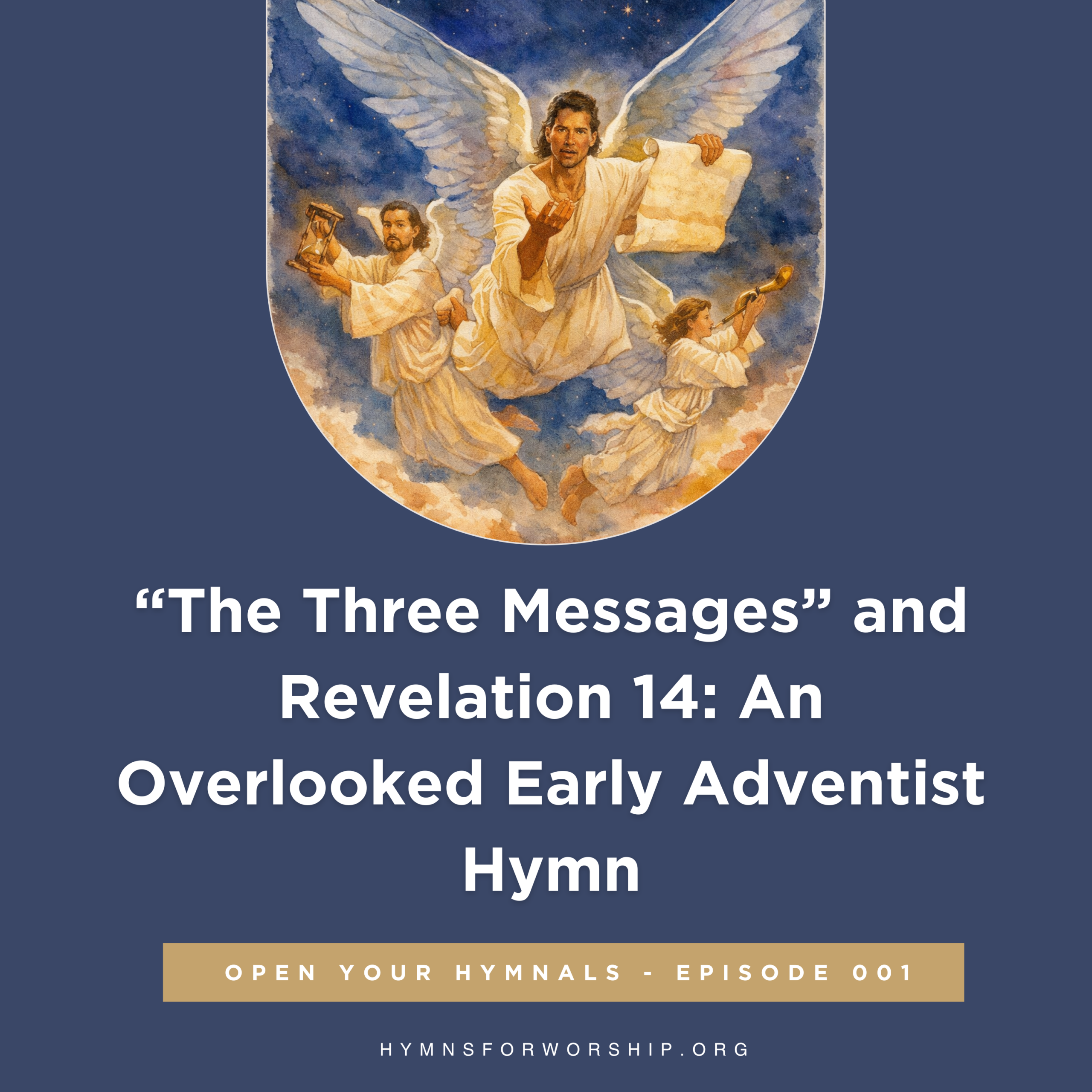
I recently read an article from Adventist Review written by Oliver Jacques—a retired pastor and teacher, and a great-grandson of James and Ellen White. It was mainly a story about how the publishing work started among a small group of Adventists during the 1800s.
What impressed me most was the fervor and passion the publishing team had—which by the way, was mainly run by young people. Many of them were 25 and below.
I also read stories of early Adventist believers who gave up jobs, farms, possessions, and dreams—all in preparation for Christ’s soon return.
And I wondered: do I have what it takes to be so passionate about something I believe in that I’m willing to risk everything I have?
Sermons were preached about Christ’s soon return. Prayers were breathed as they asked God to prepare their hearts to see Him. Hymns were sung to cheer and strengthen them as they traveled to and fro, telling friends and neighbors, “The Lord is coming!”
As I kept reading their accounts, I could almost feel the electricity—the excitement of people who, deep in their hearts, truly longed to see Jesus.
And from a musician’s point of view, I couldn’t help asking: what kind of hymns were they singing during this time?
As I pored over old hymnals compiled for camp meetings, worship services, and religious gatherings, I discovered a treasure trove of distinct Adventist hymns. Many are still in the SDA Hymnal—but sadly, they’re not well-known in today’s Adventist congregations.
As a pianist, I’m often invited to SDA churches to accompany worship services to play prelude, offertory, postlude, the whole thing. But I honestly don’t recall a time when a song leader announced an early Adventist hymn to be sung. And even worse, I don’t recall a time when I ever played an early Adventist hymn arrangement.
That gap is part of what gave birth to the Almost Home album.
It consists of 11 piano hymn arrangements under the theme of Christ’s second coming—many of which are early Adventist hymns that are rarely sung in our pews today.
I’m excited to talk about one of the hymns in this episode, and the next 11 in the following episodes. So join me on this journey!
How Hymns Are Created
Many hymn tunes are composed separately from hymn texts. Sometimes lyrics are fitted to tunes that already existed, and sometimes tunes are written for texts that already circulated. That’s why you’ll find hymns where the text was written in the 1100s or 1800s, but the tune was composed in the 1900s.
Sometimes a famous tune becomes a vessel for multiple texts—like Beethoven’s “Ode to Joy” sung as “Joyful, Joyful We Adore Thee,” or Gustav Holst’s Finlandia, originally a patriotic tone poem, now sung in church as “Be Still, My Soul.”
And then, in some cases, the hymnwriter and composer lived at the same time, knew each other, and collaborated. Some even wrote both the words and the melody themselves.
CWM RHONDDA
For today’s episode, the hymn tune CWM RHONDDA is central—because several hymn texts fit it.
It was composed by John Hughes in 1905 for a Cymanfa Ganu which is a Welsh song festival.
A Cymanfa Ganu is a unique Welsh tradition where a congregation gathers to sing sacred hymns in four-part harmony, led by a conductor. It creates a powerful, unified sound—often described as the soul of Wales expressed through music.
The text “Guide Me, O Thou Great Jehovah” had always been sung to the tune CAPEL-Y-DDOL. but the words just didn’t match the sweet, solemn mood of the music.
But as the congregation in the Cymanfa Ganu sang the words:
Guide me, O thou great Jehovah,
pilgrim through this barren land.
I am weak, but thou art mighty;
hold me with thy powerful hand.
Bread of heaven, bread of heaven,
feed me till I want no more;
Feed me till I want no more
…to the newly composed CWM RHONDDA, they realized that the combination worked so well—emotionally and poetically—that it basically became “set in stone.”
Some hymnals use “Redeemer” instead of “Jehovah,” but the meaning and poetry remain the same. This is the most popular pairing, and though both tune and text are Welsh in origin, the English version became so widely loved that it even found its way into royal weddings and services.
One beautiful recording is sung by Welsh opera bass-baritone Bryn Terfel (in both English and Welsh) in his album Homeward Bound, arranged by Mack Wilberg in collaboration with the Mormon Tabernacle Choir. A link to this performance is included in the show notes.
Three Texts in the SDA Hymnal
The current Seventh-day Adventist Hymnal was published in 1985, and its editors included three hymn texts set to CWM RHONDDA.
They kept the “original” pairing: William Williams’ “Guide Me, O Thou Great Jehovah,” under the Guidance theme. It relates the experience of the Israelites in the wilderness and uses many literary devices to also connect to the Christians’ pilgrimage in this life.
The two other hymn texts are:
- “Christ Is Coming” (SDAH 201) by John R. MacDuff, under the Second Advent theme
- “Christ the Lord, All Power Possessing,” (SDAH 415) under the Judgment theme
Christ is Coming is a powerful second advent hymn that rouses the congregation into readiness for Jesus’ return. MacDuff used the phrase “Christ is coming” six times in the hymn. This type of repetition is intentional, and highlights the main message of the text. He refers to His coming as the “blessed hope” and includes the urgent prayer in Revelation 22:20, “Even so Lord, quickly come!”
MacDuff, a Scottish minister, also wrote books about pre-millenialism. It’s basically the belief that there will be a rapture (Left Behind style) and that Jesus comes to earth and will reign in peace for a thousand years. None of those beliefs are insinuated in the hymn, of course, but one wonders whether that was in his mind as he was writing. Nonetheless, if we looked at the hymn from an Adventist lens, we will still get a correct understanding and feel the same urgency of Christ’s soon return.
The third text that the editors added is C. Mervyn Maxwell’s Christ the Lord All Power Possessing. This hymn has a strong Adventist flavor because not only was it written by an Adventist, but as a church history professor, Maxwell outlines how the final events of this earth’s history happens, and that they are found in Daniel and Revelation. He uses a sequence of phrases to quickly show Christ’s movements — “Christ ascended…” “Christ approaches…” “Christ is coming…”
I’ve written a more in-depth article on the writers and the texts, and I’ll link those in the show notes too.
Suffice it to say: CWM RHONDDA is well represented in our hymnal.
Discovering the “The Three Angels’ Messages”
As I was researching for hymns to include in the Almost Home album, I gravitated towards Maxwell’s, “Christ the Lord All Power Possessing” to be the basis of the arrangement. I had commissioned composer and organist Alejandro Consolacion II to arrange these hymns and wanted to take the time to explain the background of the hymns he will be working on. My intention, of course is to give him some idea where the hymn is coming from and what it’s trying to say. I think that kind of information helps in matters of composing as well as arranging.
Just then I came across another hymn text, not in the current SDA Hymnal but in one of the earliest hymnals in Adventist history.
James White had compiled a hymnal called “Hymns, for God’s Peculiar People, that keep the Commandments of God, and the Faith of Jesus.” It was published in 1849, just a few years after after The Great Disappointment of October 22, 1844. And it included several hymns that uniquely showcases our beliefs as Seventh-day Adventists, one of which is entitled “Second Advent History” later on changed to “Three Messages” in another hymnal compiled by James White.
I quickly scanned the text and realized that the hymn writer based it from Revelation 14:6-12, which is basically the three angels messages in rhyme and meter. I wondered what could have been the tune it was sung to since there was no music included.
I counted the syllables per line: 8.7.8.7.8.7.7.
I quickly scanned the back of the SDA Hymnal to see what tunes have the same measurement. Lo and behold, the mighty, emotionally compelling, and soaring CWM RHONDDA is included in the list.
What’s so special about the Three Angels’ Messages?
Growing up Adventist, I’m no stranger to the Three Angels’ Messages. It was one of those verses we had to memorize and recite at home, at church, in Bible classes at school and even in Pathfinders. It’s baked into our beliefs. Even the symbol of three angels was prominent in the old Adventist logo until it was changed in 1996. The current logo still contains the symbolism—though it’s less obvious—but the message remains one of the distinct things that sets this movement apart.
But what is so special about it? Revelation 14:6–12 basically outlines a series of “warnings” a faithful Christian should heed while preparing for the Second Coming of Christ.
I know… “warnings” sound scary. Why would there be warnings for when Jesus comes again? In my younger years, I saw the events surrounding Christ’s coming as scary, full of doom and gloom and honestly, just deeply confusing.
But I praise God for His patience and wisdom. As I matured and learned more about how God works — I still saw the three angels as warnings, but warnings given in love and concern.
As a mom, I foresee whether my 3 year old son’s adventurous activities in the yard will later be dangerous for him. He will say, “Mama, can I use this stick to reach that branch?” Or “Mama, can I use this plank of wood to build a bridge between these two stones.” I mean, I’m all for fun and adventure, but I usually find myself saying, “Yes you can, but be careful, that branch might fall on you…” or “Yes you can make a bridge but watch out for the big ants in that corner. Maybe you should move over here instead.” Should my son be scared of me because I just gave him a bunch of warnings? Maybe I’m on the more cautious side, because I love him and wants him to enjoy his playtime rather than have that branch accidentally fall on his head or have the ants bite him and trigger his skin rashes.
I see God and the warning of the three angels messages that way. Warnings given out of love and concern.
The Message of the Three Angels
You can open your Bibles with me to Revelation 14, and let’s read verses 6-7. It says:
THE FIRST ANGEL’S MESSAGE
6 And I saw another angel fly in the midst of heaven, having the everlasting gospel to preach unto them that dwell on the earth, and to every nation, and kindred, and tongue, and people,
7 Saying with a loud voice, Fear God, and give glory to him; for the hour of his judgment is come: and worship him that made heaven, and earth, and the sea, and the fountains of waters.
Here, the first angel begins with the heart of Christianity: the everlasting gospel. What is that? That salvation is found in Christ alone. That through His righteousness and grace, He has power to justify the sinner and sanctify the believer, making the gospel more tangible, not just a belief.
And when the angels says: “the hour of His judgment has come,” it is not meant to create fear—it’s meant to wake us up. This judgment message is anchored in Daniel 8:14, where the prophecy of the 2,300 days or years as in prophetic time, points to the cleansing of the sanctuary. From the Adventist understanding, since October 22, 1844, we’ve been living in the investigative judgment, or the cleansing of the heavenly sanctuary, revealing who will be ready to go to heaven when Jesus returns.
And then the angel mentions worship. To worship the Creator is to honor the memorial of creation, the Sabbath, and to reject origin stories that deny God’s creative authority—like evolution.
So in the first angel alone, God gives the good news, tells us He is coming soon by pointing to the judgment already happening, and then gives us instructions on how we can render worship to Him.
SECOND ANGEL’S MESSAGE
Let’s continue with Revelation 14:8. It says:
“And there followed another angel, saying, Babylon is fallen, is fallen, that great city, because she made all nations drink of the wine of the wrath of her fornication.
The second angel’s message is short, but may sound harsh to some: “Babylon is fallen.” “Babylon” points to churches that rejected the judgment warning and turned away from advancing biblical light. This is echoed in Revelation 18:1–4, but with a louder cry and warning: Come out of Babylon so they won’t share in her sins or receive her plagues. Babylon includes religious systems that continue theological errors that distort Scripture and confuse worship.
As Adventists, we believe that this message, to come out of Babylon, had already began in 1844, and is still unfolding gradually in our times. The message is still being proclaimed and it won’t be complete until churches fully reject this message and fully align with Satan and the world.
So this second warning wants us to wake up to the truth and be aware of what Satan is doing to deceive God’s people.
THIRD ANGEL’S MESSAGE
The final portion is found in Revelation 14:9-12, which says:
9 And the third angel followed them, saying with a loud voice, If any man worship the beast and his image, and receive his mark in his forehead, or in his hand,
10 The same shall drink of the wine of the wrath of God, which is poured out without mixture into the cup of his indignation; and he shall be tormented with fire and brimstone in the presence of the holy angels, and in the presence of the Lamb:
11 And the smoke of their torment ascendeth up for ever and ever: and they have no rest day nor night, who worship the beast and his image, and whosoever receiveth the mark of his name.
12 Here is the patience of the saints: here are they that keep the commandments of God, and the faith of Jesus.
The third angel does not mince words. It plainly says: do not worship the beast or its image, and do not receive its mark. The beast represents the papacy, and the second beast, understood as the United States — forms an alliance. This alliance gains control of civil power, creating a church–state union that enforces worship.
Within this framework, the mark of the beast is understood as false-day worship—a man-made institution where the seventh-day Sabbath was changed from Saturday to Sunday. But it ends with a promise that there will be a group of people who will be faithful and will keep God’s commandments.
As you can see, all three angels are sounding the alarm, but they are given ahead of time for us so we can prepare.
Almost Home: Application of “The Three Angels’ Messages” to music
With that backdrop, I told Alejandro—the arranger I commissioned—to capitalize on the theme of urgency. If music is to be one of the vehicles in which a serious message like this can be shared, then it should be sounded with persistence and obstinacy.
How can music reflect that? This is where the creativity of the arrangement lies:
- First, the opening tempo is fast. 200 on the metronome, marked ritmico energico. If I would put that on the metronome, a quarter note will be played at this speed (plays the metronome). And that’s pretty fast
- In the first stanza, the melody darts forward with shifting downbeats, creating a syncopated vibe that dots across the landscape of fast moving notes.
- The left hand accompaniment is sparse, but steady—just enough to ground that sense of movement. Let me play the first stanza so you can hear what I mean.
- The second stanza becomes richer. Instead of the melody alone, AJ added a second harmonizing voice. To me, it suggests the message expanding—like the proclamation growing. (That’s my interpretation, of course, and may not be AJ’s.) But “two” is definitely featured: two voices tracing the line, giving variation from the first stanza.
- It also modulates from G major to C major, and the melody shifts an octave higher. The new key, the shift in octaves tells you here’s another message. A second message.
- Notice though that the overall tone is not gloomy or scary. Instead AJ uses an interlude that uses melodies and chord progressions that gives off “loving vibes” (for lack of a better musical term). Which interprets what I have mentioned awhile ago, yes God gives warnings, but out of love and concern for us. Let me play the second stanza for you, including the interlude.
- The third stanza turns more somber and serious. The tempo relaxes, and we get chordal writing—almost like a straightforward four-part hymn. It seems to say, slow down and pay attention.
- And finally, it concludes with a fourth stanza that feels like a reprise of the first—ending in a mighty glissando, which proclaims the victory of God’s faithful people. Let me play the third and fourth stanza for you.
If you want to hear the full version without my interjections and interpretation, the Spotify link is in the show notes as well. And if you’re a pianist—or you know a pianist who would appreciate an arrangement like this—the music score is linked there as well.
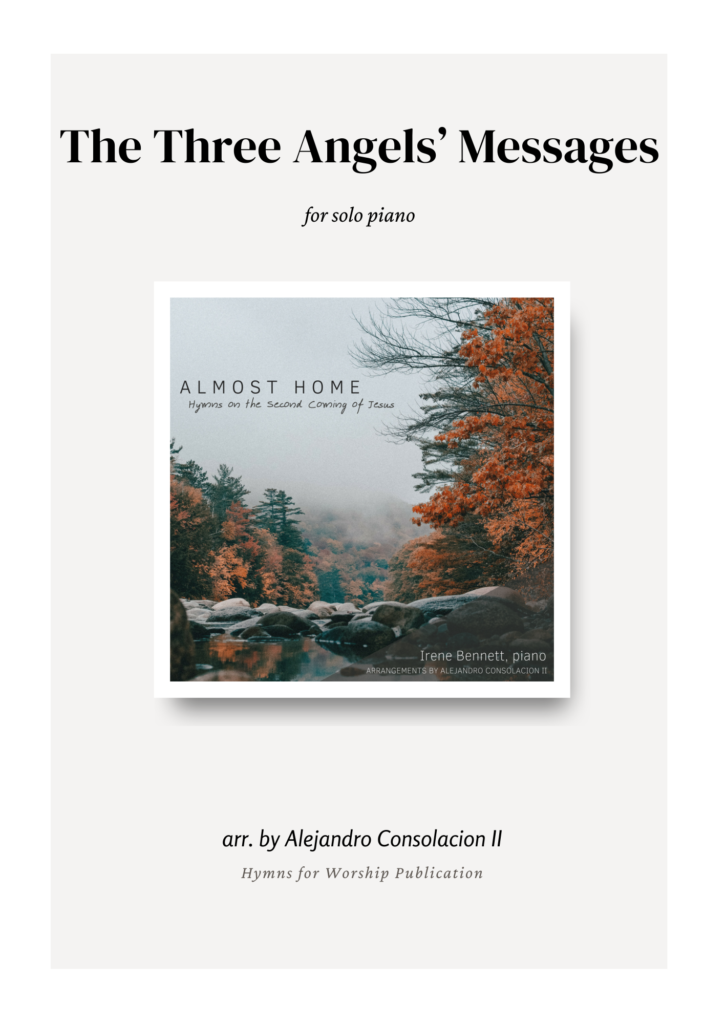
This is a 5-page arrangement for solo piano based on the familiar hymn tune CWM RHONDDA. The text draws from Revelation 14, echoing the Three Angels’ Messages, and was first published in James White’s 1849 Hymns for God’s Peculiar People. Alejandro Consolacion II crafted an arrangement that vividly suggests angels in swift flight—urgent, radiant messengers carrying heaven’s final appeal, calling God’s people to be ready for Christ’s soon return.
Conclusion
As we close, I want to return to the people who started this movement—people who preached, prayed, and sang like Jesus was truly coming soon… because to them, it was real. And it is REAL.
That’s what early Advent hymns do when we let them. They don’t just preserve history. They revive urgency. They take doctrine and put it into melody. They help us worship with our minds and our hearts.
Honestly, I believe the richness of early Advent hymns deserves to be revived—not as nostalgia, but to give an impetus to our personal spiritual journey.
Here’s two practical ways to start:
- First, find the EARLY ADVENT section of the hymnal and learn the songs there. Start by teaching it to yourself and to your family during worship. You can use the accompaniments in the Hymns for Worship website if you don’t have a pianist at home. And then your family can be the confident leading voices in churches when teaching these songs to the congregation.
- Another way is for you to sing the four texts we learned today to the tune of CWM RHONDDA. Start with the original pairing, and once you’ve learned the first one, it is easy to sing the other three.
For the worship and music leaders at church:
- Try intentionally incorporating CWM RHONDDA in the prelude, offertory or postlude not just for one Sabbath but for several weeks. Familiarity will help the congregation learn new hymns faster
- Once familiar, incorporate the hymns in the song service and allow the overall theme of hymns (like Guidance, Second Coming and Judgment) guide your song service repertoire.
Lastly, I’d love to hear from you: Which of the four hymn texts resonate to you the most and why? You can comment here on Spotify or you can visit Hymns for Worship’s Facebook and Instgram pages to interact with me. If this episode blessed you, please follow/subscribe so you won’t miss the next one. Until next time—open your hymnals, and let’s keep singing with understanding.