Resources Mentioned
1. The Morning Trumpet for the Tabernacle Choir and Orchestra – TTBB (Mack Wilberg)
2. The Morning Trumpet – SATB (Mark Hayes)
3. The Morning Trumpet -SATB (Lloyd Larson)
4. The Morning Trumpet – SSA (Ken Berg)
5. O When Shall I See Jesus; Morning Trumpet (Irene Bennett)
6. Millenial Musings (JV Himes & Josiah Litch)
7. The Sacred Harp (BF White)
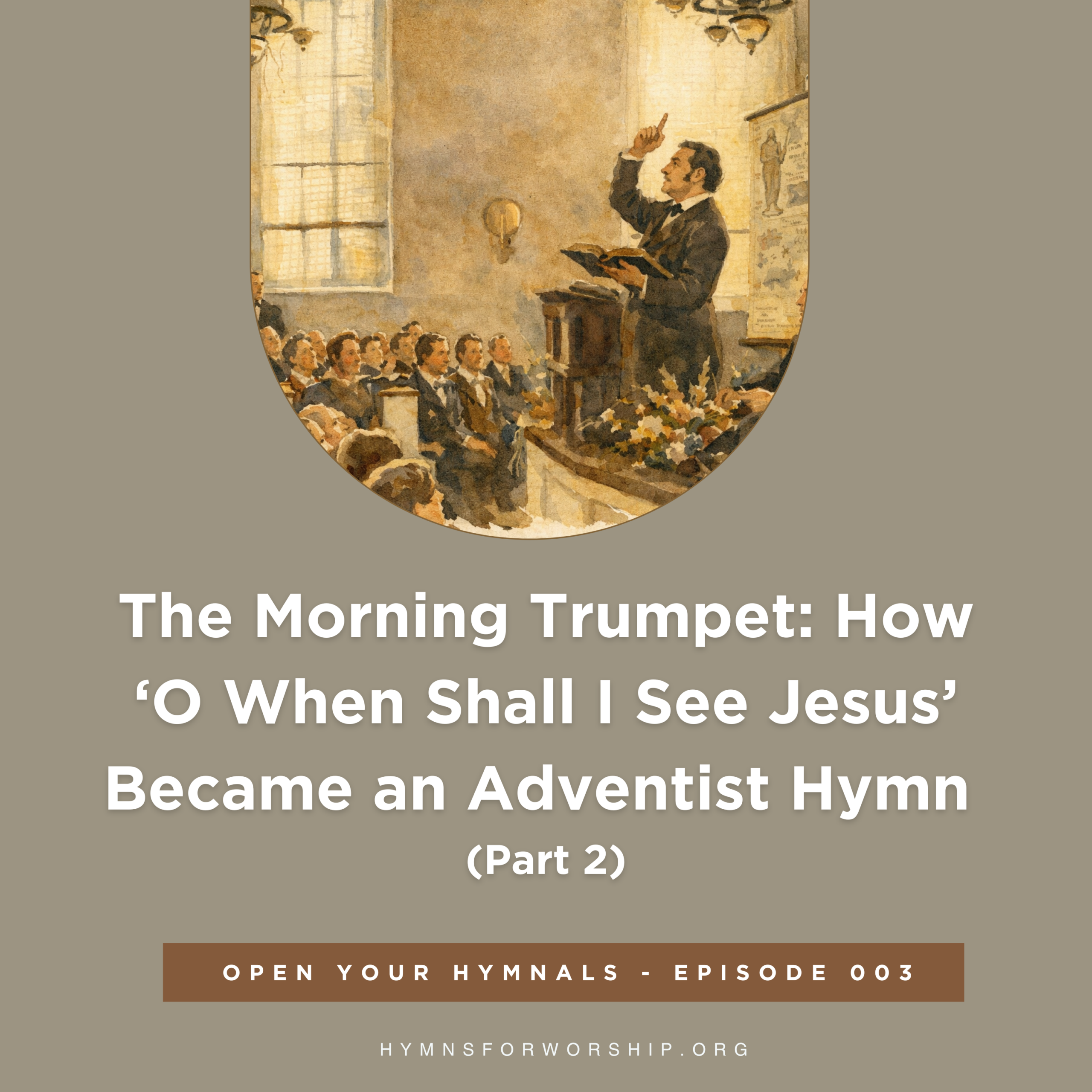
In Part 1, we started with the man behind the text—John Leland—his background as a Baptist preacher, and how this hymn comes from a very real, very urgent longing for Christ’s return. Then we followed the hymn’s journey into America’s singing-book tradition, where it landed in the hands of Benjamin Franklin White. Through White and The Sacred Harp, the hymn took on the form many of us recognize today—paired with THE MORNING TRUMPET, complete with the refrain and that unforgettable repeated line about hearing the trumpet sound.
From there, we traced how the hymn also appears in Millerite circles—showing up in Millennial Musings, compiled by both J.V. Himes and Josiah Litch, and finally how it becomes part of our own worship story in the Seventh-day Adventist Hymnal, where it’s listed as an Early Advent hymn.
Now in Part 2, we’re going to slow down and sit with the words themselves. We’ll do a deeper dive into the hymn text—what it’s actually saying, why it resonates so strongly with Adventist hope, and how we can apply it practically in our daily lives. And then we’ll listen for how the piano arrangement from Almost Home interprets that longing, urgency, and promise in sound.
Text Analysis
I’d like to talk briefly about the hymn text itself and how we, as Seventh-day Adventist Christians, can connect with it. First, it helps to remember that this text was written by a preacher. So it’s not surprising that singing it feels like a distilled Bible study—not only on the Second Coming of Jesus, but also on how we prepare for it. I’ll be analyzing the text as it appears in the current SDA Hymnal.
STANZA 1
The first stanza opens with a deeply personal question: “O, when shall I see Jesus and reign with Him above?”
I can imagine why that line hooked early Advent believers. The Second Coming was near, real, and urgent. And when they believed they had finally understood the time, many didn’t respond with excitement alone, but with deep heart-searching: Am I ready to meet Him? That’s the kind of question that rearranges priorities. It’s why so many simplified their lives and poured their energy into sharing the message.
But notice what happens next. The hymn doesn’t only ask when—it gently reveals what the singer is longing for when that day comes: to see Jesus, to be with Him, and to enter the joy of His kingdom.
“Reign with Him above” might sound self-focused at first, but Scripture frames it differently. It’s not about status—it’s about belonging. Revelation 20:4 pictures the redeemed sharing in Christ’s reign during the millennium. In Adventist understanding, this is part of God’s healing and restoring work—bringing His people close, safe, and finally home.
In the third line, the “flowing fountain” is Revelation language: God leading His people to living waters (Rev. 7:17), the river of life flowing from His throne (Rev. 22:1–2). It’s a simple picture of thirst finally ended—the redeemed drinking in God’s life and love forever.
STANZA 2
In the second stanza, we can hear how much the lines draw from Paul’s writings:
“Gird on the gospel armor of faith and hope and love.”
This line is basically Paul in hymn form. It immediately brings to mind the “armor of God” passage in Ephesians 6:11 and 13:
11 Put on the whole armour of God, that ye may be able to stand against the wiles of the devil.
13 Wherefore take unto you the whole armour of God, that ye may be able to withstand in the evil day, and having done all, to stand.
Paul then spells out what that armor includes: v. 14 loins girt about with truth, v. 14 breastplate of righteousness, v. 15 feet shod with the preparation of the gospel of peace, v. 16 shield of faith, v. 17 helmet of salvation, and v. 18 sword of the Spirit, which is the word of God.
But instead of using the full list, John Leland distills the essence of the “whole armor” using the language of 1 Thessalonians 5:8:
“But let us, who are of the day, be sober, putting on the breastplate of faith and love; and for an helmet, the hope of salvation.”
Hence the line: “Gird on the gospel armor” (Ephesians 6:11, 13) “of faith and hope and love” (1 Thess. 5:8).
Ellen White writes in the same vein in Christian Leadership, p. 24:
“God’s soldiers must put on the whole armor of God. We are not required to put on human armor, but to gird ourselves with God’s strength. If we keep God’s glory ever in view, our eyes will be anointed with the heavenly eye salve; we will be able to look deeper, and see afar off what the world is.”
And the final line of the stanza—“And when the combat’s ended He’ll carry you above”—also reminds me of 2 Timothy 4:7–8:
7 I have fought a good fight, I have finished my course, I have kept the faith.
8 Henceforth there is laid up for me a crown of righteousness…
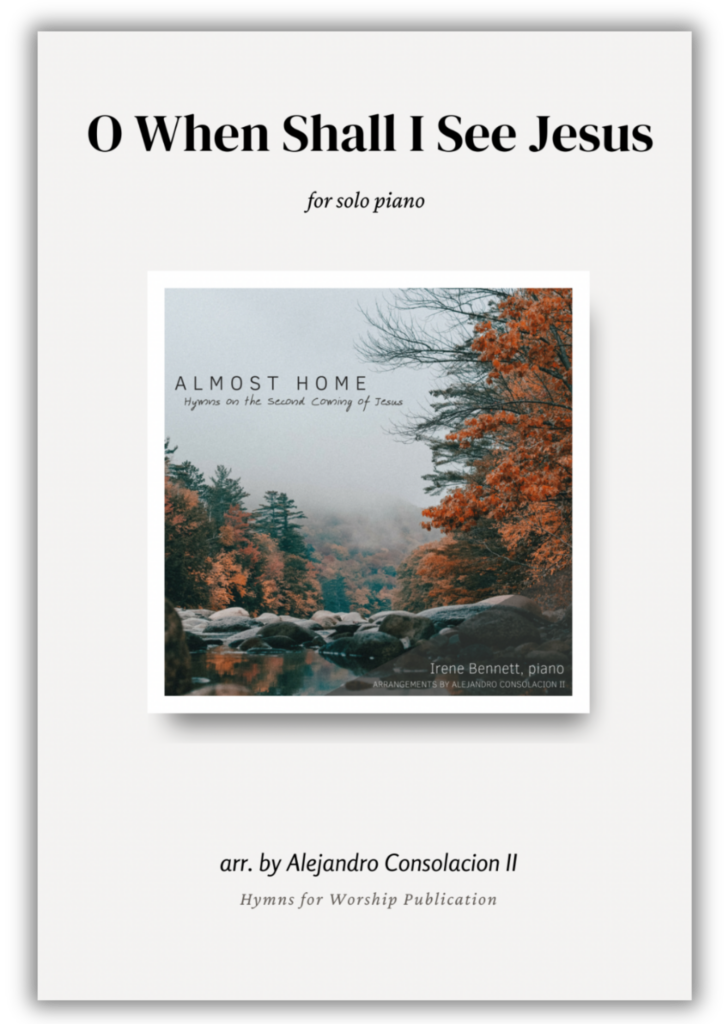
This is an 8-page arrangement for solo piano based on the hymn tune THE MORNING TRUMPET. This well-loved hymn appears in many hymnals and has been especially familiar through various Seventh-day Adventist hymn publications across the years. Alejandro Consolacion II was commissioned by the Hymns for Worship team to arrange this piece, and he powerfully captures the heartbeat of early Adventism—the urgency of Christ’s soon return, the pioneers’ deep longing as they waited, and the ache of disappointment when He did not come as expected. Barbara Irene Bennett, creator of Hymns for Worship, performs on the piano.
STANZA 3
The third stanza has a pattern: it begins with listening to singing, and it resolves by joining in the singing.
“Our ears shall hear with transport the host of heaven sing.”
That’s not everyday English, so here’s what Leland is painting in plain terms: one day, we’re going to actually hear heaven’s choir. “With transport” means carried away with joy—the kind of joy that hits when what you’ve hoped for finally becomes real.
And the “host of heaven” is Bible language for the angelic multitude. Think of the night Jesus was born—“a multitude of the heavenly host” praising God (Luke 2:13–14). Revelation zooms out even more: countless voices—angels and the redeemed together—worship filling everything (Rev. 5:11–13; 7:9–12). So Leland paints that we shall hear the heavenly host singing.
Then we come to the final line: “Our tongues shall chant the glories of our immortal King.” It won’t just be something we listen to—we’ll join in. We will be chanting and singing as well. Revelation calls it “the song of Moses… and the song of the Lamb” (Rev. 15:3)—a victory song after rescue.
The Repeating Trumpet Line
If you look at the SDA Hymnal version (#448), the phrase “and shall hear the trumpet sound in that morning” shows up twice in each stanza and then once more in the chorus. And if you take into account that the chorus is sung three times, then the congregation ends up singing that trumpet line about nine times.
That kind of repetition isn’t accidental songwriting—it’s the hook. In folk-hymn writing, repeating a single line lets everyone latch on quickly, even if they don’t know all the verses. (Old accounts of these songs even note that the whole crowd could jump in strongly on the chorus.)
So the repetition is doing two things at once. Musically, it makes the hymn accessible: people can join quickly because the refrain gives them something stable to hold onto. Spiritually, it keeps the event of Christ’s return at the center—linked to the trumpet of God, the resurrection, and the transformation of the faithful. In other words, the hymn doesn’t let this hope become vague. It keeps naming it, again and again, until the congregation can’t help but remember what they’re singing toward.
Biblically, that “trumpet” isn’t a random poetic detail—it’s a signal God repeats again and again as a marker of public, audible, decisive action. In the New Testament, Paul uses it as the sound that accompanies Christ’s return in unmistakable clarity: “the Lord himself shall descend… with the trump of God” (1 Thess. 4:16). And what happens at that sound isn’t vague or private—it’s the turning point of history: the dead in Christ rise first, and then the living who are faithful are caught up together to meet the Lord (1 Thess. 4:16–17). Paul ties the same image to transformation in 1 Corinthians: “at the last trump… the dead shall be raised incorruptible, and we shall be changed” (1 Cor. 15:51–52). So when the hymn says, “And shall hear the trumpet sound in that morning,” it’s basically compressing a whole chain of promises into one line: Christ returns → the trumpet sounds → the graves open → God’s people are changed → reunion happens.
And the hymn’s choice of the word “morning” is theologically loaded. Morning is what comes after a long night—after waiting, after grief, after the quiet of the grave. Scripture itself often frames death as sleep (like 1 Thess. 4 does), and the resurrection as the moment God wakes His people. So “morning” isn’t just a time of day; it’s an image for the end of death’s night and the beginning of a new day of life. It’s “morning” because it’s the moment when God’s faithful don’t just believe the promise anymore—they experience it. The trumpet becomes the audible line between the present world and the world to come.
There’s also a reason this line hits so strongly in congregational singing: it isn’t merely saying we’ll see something—it says we’ll hear it. That matters. In the biblical picture, the Second Coming is not something only a few perceive; it’s something that breaks into reality with sound and authority. The hymn makes it personal—I will hear it. We will hear it. And that’s why the line feels so steady and certain: it’s not describing a mood; it’s announcing an event.
So every time the hymn repeats that phrase, it’s doing more than building musical momentum. It’s anchoring the whole song to one unmistakable promise: the day is coming when God will call His people out of the grave, gather the living and the resurrected together, and make the waiting finally give way to homecoming—all at the sound of the trumpet in that morning.
Almost Home: O When Shall I See Jesus (Arr. by Alejandro Consolacion II)
It was a bit difficult to put all of these ideas into a piano arrangement. I remember having to describe to AJ Consolacion II—the arranger I commissioned—what the Adventist pioneers went through as they found themselves at Ascension Rock, waiting for Jesus to literally come on October 22, 1844. And when He didn’t, I pictured many of them asking, “If not today, then when shall I see Jesus?”
Last week’s hymn, The Three Messages, tried to capture urgency. But in this episode’s hymn, the arrangement tries to capture longing, excitement, disappointment, and hope.
So here in the first stanza, I’m picturing William Miller in the silence, studying his Bible, when he comes across Daniel 8:14.
It starts a bit distant—like the kernel or seed of truth about Christ’s coming, especially the when. At first, the timing is hazy, but it becomes clearer and clearer as he studies the meaning of the 2300 days. He seems unsure at first, but the more he studies, the more he sees biblical proof that Christ is coming very soon.
So the first ten measures of the music were meant to capture this. It starts slow, meandering—restless and distant. AJ achieves this by placing the melody in the left hand, not in the lower register, but in the middle register of the piano. The right hand plays an Alberti bass that simply repeats throughout those ten measures. (insert music)
In the measures that follow, the music swells a bit. AJ makes more use of the bass sound, with more notes filling in the harmony. There’s more confidence in how the melody is played because it moves into octaves. The left-hand broken chords become more extended, spanning almost three octaves. Here, William Miller is more confident that the prophecywill be fulfilled in his lifetime, and he has heeded the call to share what he has discovered. Small rural churches, small Bible study groups—listening to William Miller’s explanation of the 2300-day prophecy.
Let me play the first section for you so you can get a better sound picture. (insert music)
The next section is fast, florid, syncopated, and has a driving force to it. This is the section where J. V. Himes meets William Miller, and together they go out to the larger cities—bigger churches, larger groups of people listening to him. There’s urgency and electricity in the air because, according to their calculations, Jesus is coming soon—literally in just a few years.
Some people accepted it, but a lot of people rejected it. Those who believed were kicked out of their churches, and the believers began grouping together to study more. This group then became known as the Millerites. The last measure sounds like a door being shut in their faces. Let me give you the musical interpretation of that scenario. (insert music)
The following measures become a bit more tender after that, but still restless. Here, I picture the Millerites fervently studying their Bibles. The first calculated date was wrong, but further study helped them see the significance of October 22, 1844.
And so the believers left their jobs. Accounts from J. N. Loughborough say that masons and carpenters closed their shops, left their tools, and went out to help spread the message of His soon return. A farmer left his potato field unharvested, knowing there was no time. He must prepare for the soon return of Christ, which was only days away. (insert music)
The final section is the climax of the arrangement, as the people gathered at Ascension Rock to witness Christ coming in the clouds of heaven. Some gathered in their homes, barns, and backyards as they looked toward heaven. They prayed, they sang, they forgave everyone. They did this throughout the whole day as they waited and waited and waited.
AJ captures this with expansive broken chords, stretching the melody—tremolos, swirling sixteenth notes, and a melody played not only in octaves, but in full four-note chords.
As the day wore on, day turned to night, and no Jesus was in sight. Jesus did not come. Undeterred, they waited all night, lest He come and they be found sleeping. Past midnight, and the date is now October 23. The morning was quiet and heavy. The question lingers… why did He not come? And another question lingers: O when shall I see Jesus?
Here’s the climactic final section. (insert music)
If you want the full version of this music, you can listen to it on Spotify, iTunes, and Amazon Music. All links are in the show notes.
Conclusion
Before we close, I want to end with a passage that has always challenged me—in the best way. Because when you listen to the story behind this hymn, and you think about early Advent believers in 1843 and 1844, you realize they weren’t just interested in the Second Coming. They were awake. They acted on what they believed. And that raises an important question for us: what does it look like to wait for Jesus in a way that’s faithful—not frantic, not passive, but steady and true?
Listen to this:
“In this connection my mind reverted to the activity of the Advent believers in 1843 and 1844. At that time there was much house-to-house visitation, and untiring efforts were made to warn the people of the things that are spoken of in God’s Word. We should be putting forth even greater effort than was put forth by those who proclaimed the first angel’s message so faithfully. We are rapidly approaching the end of this earth’s history; and as we realize that Jesus is indeed comingsoon, we shall be aroused to labor as never before. We are bidden to sound an alarm to the people. And in our own lives we are to show forth the power of truth and righteousness. The world is soon to meet the great Lawgiver over His broken law. Those only who turn from transgression to obedience can hope for pardon and peace.”
—Ellen White, Counsels to the Church, 355.2
That’s such a strong picture—house-to-house effort, untiring labor, a people moved by conviction. And it reminds me that the pioneers knew what it felt like to wait with their whole hearts—and also what it felt like to be humbled by timing. But waiting didn’t erase the promise; if anything, it purified their hope and clarified their mission.
So here’s my practical invitation for this week: choose one concrete way to “gird on the gospel armor”—faith, hope, and love. Maybe it’s making peace with someone you’ve avoided. Maybe it’s returning to Scripture before your phone in the morning. Maybe it’s sharing hope with one person who feels tired of waiting. Because if the morning trumpet is real—and we believe it is—then our best preparation isn’t speculation. It’s faithfulness.
And if you’re in your own season of “Lord, when?” this hymn gives you language: longing, honesty, endurance—and a chorus that still points forward. One day, our waiting won’t just be waiting. It will be seeing.
And here’s my challenge for you: sometime today, open your hymnal and sing #448 slowly—one stanza at a time. Circle (or write down) one line that hits you, and turn it into a one-sentence prayer. If you want to go deeper, check the show notes: I’ve linked the sources, the blog article, and the full piano arrangement on Spotify, Apple, and Amazon. And if this episode helped you, share it with a friend or your song leader—and leave a quick rating or review so more people can find the podcast.
Until next time—open your hymnals, and let’s keep singing with understanding.