SENTENCES & RESPONSES
SDAH 682
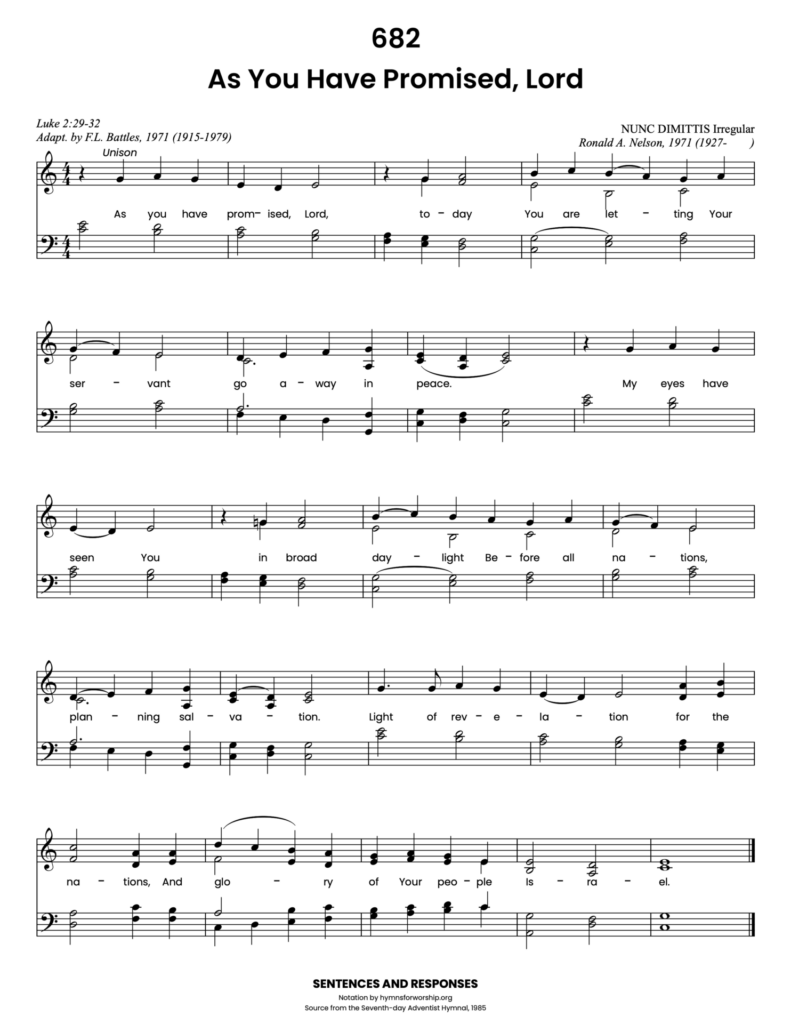
As You have promised, Lord, today,
You are letting Your servant go away in peace.
May eyes have seen You in broad daylight
before all nations, planning salvation.
Get the hymn sheet in other keys here
For Worship Leaders
Make each hymn more meaningful with these helpful tools: Short, ready-to-use hymn introductions for church bulletins, multiple ways to introduce a hymn based on your worship theme and in-depth history and insights to enrich your song service.
📖 Reference: Feel free to share but please cite hymnsforworship.org when reproducing.
Introductions for Sabbath School Song Service (based on specific lesson quarterlies):
This adaptation of Simeon’s prayer, known as the Nunc Dimittis, comes – from the first words of the Latin Vulgate version of Luke 2:29-32. Many poets have versified these words, and even in the days when only metrical versions of the psalms were permitted in church, some editors added this to the psalter, to be sung at the close of a service.
Ford Lewis Battles was born January 30, 1915, in Erie, Pennsylvania. He graduated from West Virginia University in 1936 and received his M.A. from Tufts University in 1938. Appointed a Rhodes Scholar that same year, he entered Exeter College, Oxford University, where he studied chiefly under the noted theologian and author, C. S. Lewis. During World War II he served (1940-1945) in the Air Force intelligence bureau. His Ph.D. was earned in medieval church history from the Hartford Seminary Foundation in 1950. He joined the faculty and taught there until 1966. From then until 1978 he taught at Pittsburgh Theological Seminary; his final year of service, before his death in 1979, was at Calvin Theological Seminary. Battles is known chiefly as a Calvin scholar and translator of the modern English edition of Calvin’s Institutes. He also pioneered in the use of the computer for scholarly purposes, producing a Computerized Concordance to Calvin’s Institutes. He authored John Calvin’s Commentary on Seneca’s De Clementia, The Piety of Calvin, and numerous other works. Among his many awards were the Guggenheim Fellowship and the Fullbright Award. He loved to write hymn texts and was keenly interested in drawing on the treasury of the great writings of the church for the use of modern congregations. For seven years he was a member of the hymnal committee for the United Church of Christ.
Ronald A. Nelson (his father’s name on citizenship papers reads “Nilsson”) was born April 29, 1927, in Rockford, Illinois. He graduated summa cum laude from St. Olaf College, and earned the M.Mus. degree from University of Wisconsin at Madison. During a time as a music teacher in the public schools of Rockford, he served as organist-choirmaster for Tabor Lutheran and Our Saviour’s Lutheran churches in the same city. Since 1955, he has held the position of music director for Westwood Lutheran Church, St. Louis Park, Minnesota, which includes work with eight choirs from 3-year-olds to adults, and directing the parish school, which offers instruction in sightsinging, worship, and the arts. Nelson is a highly respected clinician at music institutes, choir camps, and festivals; he has done this work in 36 states and four Canadian provinces. He does promotional and development work for Augsburg Publishing House; they have 32 of his anthems in print, plus three cantatas: The Passion According to St. Mark, How Far Is It to Bethlehem? and Who Is My Neighbor? He has other anthems in print by Calvary Press, Broadman, and Choristers Guild. A member of the hymn music committee for the Lutheran Book of Worship, 1978, Nelson wrote one of the new settings for the service of Communion. A recent letter from him gives this statement: “The primary focus of my work has been on music as ‘servant’ in worship. Most satisfying experiences come when music for a given service amplifies and expands on the theme for that particular day. The emphasis of choir school is on service -one way in which even a 3-year-old can begin to serve the church. “The primary role of all choirs is leadership in worship. This must imply quality as well as thematic unity.”
This benediction response is in the free rhythm of speech, so no time signature is given. The smoothly flowing melody arrives approximately at its climax on the word “glory.”
📖 Reference: Companion to the Seventh-day Adventist Hymnal by Wayne Hooper and Edward E. White. Review and Herald Publishing Association, 1988.

Text
As You have promised, Lord, today,
You are letting Your servant go away in peace.
May eyes have seen You in broad daylight
before all nations, planning salvation.
Light of revelation for the nations,
and glory of Your people Israel.

Hymn Info
Biblical Reference
(a) Luke 2:29-32
Adapted
F.L. Battles (1915-1979)
Year Published
1971
Performance Suggestions
Unison
Copyright
Reprinted by permission of the publisher from The Hymnal of the United Church of Christ. Copyright 1974 United Church Pres..
Hymn Tune
NUNC DIMITTIS
Metrical Number
Irregular
Composer
Robert A. Nelson, 1971 (1927-)