SENTENCES & RESPONSES
SDAH 678
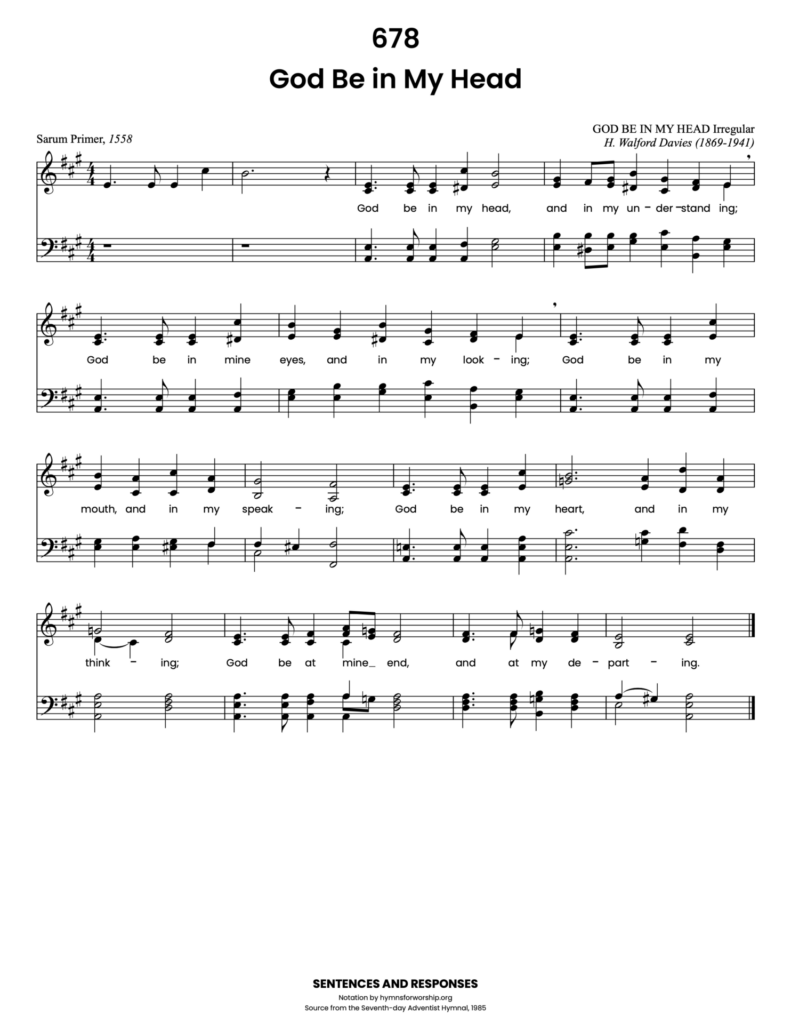
God be in my head, and in my understanding;
God be in mine eyes, and in my looking;
Get the hymn sheet in other keys here
For Worship Leaders
Make each hymn more meaningful with these helpful tools: Short, ready-to-use hymn introductions for church bulletins, multiple ways to introduce a hymn based on your worship theme and in-depth history and insights to enrich your song service.
📖 Reference: Feel free to share but please cite hymnsforworship.org when reproducing.
Introductions for Sabbath School Song Service (based on specific lesson quarterlies):
The first appearance of this beautiful devotional prayer in English was in the Book of the Hours of the Blessed Virgin, printed by Richard Pynson in London, 1514. These anonymous words were used as a personal prayer before the daily offices, or services. One earlier French source, dated from 1490, and it was in the English Sarum Primer, 1558. The first printing for congregational use was in the Oxford Hymn Book, 1908.
H. Walford Davies’ (1869-1941; see SDAH 641) tune GOD BE IN MY HEAD composed especially for these words, continues to be the universal favorite in most hymnbooks. First published in a leaflet in 1910, it was used again in the Festival Service Book of the London Church Choir Association for use at St. Paul’s Cathedral in 1912. The upward leap of interval of the sixth (a device characteristic of this composer) is used four times in the tune.
📖 Reference: Companion to the Seventh-day Adventist Hymnal by Wayne Hooper and Edward E. White. Review and Herald Publishing Association, 1988.

Text
God be in my head, and in my understanding;
God be in mine eyes, and in my looking;
God be in my mouth, and in my speaking;
God be in my heart, and in my thinking;
God be at mine end, and at my departing.

Hymn Info
Biblical Reference
(a) 1 Cor 10:31
Text Source
Sarum Primer, 1558
Copyright
Music used by permission of Oxford University Press
Hymn Tune
GOD BE IN MY HEAD
Metrical Number
Irregular
Composer
H. Walford Davies (1869-1941)