CHRISTIAN LIFE >> LOVE OF COUNTRY
SDAH 648
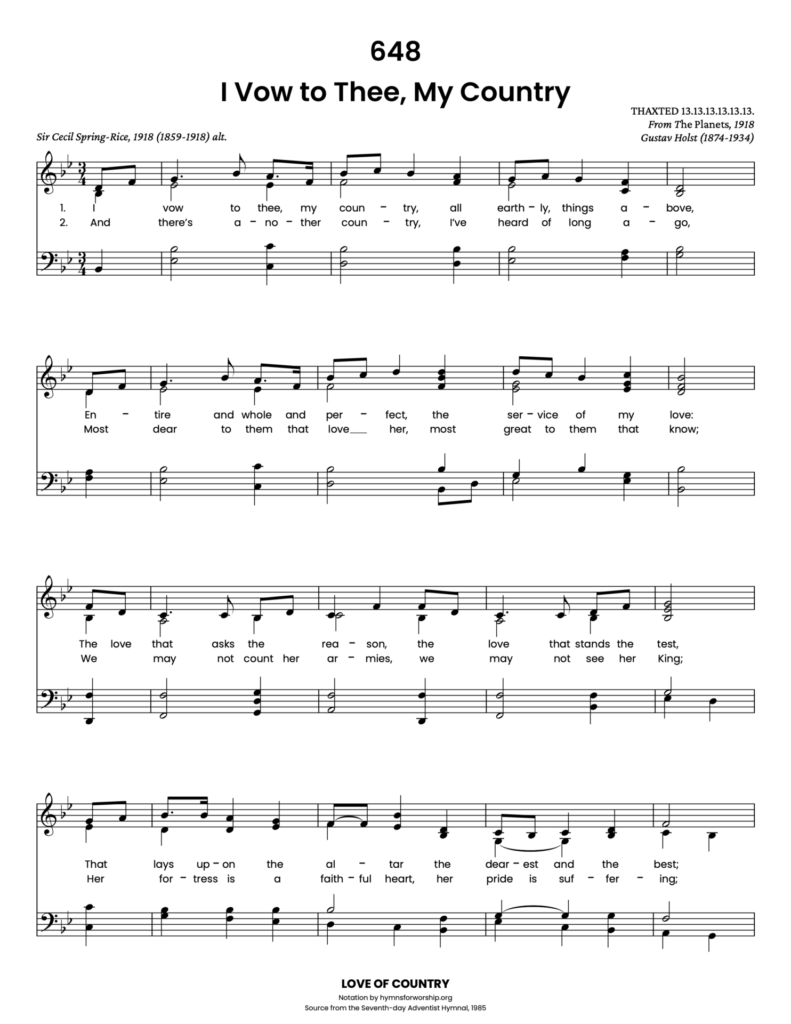
I vow to thee, my country,
all earthly things above,
Entire and whole and perfect,
the service of my love:
Get the hymn sheet in other keys here
For Worship Leaders
Make each hymn more meaningful with these helpful tools: Short, ready-to-use hymn introductions for church bulletins, multiple ways to introduce a hymn based on your worship theme and in-depth history and insights to enrich your song service.
📖 Reference: Feel free to share but please cite hymnsforworship.org when reproducing.
Introductions for Sabbath School Song Service (based on specific lesson quarterlies):
Because of the many countries served by SDAH, the committee decided not to include the specific patriotic hymns of each, but rather to have a few hymns that could be sung with fervor in any country. This one is unique in that the first stanza pledges loyalty to an earthly country and the second gives allegiance to the kingdom of God we all look forward to. Sir Valentine Chirol wrote a Memoir of Spring-Rice, in which appears this account of the origin of these lines: “Written on January 12, 1918, by Sir Cecil Arthur Spring-Rice, His Majesty’s ambassador to the United States, on the eve of his final departure from Washington. The vow recorded in them had been kept long before he put it into words, for he had served his country for a quarter of a century with the ‘love that never falters’; and, though he knew it not, he was already a dying man.” He died the very next night, January 13, 1918, in Ottawa, Canada.
After the announcement that he was leaving Washington, Spring-Rice received a letter from William Jennings Bryan, whom he very much admired. In his answer he said: “I have been reading your ‘Heart to Heart Appeals’ with great profit and satisfaction, and they have inspired me with some lines which I venture to enclose-as a sort of spontaneous outpouring. These two stanzas follow. As a hymn, it was included in several British hymnals, but to our knowledge this is the first time it has been used in the United States.
Cecil Arthur Spring-Rice was born February 27, 1859, in London, educated at Eton and Balliol, and was a secretary and clerk in the War and Foreign offices. He was knighted in 1908. He held posts as a diplomat in Brussels, Teheran, Cairo, St. Petersburg, and Sweden. From 1912 to 1918 he was ambassador to the United States. Of him Theodore Roosevelt said: “Only a man of rare unselfishness, a man completely lacking in the vulgar ambition to keep in the public eye, could in this crisis have rendered the literally invaluable service that his country-and my country, too-needed, and that Cecil rendered” (Stephen Gwynn, Letters and Friendships of Sir Cecil Spring-Rice, 1929). Poems, a book of his works, was published in 1920 after his death.
THAXTED, named for a village in Essex that boasts a seventeenth- century guild hall and a famous church, was composed by Gustav Holst (1874-1934; see SDAH 224). It is an arrangement from the melody of the Jupiter section of his major orchestral suite, The Planets. It has been characterized by Archibald Jacob in Songs of Praise Discussed, 1933, as a tune with an “Irish” flavor. One note has been altered-the final note at the end of the second score in the original goes down to a low F.
📖 Reference: Companion to the Seventh-day Adventist Hymnal by Wayne Hooper and Edward E. White. Review and Herald Publishing Association, 1988.

Text
1
I vow to thee, my country,
all earthly things above,
Entire and whole and perfect,
the service of my love:
The love that asks the reason,
the love that stands the test,
That lays upon the altar
the dearest and the best;
The love that never falters,
the love that pays the price,
The love that makes undaunted
the final sacrifice.
2
And there’s another country,
I’ve heard of long ago,
Most dear to them that love her,
most great to them that know;
We may not count her armies,
we may not see her King;
Her fortress is a faithful heart,
her pride is suffering;
And one by one and fervently
we pray for her increase,
And her ways are ways of gentleness,
and all her paths are peace.

Hymn Info
Biblical Reference
(b) Heb 11:14, Prov 3:17
Author
Sir Cecil Spring-Rice (1859-1918) alt.
Year Published
1918
Copyright
Music copyright J. Curwen & Sons. Used by permission of G. Schirmer, Inc., USA agents.
Hymn Tune
THAXTED
Metrical Number
13.13.13.13.13.13.
Composer
Gustav Holst (1874-1934)
Tune Source
from The Planets, 1918
Recommended Reading
The general idea when it comes to hymns is that there is a close bond between the author and the composer. That the author writes a hymn and the composer invents a tune to suit it, and then provides the harmony to accompany the tune. However, such wasn’t always the case.
Many hymns actually worked vice versa wherein authors would write verses according to existing tunes. Hundreds of hymns are sung from borrowed tunes, such as secular songs, chants, and even classical works. That being said, I went ahead and researched which hymns in the SDA Hymnal were originally classical works.