CHRISTIAN LIFE >> LOVE OF COUNTRY
SDAH 647
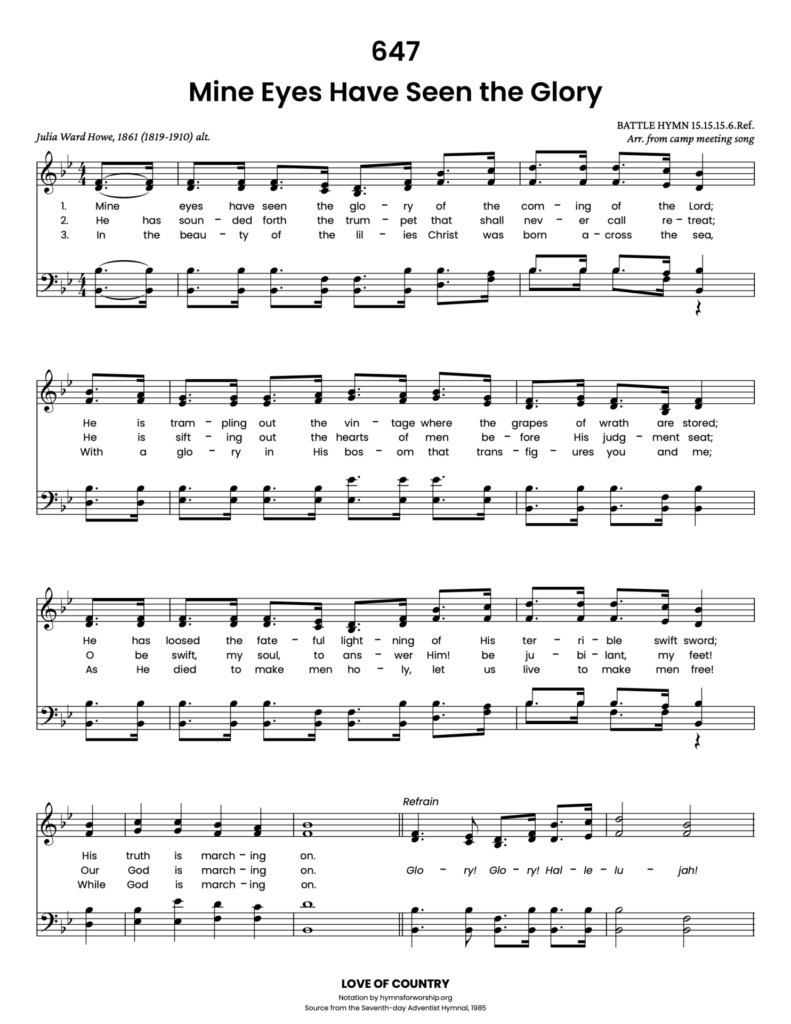
Mine eyes have seen the glory of the coming of the Lord;
He is trampling out the vintage where the grapes of wrath are stored;
He has loosed the fateful lightning of His terrible swift sword;
His truth is marching on.
Get the hymn sheet in other keys here
For Worship Leaders
Make each hymn more meaningful with these helpful tools: Short, ready-to-use hymn introductions for church bulletins, multiple ways to introduce a hymn based on your worship theme and in-depth history and insights to enrich your song service.
📖 Reference: Feel free to share but please cite hymnsforworship.org when reproducing.
Introductions for Sabbath School Song Service (based on specific lesson quarterlies):
Julia Ward Howe, a Unitarian, was born May 27, 1819, in New York but live later in Boston. She was a pioneer in women’s right and the abolition of slavery, a poet as well as a campaigner for prison reform and world peace. She preached occasionally in Unitarian Churches. In 1848 she married S. G. Howe, who had similar ideas and interests. Julia Howe wrote several books and collections of verse. She died October 17, 1910, at Newport, Rhode Island. In the April 1976 issue (official organ of the Hymn Society of America) T. J. Trimborn tells this story of how the hymn came to be written:
“On November 20, 1861, one of many Union troop reviews held during the Civil War took place at Baileys Crossroads, Virginia, a short distance from Washington. President Abraham Lincoln, Cabinet officers, diplomats, other dignitaries with their wives and families, and 25,000 spectators were in attendance to review the assembled regiments. .
“That night one of the multitude of spectators did not sleep well, and in her reminiscences wrote why. ‘On the return from the review of troops near the city, to beguile the rather tedious drive we sang from time to time snatches of the army songs so popular at that time, concluding I think with “John Brown’s Body” [a song about a militant abolitionist hanged in Charles Town for his fight against slavery].’ The Reverend James Clarke, who had accompanied the woman and her husband that day, suggested that she write some words more suitable for the stirring tune. And so it was that that night this chance remark kept coming back to her mind. Finally she arose from bed, found in the dimness an old stump of a pen, and without hesitation scrawled several verses almost without looking at the paper. Julia Ward Howe had realized the inspiration for a song-music which would later touch President Lincoln deeply and stir the hearts of a whole people to become not merely a timely melody but a national musical treasure.’
In 1864 President Lincoln attended the second anniversary meeting of the Christian Commission (a volunteer organization that gathered food and supplies for and gave medical help to combat soldiers), held in the House of Representatives. After many speeches, the “singing Methodist chaplain,” Charles C. McCabe, told a chilling account of his capture and imprisonment in the Confederate Libby Prison at Richmond, Virginia, and closed by singing this song, which he had taught to the other prisoners; “Mine eyes have seen the glory of the coming of the Lord.” When he got to the chorus, “Glory! glory! Hallelujah!” the entire audience and band joined in. Before the last notes died away, a voice was heard; “Sing it again!” It was the voice of none other than President Lincoln. “The Battle Hymn” was duly repeated with great fervor, Mr. Lincoln standing, his voice raised in song, tears streaming down his cheeks, obviously very moved.
The tune BATTLE HYMN, so named for its use by the Yankee soldiers in the Civil War, was in constant use for a number of texts long before the Civil War, including the camp meeting song, “Say, Brothers, Will You Meet Us.” It has been claimed by William Steffe, organist and choirmaster of camp meeting festivals, who probably borrowed it from an earlier secular song melody composed by a Philadelphia musician.
📖 Reference: Companion to the Seventh-day Adventist Hymnal by Wayne Hooper and Edward E. White. Review and Herald Publishing Association, 1988.

Text
1
Mine eyes have seen the glory of the coming of the Lord;
He is trampling out the vintage where the grapes of wrath are stored;
He has loosed the fateful lightning of His terrible swift sword;
His truth is marching on.
Refrain
Glory! Glory! Hallelujah! Glory! Glory! Hallelujah!
Glory! Glory! Hallelujah! His truth is marching on.
2
He has sounded forth the trumpet that shall never call retreat;
He is sifting out the hearts of men before His judgment seat;
O be swift, my soul, to answer Him! be jubilant, my feet!
Our God is marching on.
3
In the beauty of the lilies Christ was born across the sea,
With a glory in His bosom that transfigures you and me;
As He died to make men holy, let us live to make men free!
While God is marching on.

Hymn Info
Biblical Reference
(a) Matt 24:30, Isa 63:3 (b) Zec 9:14, Dan 5:27 (c) Luk 2:11 (r) 2 Cor 13:8
Author
Julia Ward Howe (1819-1910) alt.
Year Published
1861
Hymn Tune
BATTLE HYMN
Metrical Number
15.15.15.6.Ref.
Arranger
from a camp meeting song