CHRISTIAN LIFE >> LOVE OF COUNTRY
SDAH 646
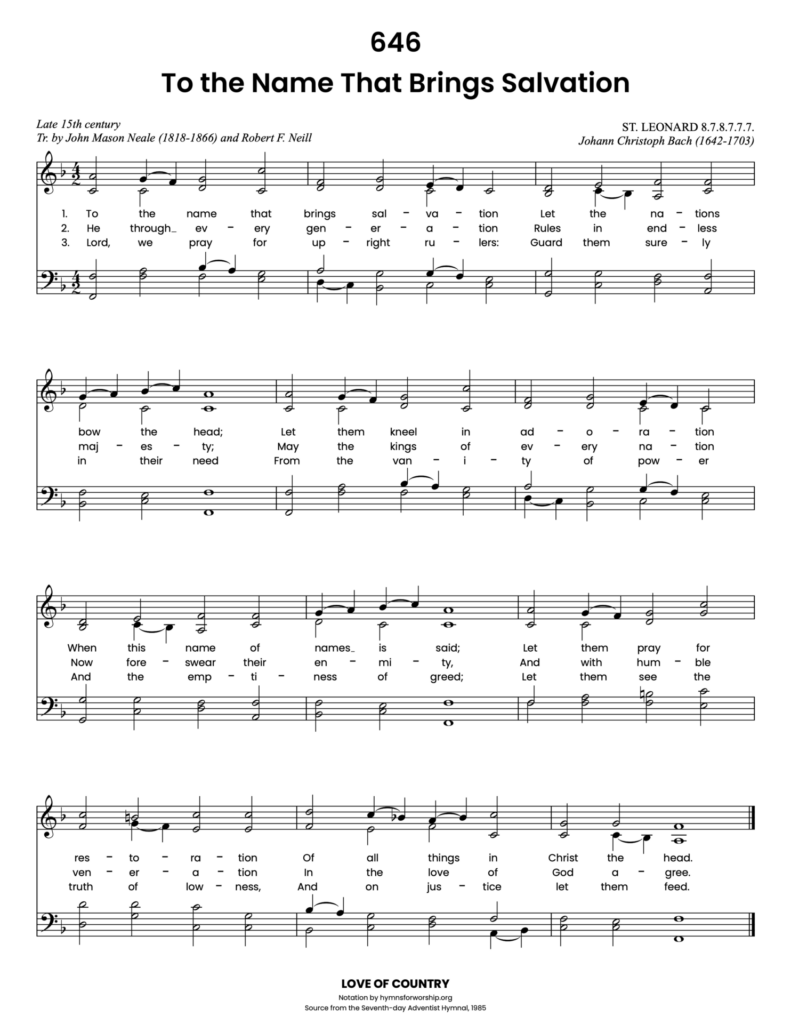
To the name that brings salvation
Let the nations bow the head;
Let them kneel in adoration
When this name of names is said;
Get the hymn sheet in other keys here
For Worship Leaders
Make each hymn more meaningful with these helpful tools: Short, ready-to-use hymn introductions for church bulletins, multiple ways to introduce a hymn based on your worship theme and in-depth history and insights to enrich your song service.
📖 Reference: Feel free to share but please cite hymnsforworship.org when reproducing.
Introductions for Sabbath School Song Service (based on specific lesson quarterlies):
An anonymous hymn in Latin entitled “Gloriosi Salvatoris” (“of the glorious Savior”), it comes from the Antwerp Breviary, 1446, and the Meissen Breviary, Liege, C. 1510. John M. Neale (1818-1866; see Biographies), who translated it in his Mediaeval Hymns, 1851, claimed that it was the first rendering in English and said concerning the original, “A German hymn on the Festival of the Holy Name of Jesus.” It is based on Acts 4:12, “Neither is there salvation in any other: for there is none other name under heaven given among men, whereby we must be saved.”
The version SDAH uses was adapted by Robert F. Neill and printed in the New Saint Basil Hymnal. This version, however, is a translation of the first line only of the original hymn, which directs the rulers of the nations to settle their differences by humbly submitting to the King of kings. The remaining five stanzas enlarge on the different aspects of the name of Jesus: name of gladness, name of adoration, name of music and wisdom, name exalted and strong, and finally a name to be written in the heart. The present hymn is therefore not to be credited to Neale, except the first line only.
While it is basically a hymn extolling the name of Jesus, the language forcefully reminds us that ideally the rulers of the nations could profit by giving their allegiance to “Christ the head.”
ST. LEONARD is a typical German chorale of the late seventeenth century, most often attributed to Johann Christoph Bach, the second cousin of the great J. S. Bach. It was printed in Neuvermehrtes Meiningisches Gesangbuch (New Enlarged Meiningen Hymnal), 1693, and later taken up by many other German collections.
Johann Christoph Bach was born December 8, 1642, at Arnstadt, near Erfurt, now East Germany. At the age of 23 he became organist at Eisenach, and stayed there until his death on March 31, 1703, 38 years later. He was bold for his time in the use of daring harmonies, and he excelled in writing vocal music. A setting he made of Revelation 12:7-12 for two choirs of five voices each, plus strings, bassoon, trumpets, tympani, and organ, was performed by J. S. Bach at Leipzig on a scale that profoundly impressed his peers.
📖 Reference: Companion to the Seventh-day Adventist Hymnal by Wayne Hooper and Edward E. White. Review and Herald Publishing Association, 1988.

Text
1
To the name that brings salvation
Let the nations bow the head;
Let them kneel in adoration
When this name of names is said;
Let them pray for restoration
Of all things in Christ the head.
2
He through every generation
Rules in endless majesty;
May the kings of every nation
Now foreswear their enmity,
And with humble veneration
In the love of God agree.
3
Lord, we pray for upright rulers:
Guard them surely in their need
From the vanity of power
And the emptiness of greed;
Let them see the truth of lowness,
And on justice let them feed.

Hymn Info
Biblical Reference
(a) Acts 4:12, Eph 5:23
Translator
John Mason Neale (1818-1866) and Robert F. Neill
Hymn Tune
ST. LEONARD
Metrical Number
8.7.8.7.7.7.
Composer
Johann Christoph Bach (1642-1703)