CHRISTIAN LIFE >> Watchfulness
SDAH 602
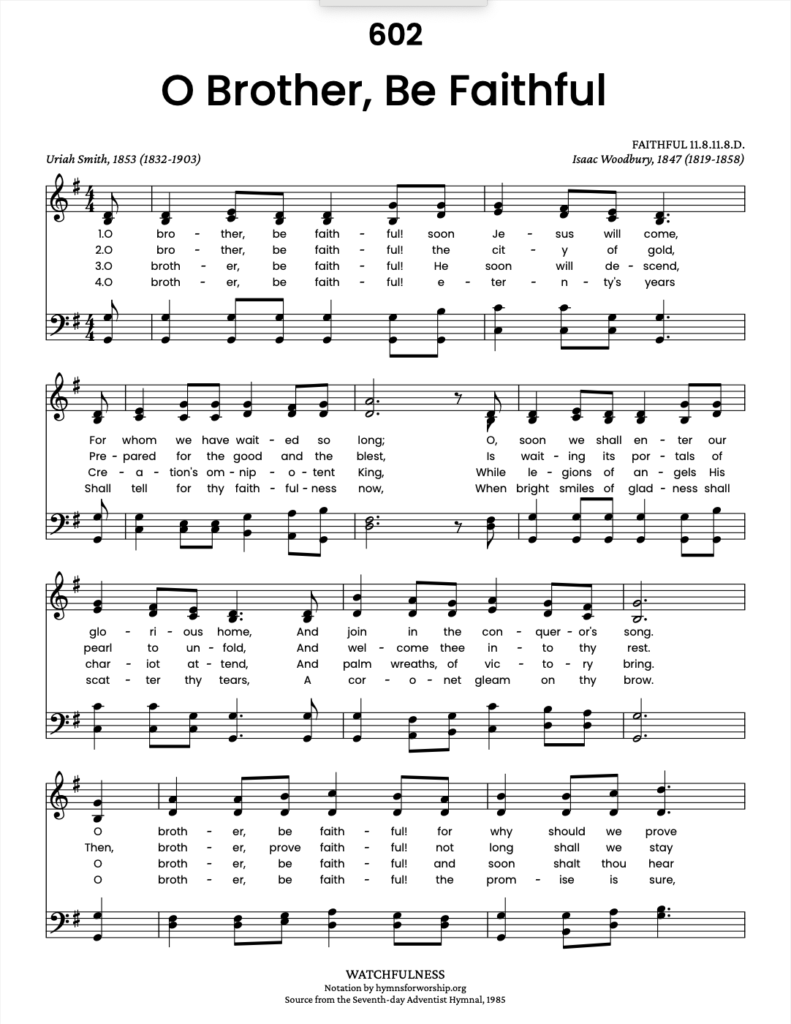
O brother be faithful! soon Jesus will come,
For whom we have waited so long;
O, soon we shall enter our glorious home,
And join in the conqueror’s song.
This hymn appears in:
Get the hymn sheet in other keys here
For Worship Leaders
Make each hymn more meaningful with these helpful tools: Short, ready-to-use hymn introductions for church bulletins, multiple ways to introduce a hymn based on your worship theme and in-depth history and insights to enrich your song service.
📖 Reference: Feel free to share but please cite hymnsforworship.org when reproducing.
Introductions for Sabbath School Song Service (based on specific lesson quarterlies):
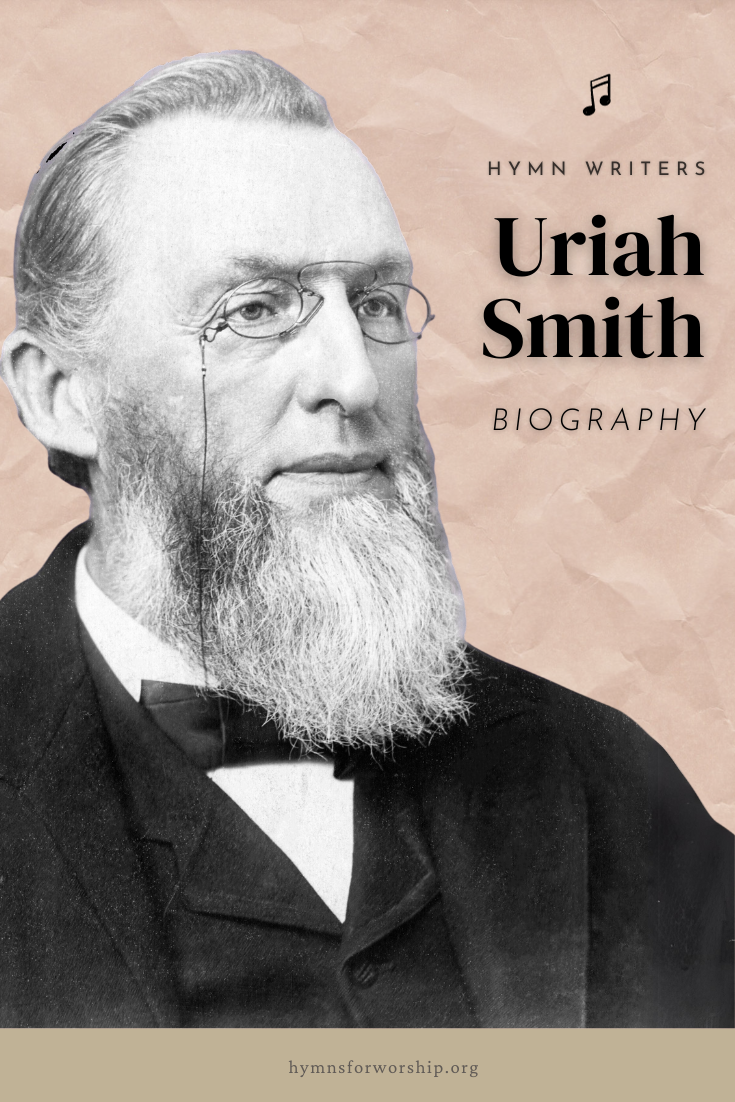
The author of this hymn, Uriah Smith, was born on May 2, 1832, in West Wilton, New Hampshire. In his boyhood he followed William Miller’s teachings, but after the disappointment in 1844, when the Lord did not return to earth, he lost interest in religion. However, he was reconverted in 1852 and in the next year joined the staff of the Review and Herald to begin what was to be a period of 50 years of denominational service. He edited the Review for many years; invented a school desk; because his own artificial leg hampered his movement, patented a better artificial leg; was an accomplished writer and a deep student of the Word of God; and was was a pillar of the Seventh-day Adventist church in its developing and expanding years. He was secretary of the General Conference for five different periods totaling 21 years, and treasurer for one year, 1876-1877. He died March 6, 1903, at Battle Creek, Michigan. He is probably best known as the author of the monumental work Thoughts on Daniel and the Revelation. The words of this hymn are a fit epitaph of his own life, which was remarkable for its faithfulness to duty. The poem appeared on the front page of the Review and Herald, September 27, 1853, with instructions to be sung to the tune of the song “Be Kind to the Loved Ones at Home.” As would be expected, the hymn is replete with allusions to the Scriptures.
The tune suggested by Smith was to a secular song beginning “Be kind to thy father, for when thou wert young.” The song was written in 1847 by Jacob E. Hosmer, and the tune by Isaac Baker Woodbury (1819-1858) of Beverly, Massachusetts. At 13 years of age Woodbury went to Boston to learn music, but learned the trade of blacksmithing. However, music was the dominant factor in his life, and he played, edited, learned, and composed music. He learned the violin and promoted singing in schools and in choirs. At the age of 19 he went for a year’s study of music to London and to Paris. The first of many visits to Europe. He founded a musical association in Vermont and composed many popular secular songs. In 1849 he moved to New York, where he became a music teacher, and edited The Musical Review and The Musical Pioneer. With help from others he compiled the Boston Musical Education Society’s Collection of Church Music in 1842 and The Choral in 1845. Another of his publication was The New Lute of Zion in which he stated his philosophy of music was to worship God in simple song rather than to treat music as a form of art. Woodbury never enjoyed good health; on a trip to seek a cure in the southern United States he died at Columbia, South Carolina, in 1858, at the early age of 39.
The song “Be Kind to Thy Father” appeared as a gospel song in the American Sunday School Hymn Book, 1860, for it does promote the Christian grace of kindness. The three other stanzas begin “Be kind to thy mother,” “Be kind to thy brother,” “Be kind to thy sister,” respectively.
📖 Reference: Companion to the Seventh-day Adventist Hymnal by Wayne Hooper and Edward E. White. Review and Herald Publishing Association, 1988.
The Transformation of the Hymn ‘O Brother, Be Faithful’
Today’s congregational singing scene in many Protestant churches is a far cry from what it had been a couple hundred years ago. Aside from the simplicity with which their song service were carried on, their hymnals then were also very different in that it did not contain written notes. At best, it contained words, with a few indications of a metric index — a system that helped them quickly match the verses with a particular tune. Today, churches have fancy hard bound hymnals with notes in 4-part voices, and a companion book to supplement the hymnals in case more information is needed about the hymns.
RELATED POSTS


Text
1
O brother be faithful! soon Jesus will come,
For whom we have waited so long;
O, soon we shall enter our glorious home,
And join in the conqueror’s song.
O brother be faithful!
for why should we prove
Unfaithful to Him who had shown
Such deep, such unbounded and infinite love
Who died to redeem us His own.
2
O brother be faithful! the city of gold,
Prepared for the good and the blest,
Is waiting its portals of pearl to unfold,
And welcome thee into thy rest.
Then, brother be faithful!
not long shall we stay
In weariness here, and forlorn,
Time’s dark night of sorrow is wearing away,
We haste to the glorious morn.
3
O brother be faithful! He soon will descend,
Creation’s omnipotent King,
While legions of angels His chariot attend,
And palm wreaths, of victory bring.
O brother be faithful!
and soon shalt thou hear
They Savior pronounce the glad word,
Well done, faithful servant, they title is clear,
To enter the joy of thy Lord.
4
O brother be faithful! eternity’s years
Shall tell for thy faithfulness now,
When bright smiles of gladness shall scatter thy tears,
A coronet gleam on thy brow.
O brother be faithful!
the promise is sure,
That waits for the faithful and tried;
To reign with the ransomed, immortal and pure,
And ever with Jesus abide.

Hymn Info
Biblical Reference
(a) Matt 25:21; Isa 25:9; Eph 3:18, 19 (b) Rev 21:18, 21 (c) Matt 16:27; Rev 7:9; Matt 25:21 (d) Jas 1:12
Author
Uriah Smith (1832-1903)
Year Published
1853
Theme
WATCHFULNESS
Hymn Tune
FAITHFUL
Metrical Number
11.8.11.8.D.
Composer
Isaac Woodbury (1819-1858)
Year Composed
1847