CHRISTIAN LIFE >> Guidance
SDAH 555
Shepherd of tender you,
Guiding in love and truth,
Through devious way;
Christ our triumphant King,
Get the hymn sheet in other keys here
For Worship Leaders
Make each hymn more meaningful with these helpful tools: Short, ready-to-use hymn introductions for church bulletins, multiple ways to introduce a hymn based on your worship theme and in-depth history and insights to enrich your song service.
📖 Reference: Feel free to share but please cite hymnsforworship.org when reproducing.
Introductions for Sabbath School Song Service (based on specific lesson quarterlies):
This hymn is the earliest Christian one extant. It appeared in a book of philosophy, written in Greek, entitled The Tutor. The author was Titus Flavius Clemens (c. 170-c. 220), known as Clement of Alexandria. Born in Athens, he had a very inquiring mind and seriously studied Assyrian, Egyptian, Greek, and Jewish sources in order to discover truth. He moved to Alexandria and, after studying the writings of the early Christian fathers, was converted to Christianity. He became a teacher and later the principal in the Christian school in Alexandria. The purpose of his book was to present Jesus Christ as the perfect tutor and to erect a bulwark against the inroads of paganism. Under the persecution of Christians during the reign of the emperor Lucius Septimius Severus, c. A.D. 203, Clemens fled; he is presumed to have died about the year A.D. 220.
The Tutor included two poems, this one entitled “A Hymn of the Savior.” The complete hymn presents many types of Christ, some of them not found in the Scriptures, for example: Bridle of colts untamed, Wing of wandering birds, Rudder of youth unbending, Shepherd with wisdom tending, Curb of the stubborn steed, Helm for the ships. The four stanzas of the SDAH hymn present Him as King, Lord, Word, High Priest, Guide, Shepherd, and the Christ. The hymn was translated freely from the Greek in 1846 by Henry Martyn Dexter for use in his sermon based on Deuteronomy 32:7: “Remember the days of old,” in which he preached on some prominent characteristics of early Christians.
Dexter was born in Plympton, Massachusetts, on August 13, 1821, and educated at Yale and Andover Theological Seminary. In 1844 he was ordained as a Congregational minister and appointed to Manchester, New Hampshire. He moved to Boston in 1848 and ministered there until 1867, when he became editor of The Congregationalist. His hymn had appeared in this magazine on December 21, 1849. Dexter died in 1890.
KIRBY BEDON, which means “the church near Bedon,” a village near Norwich, Norfolk, England, was composed in 1887 by Edward Bunnett. He was born on June 26, 1834, in Norfolk. He was a chorister in the Norwich Cathedral, then he worked as a deputy organist there, with Zechariah Buck, for 22 years. A good singer also, he sang “Lift Thine Eyes” with the famous Jenny Lind and a Miss Dolby in 1849. For some years he was organist at St. Peter Mancroft, conducted the Norwich Musical Union, and was organist for the Norwich Musical Festivals. He wrote cantatas, hymn tunes, carols, anthems, part-songs, service music, and organ pieces. He died January 5, 1923.
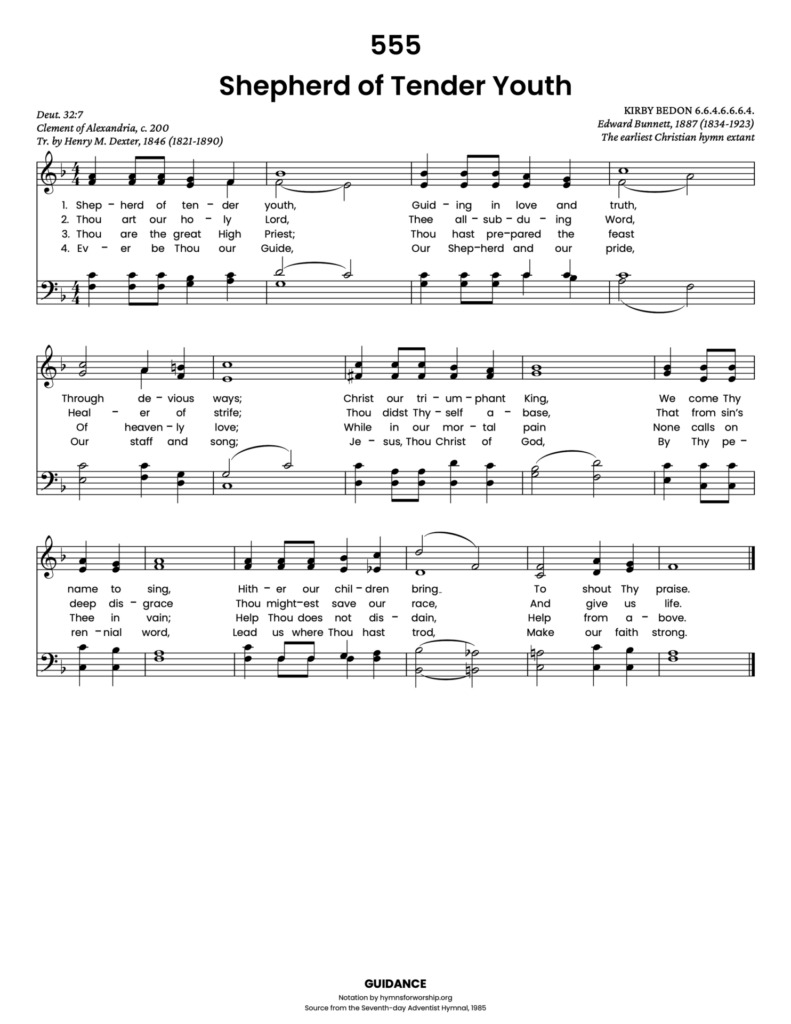
The melody shows an interesting structure-phrases 1, 2, 4, 5, and 6 each have a quarter note followed by two eighth notes. Furthermore, phrase 2 is exactly one tone above phrase 1, and phrase 4 is exactly one tone above 5. Then in contrast, phrase 6 ascends, whereas the other phrases mentioned descend. Each one of the four parts has an interesting melody of its own.
📖 Reference: Companion to the Seventh-day Adventist Hymnal by Wayne Hooper and Edward E. White. Review and Herald Publishing Association, 1988.

Text
1
Shepherd of tender you,
Guiding in love and truth,
Through devious way;
Christ our triumphant King,
We come Thy name to sin,
Hither our children bring
To shout Thy praise.
2
Thou are our holy Lord,
Thee all subduing Word,
Healer of strife;
Thou didst Thyself abase,
That from sin’s deep disgrace
Thou mightest save our race,
And give us life.
3
Thou are the great High Priest;
Thou has prepared the feast
Of heavenly love;
While in our mortal pain
None call on Thee in vain;
Help Thou does not disdain,
Help from above.
4
Ever be Thou our Guide,
Our Shepherd and our pride,
Our staff and song;
Jesus, Thou Christ of God,
By Thy perennial word,
Lead us where Thou hast trod,
Make our faith strong.

Hymn Info
Biblical Reference
Deut 32:7 (a) John 10:11; Rev 17:14 (b) John 1:1; Phil 2:7 (c) Heb 3:1 (d) Luke 9:20
Author
Clement of Alexandria
Translator
Henry M. Dexter, 1846 (1821-1890)
Text Source
c. 200, the earliest Christian hymn extant
Hymn Tune
KIRBY BEDON
Metrical Number
6.6.4.6.6.6.4.
Composer
Edward Bunnett (1834-1923)
Year Composed
1887