CHRISTIAN LIFE >> Guidance
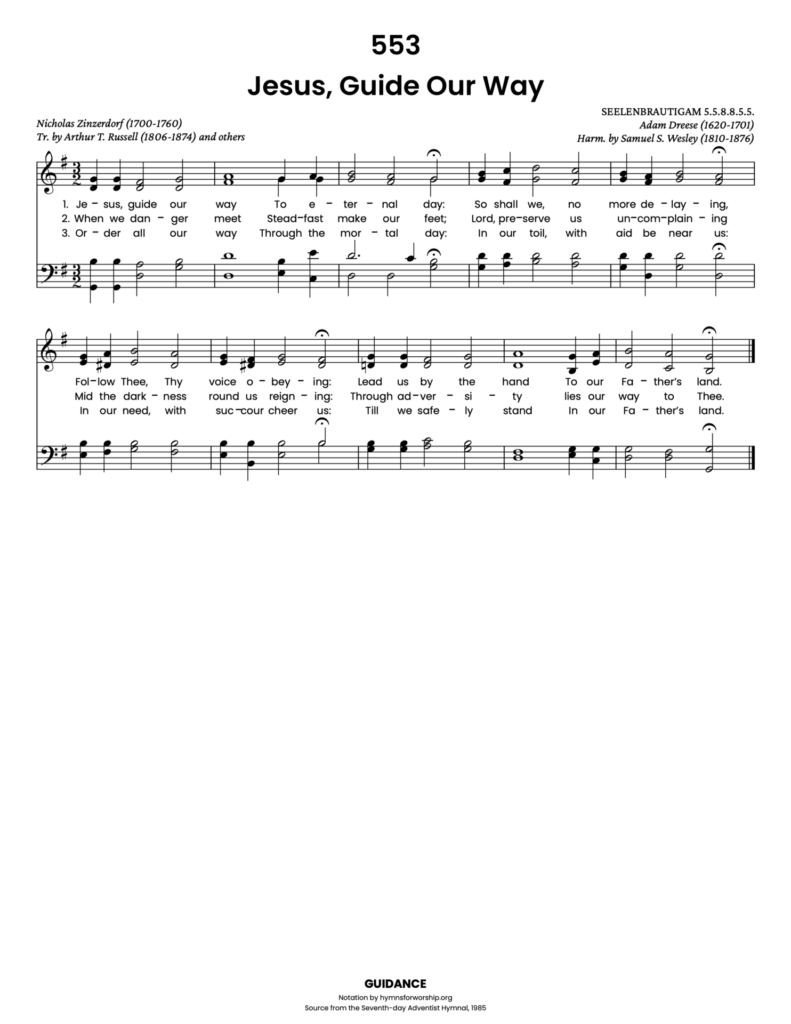
SDAH 553
Shepherd of tender you,
Guiding in love and truth,
Through devious way;
Christ our triumphant King,

Get the hymn sheet in other keys here
For Worship Leaders
Make each hymn more meaningful with these helpful tools: Short, ready-to-use hymn introductions for church bulletins, multiple ways to introduce a hymn based on your worship theme and in-depth history and insights to enrich your song service.
📖 Reference: Feel free to share but please cite hymnsforworship.org when reproducing.
Introductions for Sabbath School Song Service (based on specific lesson quarterlies):
Count Nicholaus Ludwig von Zinzendorf (1700-1760; see SDAH 177), was the author of this hymn. Actually, it is a combination of two of his other hymns, namely three stanzas from Seelenbräutigam (Souls of the Bridegroom), written in September 1721, and one stanza from Glanz der Ewigkeit (Brightness of Eternity), written in May of the same year. The combination appeared as four stanzas of six lines each in the Brüder Gesangbuch (Hymnal for the Brethren) of 1778, a considerable condensation of the 11 stanzas and 15 stanzas, respectively, of the hymns mentioned above. Its title was “Jesu geh’ voran” (Jesus, Go Before, or Lead the Way). The SDAH translation is by Arthur Tozer Russell; it was made in 1846 and appeared in his Psalms and Hymns, 1851. Zinzendorf also wrote SDAH 177, “Jesus, Your Blood and Righteousness,” translated by John Wesley.
Russell was born on March 20, 1806, at Northhampton in the East Midlands of England. He was the son of a minister, Thomas Clout, who changed his name to Russell. The son followed his father’s calling and trained for the ministry at Cambridge University; he was ordained in 1829. He was vicar at Caxton, near Cambridge, for 22 years, then in Liverpool for 14 years, followed by seven years at Wrockwardine, near Telford in Shropshire. His last appointment was as rector at Southwick, near Brighton, but after only a few months there, he died on November 18, 1874. He wrote several theological works and biographies, and composed some hymn tunes, as well as two other collections of hymns.
SEELENBRÄUTIGAM is a melody composed in 1697 by Adam Drese for his hymn that began, as did Zinzendorf’s, with the depiction of Jesus as the bridegroom of souls. The melody proceeds almost entirely by steps, and the first score melody is repeated in the last score. Drese was born in Darmstadt in December 1620 and was sponsored by Duke Wilhelm of Weimar to study in Warsaw. On his return to Weimar in 1655 he was appointed choir director. When the duke died in 1662, his son took Drese to years later. Jena as his secretary; he appointed him as mayor of the town 10 years later.
In 1683 Prince Anton Gunther appointed him as choir director at Arnstadt, not far west of both Weimar and Jena, where he died on February 15, 1701. He was a devout Pietist and is said to have burned all his opera and secular compositions after he was converted. Pietism was a movement in Germany that emphasized practical religion in a Lutheranism that had become arid and formal.
The tune was harmonized by Samuel Sebastian Wesley (1810-1876; see SDAH 273).
📖 Reference: Companion to the Seventh-day Adventist Hymnal by Wayne Hooper and Edward E. White. Review and Herald Publishing Association, 1988.

Text
1
Jesus, guide our way
To eternal day:
So shall we, no more delaying,
Follow Thee, Thy voice obeying:
Lead us by the hand
To our Father’s land.
2
When we danger meet
Steadfast make our feet;
Lord, preserve us uncomplaining
Mid the darkness round us reigning:
Through adversity lies our way to Thee.
3
Order all our way
Through the mortal day:
In our toil, with aid be near us:
In our need, with succor cheer us:
Till we safely stand
In our Father’s land.

Hymn Info
Biblical Reference
(a) Ps 48:14 (b) Ps 27:3 (c) Ps 27:11
Author
Nikolaus Zinzendorf (1700-1760)
Translator
Arthur T. Russell (1806-1874) and others
Hymn Tune
SEELENBRAUTIGAM
Metrical Number
5.5.8.8.5.5.
Composer
Adam Dreese (1620-1701)
Harmonized
Samuel S. Wesley (1810-1876)