CHRISTIAN LIFE >> Guidance
SDAH 547
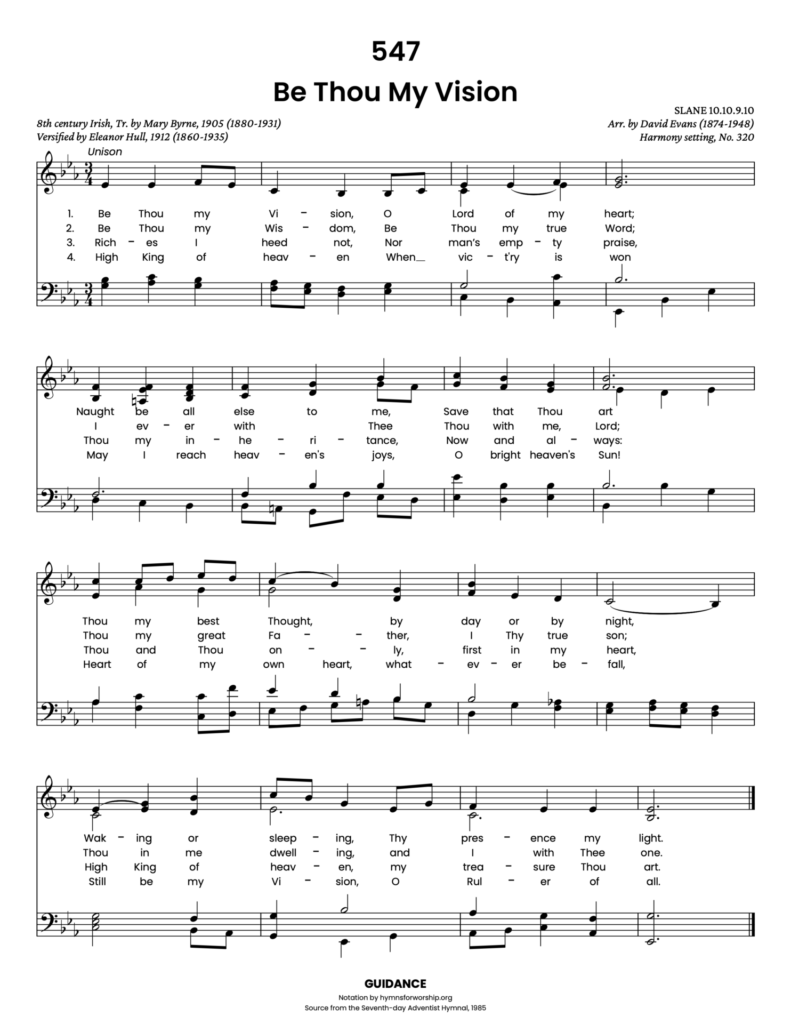
Be Thou my Vision,
O Lord of my heart;
Naught be all else to me,
save that Thou art
Get the hymn sheet in other keys here
For Worship Leaders
Make each hymn more meaningful with these helpful tools: Short, ready-to-use hymn introductions for church bulletins, multiple ways to introduce a hymn based on your worship theme and in-depth history and insights to enrich your song service.
📖 Reference: Feel free to share but please cite hymnsforworship.org when reproducing.
Introductions for Sabbath School Song Service (based on specific lesson quarterlies):
Mary Elizabeth Byrne (born in Dublin on July 2, 1880), an authority Lon ancient Irish religious poetry, coauthored the Old and Mid-Irish Dictionary for the Royal Irish Academy. She translated this poem, which dates from the eighth century, and published it as prose in the Irish journal, Erin, Vol. II. She died in Dublin on January 19, 1931. Eleanor Henrietta Hull, born January 15, 1860, in Manchester, brilliant author, and founder of the Irish Text Society, reduced the 16 prose couplets to 12 rhymed ones and published them in her Poem Book of the Gael, 1912. She died at Wimbledon, January 13, 1935. Most hymnals print only eight of the couplets, arranged in four stanzas. Two other couplets form the omitted third stanza:
Be Thou my battle-shield, my sword for the fight, Be Thou my dignity, Thou my delight;
Thou my soul’s shelter, Thou my high Tower: Raise Thou me heavenward, O Power of my power.
SLANE is the name of a hill near Tara in County Meath, Ireland, where it is said Saint Patrick (c. 389-461) lit the Paschal fire on Easter Eve, going against the Druid priests’ order that no one light the fire before theirs was lit. The melody comes from an Irish folk song, “With My Love on the Road,” published by Patrick Weston Joyce in Old Irish Folk Music and Songs, 1909. The melodic structure is ABCD, that is, all four lines are different, with no repetition as found in most hymns. Typically Irish is the wide range and the final ending on three repeated tonic notes. The tune was first used with these words in the English Church Hymnary, 1927, as arranged by David Evans (1847-1948; see Biographies), the great Welsh music teacher and composer. SLANE is also used for SDAH 320, “Lord of Creation,” with different harmony.
📖 Reference: Companion to the Seventh-day Adventist Hymnal by Wayne Hooper and Edward E. White. Review and Herald Publishing Association, 1988.

Text
1
Be Thou my Vision,
O Lord of my heart;
Naught be all else to me,
save that Thou art
Thou my best Thought,
by day or by night,
Waking or sleeping,
Thy presence my light.
2
Be Thou my Wisdom,
and Thou my true Word;
I ever with Thee
and Thou with me, Lord;
Thou my great Father,
I Thy true son;
Thou in me dwelling,
and I with Thee one.
3
Riches I heed not,
nor man’s empty praise,
Thou mine Inheritance,
now and always:
Thou and Thou only,
first in my heart,
High King of Heaven,
my Treasure Thou art.
4
High King of Heaven,
my victory won,
May I reach Heaven’s joys,
O bright Heaven’s Sun!
Heart of my own heart,
whatever befall,
Still be my Vision,
O Ruler of all.

Hymn Info
Biblical Reference
(b) 1 Cor 1:30; 1 Cor 3:16
Author
Versified by Eleanor Hull, 1912 (1860-1935)
Translator / Paraphrase
Mary Byrne (1880-1931)
Performance Suggestions
Unison
Text Source
8th century Irish
Year Published
1905
Copyright
Words from The Poem Book of the GAel, edited by Eleanor Hull, by permission of the Editor’s Estate and Chatto & Windus. Arrangement from the Revised Church Hymnary 1927 by permission of Oxford University Press.
Theme
GUIDANCE
Hymn Tune
SLANE
Metrical Number
10.10.9.10.
Arranged
David Evans (1874-1948)
Alternate Harmony
SDAH 320