CHRISTIAN LIFE >> Guidance
SDAH 541
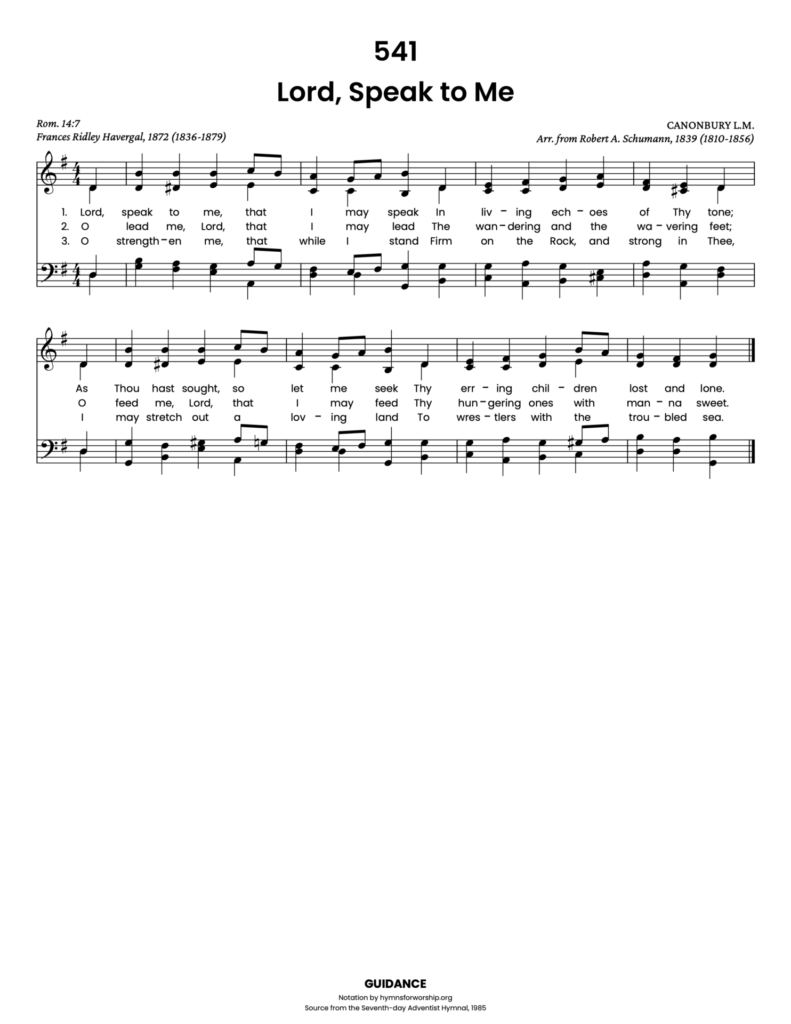
Lord, speak to me, that I may speak
in living echoes of thy tone;
as thou has sought, so let me seek
thine erring children lost and lone.
Get the hymn sheet in other keys here
For Worship Leaders
Make each hymn more meaningful with these helpful tools: Short, ready-to-use hymn introductions for church bulletins, multiple ways to introduce a hymn based on your worship theme and in-depth history and insights to enrich your song service.
📖 Reference: Feel free to share but please cite hymnsforworship.org when reproducing.
Introductions for Sabbath School Song Service (based on specific lesson quarterlies):
Frances Ridley Havergal (1836-1879; see Biographies) wrote this hymn at Winterdyne, near Bewdley, Worcestershire, on April 28, 1872, under the title “A Prayer, ‘None of Us Liveth Unto Himself.” ” SDAH has the first three stanzas only. Many of Havergal’s poems were first printed as leaflets. This one was printed by William Parlane in 1872.
CANONBURY is an arrangement from a piano piece taken from “Nachtstücke,” Opus 23, composed in 1839 by Robert Alexander Schumann. He was born June 8, 1810, at Zwickau, south of Leipzig, East Germany. When he was 16 his father died, and his mother sent him to Leipzig to study law. However, he devoted much of his time to the study of piano, and in spite of being sent to Heidelberg and then to Italy, he pursued his musical interest. In 1840 he married Clara Wieck, the daughter of his former piano teacher. She was an excellent pianist and was instrumental in making her husband’s compositions known. Unfortunately, Schumann suffered a permanent injury to his right hand in 1832 and was forced to give up his career as a pianist. However, he concentrated successfully on composition and produced a large number of piano pieces and songs, as well as symphonies, choral works, and chamber music. Toward the end of his life he suffered severe depression and attempted to drown himself in the Rhine in 1854. His last two years were spent, at his own request, in an asylum near Bonn; he died July 29, 1856.
CANONBURY is also used for SDAH 548, “Now Praise the Hidden God of Love”; and SDAH 686, “Bless Thou the Gifts.”
📖 Reference: Companion to the Seventh-day Adventist Hymnal by Wayne Hooper and Edward E. White. Review and Herald Publishing Association, 1988.

Text
1
Lord, speak to me, that I may speak
in living echoes of thy tone;
as thou has sought, so let me seek
thine erring children lost and lone.
2
O lead me, Lord, that I may lead
the wandering and the wavering feet;
O feed me, Lord, that I may feed
thy hungering ones with manna sweet.
3
O strengthen me, that while I stand
firm on the rock, and strong in thee,
I may stretch out a loving land
to wrestlers with the troubled sea.

Hymn Info
Biblical Reference
(a) Rom 14:7 (b) Isa 58:7 (c) Ps 40:2
Author
Frances Ridley Havergal (1836-1879)
Year Published
1872
Hymn Tune
CANONBURY
Metrical Number
L.M.
Arranged
from Robert A. Schumann (1810-1856)
Year Composed
1839
Theme
GUIDANCE
Recommended Reading
The general idea when it comes to hymns is that there is a close bond between the author and the composer. That the author writes a hymn and the composer invents a tune to suit it, and then provides the harmony to accompany the tune. However, such wasn’t always the case.
Many hymns actually worked vice versa wherein authors would write verses according to existing tunes. Hundreds of hymns are sung from borrowed tunes, such as secular songs, chants, and even classical works. That being said, I went ahead and researched which hymns in the SDA Hymnal were originally classical works.