CHRISTIAN LIFE >> MEDITATION AND PRAYER
SDAH 502
Sun of my soul, O Savior dear!
It is not night if Thou be near;
O may no earth-born cloud arise
To hide Thee from Thy servant’s eyes.
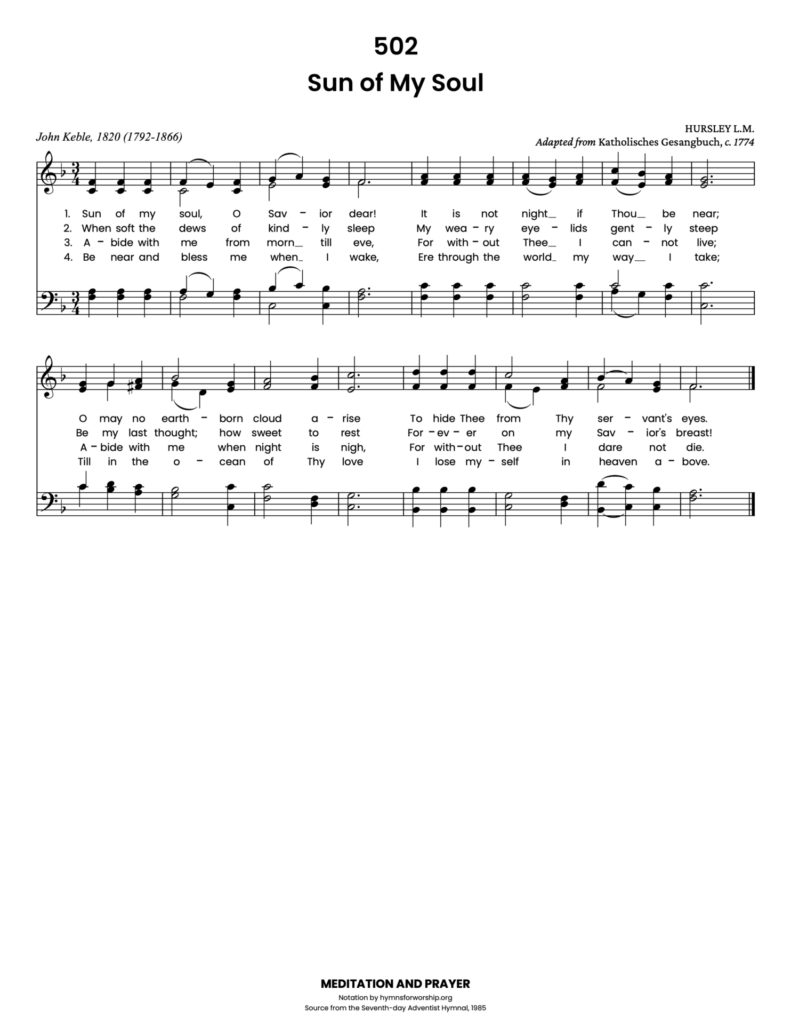
Get the hymn sheet in other keys here
For Worship Leaders
Make each hymn more meaningful with these helpful tools: Short, ready-to-use hymn introductions for church bulletins, multiple ways to introduce a hymn based on your worship theme and in-depth history and insights to enrich your song service.
Hymn Spotlight: Sun of My Soul
Drawn from a 14-stanza poem John Keble wrote in 1820 and later published in The Christian Year, this beloved evening hymn reflects the quiet plea of Luke 24:29: “Abide with us… for it is toward evening.” Its opening metaphor points back to earlier stanzas describing the setting sun, preparing the way for a prayerful close of day. Keble—English priest, scholar, poet, and influential voice in the Oxford Movement—spent his life in pastoral ministry and academic service, including a decade as Oxford’s professor of poetry. The tune HURSLEY, rooted in an 18th-century Austrian hymn and long connected with the parish where Keble ministered, lends the text its gentle, contemplative character. Together, the words and melody invite us to end each day with Christ’s steady presence, asking Him to stay near as darkness falls.
📖 Reference: Feel free to share but please cite hymnsforworship.org when reproducing.
Introductions for Sabbath School Song Service (based on specific lesson quarterlies):
This hymn is a selection from a 14-stanza poem written on November 25, 1820, by John Keble and published in his Christian Year Thoughts in Verse for the Sundays and Holydays Throughout the Year, 1827. It is entitled “Evening” and headed “Abide with us: for it is toward evening, and the day is far spent” (Luke 24:29). The opening four words of the hymn are a metaphor referring to the two preceding, but omitted, stanzas, which speak of the setting of the literal sun.
John Keble was born at Fairford, Gloucestershire, on April 25, 1792. He was educated at home in his father’s vicarage at the village of Coln St. Aldwyn, north of Fairford. He gained a scholarship to Oxford University and graduated with a Bachelor of Arts in 1810. He was ordained in 1815 and became curate of the two villages of East Leach and Burthorpe, near his father’s parish. He resided mainly in Oxford, however, which is about 17 miles farther east; he was appointed tutor at Oriel College, from 1818 to 1823. In 1823 he went to Southrop as curate, and in 1825 he was curate of Hursley in Hampshire, a small town near Winchester. He was appointed professor of poetry at Oxford for the years 1831 to 1841. He had left Hursley in 1828 to become provost of Oriel, but returned as vicar in 1836, remaining until failing health caused him to retire and move to Bournemouth, where he died on March 29, 1866. He is remembered for his Assize sermon in 1833, which John Newman (later cardinal) considered to be the beginning of the Oxford movement, and also for Keble College, Oxford, named after him in 1869, as well as for many other published works and sermons.
HURSLEY is a tune found in the Austrian Katholisches Gesangbuch (Catholic Hymnbook) of about the year 1774, set to the words “Grosser Gott, wir loben Dich” (“Great God, we praise Thee”) (see SD SDAH 30). It closely resembles a drinking song from Mozart’s Nozze di Figaro, to such an extent that Sir Herbert S. Oakley was stimulated to compose the tune ABENDS (see SDAH 242) for “Sun of My Soul.” HURSLEY is only one of many names for this tune; it commemorates the parish where Keble served for so many years. His church was restored from funds provided by profits from the sale of his Christian Year, and Keble is buried there.
📖 Reference: Companion to the Seventh-day Adventist Hymnal by Wayne Hooper and Edward E. White. Review and Herald Publishing Association, 1988.

Text
1
Sun of my soul, O Savior dear!
It is not night if Thou be near;
O may no earth-born cloud arise
To hide Thee from Thy servant’s eyes.
2
When soft the dews of kindly sleep
My weary eyelids gently steep,
Be my last thought how sweet to rest
Forever on my Savior’s breast!
3
Abide with me from morn till eve,
For without Thee I cannot live;
Abide with me when night is nigh,
For without Thee I dare not die.
4
Be near and bless me when I wake,
Ere through the world my way I take;
Till in the ocean of Thy love
I lose myself in heaven above.

Hymn Info
Biblical Reference
(b) Prov 3:24 (d) Isa 50:4
Author
John Keble (1792-1866)
Year Published
1820
Hymn Tune
HURSLEY
Metrical Number
L.M.
Adapted
Katholisches Gesangbuch, c. 1774