CHRISTIAN LIFE >> HOPE & COMFORT
SDAH 475
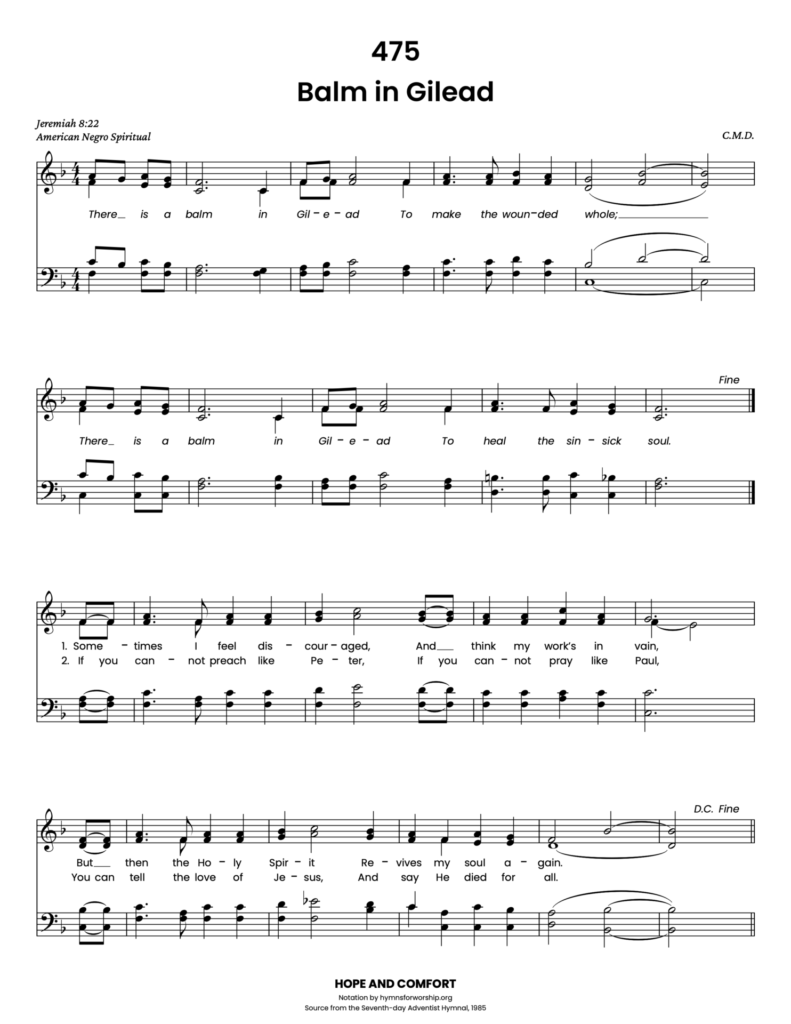
There is a balm in Gilead
To make the wounded whole;
There is a balm in Gilead
To heal the sin-sick soul.
Get the hymn sheet in other keys here
For Worship Leaders
Make each hymn more meaningful with these helpful tools: Short, ready-to-use hymn introductions for church bulletins, multiple ways to introduce a hymn based on your worship theme and in-depth history and insights to enrich your song service.
Hymn Spotlight: Balm in Gilead
Rooted in Jeremiah 8:22, this treasured African American spiritual transforms the prophet’s searching question into a bold declaration of hope: “There is a balm in Gilead!” As Howard Thurman observed, the enslaved singer turned deep spiritual struggle into triumphant faith, affirming Christ as the Great Physician who heals the “sin-sick soul.” Its simple, hovering melody carries an undercurrent of resilience—born from suffering yet brimming with optimism. Sung in revival meetings and published in The Revivalist (1868), it continues to assure weary hearts that no wound is beyond the healing grace of Jesus.
📖 Reference: Feel free to share but please cite hymnsforworship.org when reproducing.
Introductions for Sabbath School Song Service (based on specific lesson quarterlies):
This beloved Negro spiritual is based on Jeremiah 8:22, “Is there no This balm in Gilead; is there no physician there? why then is not the health of the daughter of my people recovered?”
We could give no more beautiful analysis of this song of hope than the following by Howard Thurman from his 1945 book Deep River, Reflections on the Religious Insight of Certain of the Negro Spirituals: “The peculiar genius of the Negro slave is revealed here in much of its structural splendor. The setting is the book of Jeremiah. The prophet has come to a ‘Dead Sea’ place in his life. Not only is he discouraged over the external events in the life of Israel, but he is also spiritually depressed and tortured. As a wounded animal he cried out, ‘Is there no balm in Gilead? Is no physician there?’ It is not a question of fact that he is raising-it is not a question directed to any particular person to answer. It is not addressed either to God or to Israel, but rather it is a question raised by Jeremiah’s entire life. He is searching his own soul. He is stripped to the literal substance of himself, and is turned back on himself for an answer. Jeremiah is saying actually, ‘There must be a balm in Gilead; it cannot be that there is no balm in Gilead.’ The relentless winnowing of his own bitter experience has laid bare his soul to the end that he is brought face to face with the very ground and core of his own faith.
“The slave caught the mood of this spiritual dilemma, and with it did an amazing thing. He straightened the question mark in Jeremiah’s sentence into an exclamation point: ‘There is a balm in Gilead!’ Here is a note of creative triumph. The melody itself is most suggestive. It hovers around the basic scale without any straying far afield. Only in one place is there a sharp lifting of the tonal eyebrow-a suggestion of escape; and then the melody swings back to work out its destiny within the zones of melodic agreement. The basic insight here is one of optimism- -an optimism that grows out of the pessimism of life and transcends it. It is an optimism that uses the pessimism of life as raw material out of which it creates its own strength.”
In his White and Negro Spirituals, George Pullen Jackson calls to our attention that both Charles Wesley and John Newton used the phrase “sin-sick soul.” The Newton words are:
How lost was my condition
Till Jesus made me whole,
There is but one Physician
Can cure a sin-sick soul.
The well-known refrain of this spiritual was sung in revival meetings and was published in upstate New York in The Revivalist, 1868.
📖 Reference: Companion to the Seventh-day Adventist Hymnal by Wayne Hooper and Edward E. White. Review and Herald Publishing Association, 1988.

Text
1
There is a balm in Gilead
To make the wounded whole;
There is a balm in Gilead
To heal the sin-sick soul.
2
Sometimes I feel discouraged,
And think my work’s in vain,
But then the Holy Spirit
Revives my soul again.
3
If you can not preach like Peter,
If you can not pray like Paul,
You can tell the love of Jesus,
And say He died for all.

Hymn Info
Biblical Reference
(b) 2 Cor 5:15 (r) Jer 46:11
Text Source
American Negro Spiritual
Metrical Number
C.M.D.
Watch
Recommended Reading
In this African American spiritual, the writer plaintively alludes to the balm in Gilead as the ultimate cure, not for physical ailments, but that which cures the soul, the sin-sick soul. What really is the balm in Gilead and does it really exist?