CHRISTIAN LIFE >> JOY & PEACE
SDAH 465
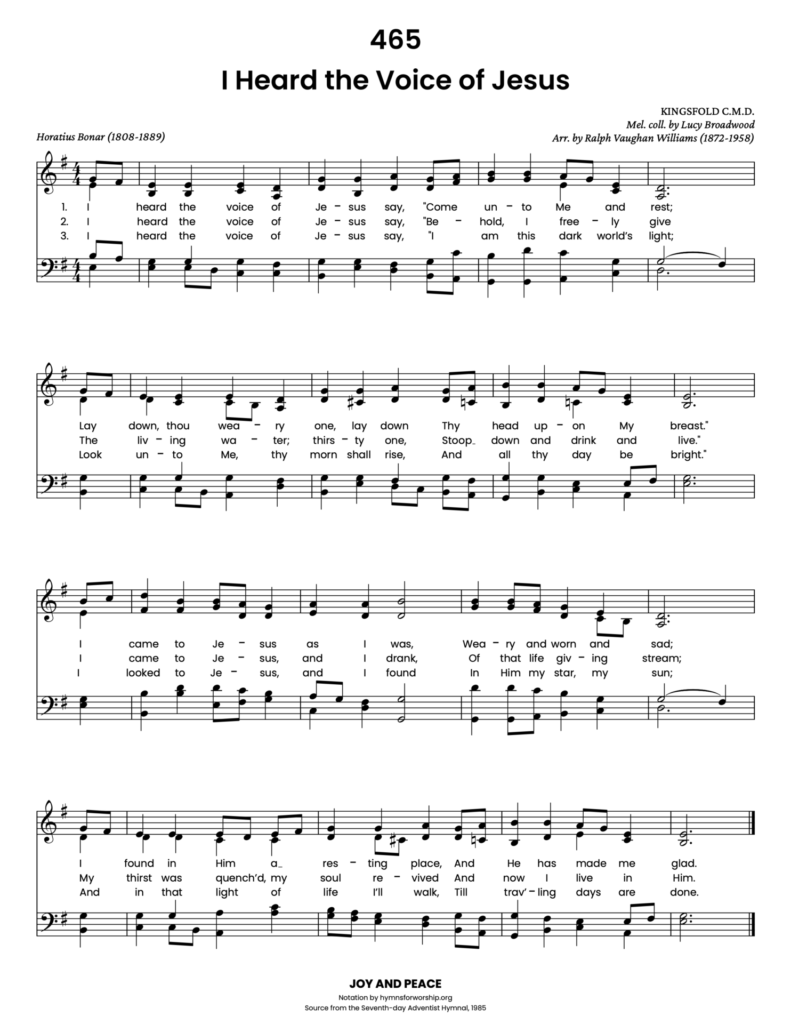
I heard the voice of Jesus say,
“Come unto Me and rest;
Lay down, thou weary one, lay down
Thy head upon My breast.”

Get the hymn sheet in other keys here
For Worship Leaders
Make each hymn more meaningful with these helpful tools: Short, ready-to-use hymn introductions for church bulletins, multiple ways to introduce a hymn based on your worship theme and in-depth history and insights to enrich your song service.
Hymn Spotlight: I Heard the Voice of Jesus
Horatius Bonar penned this hymn around 1843 while ministering in Kelso, Scotland, though it was first published in 1846. Each of its three stanzas pairs Christ’s invitation with the believer’s personal response, portraying Jesus as rest for the weary, living water for the thirsty, and light for the wandering soul (John 1:16). The folk melody KINGSFOLD, arranged by Ralph Vaughan Williams, beautifully mirrors this movement—from need and burden to joy and renewal—as the rising notes in the second half reflect the transformation in the singer’s heart. This pairing invites worshippers to both hear and answer the Savior’s call.
📖 Reference: Feel free to share but please cite hymnsforworship.org when reproducing.
Introductions for Sabbath School Song Service (based on specific lesson quarterlies):
In the manuscripts of Horatius Bonar (1808-1889; see SDAH 79), this hymn followed the one entitled “The Church Has Waited Long” SDAH 217), the latter being printed in 1845. Bonar’s son, H. N. Bonar, thinks that the original was written about 1843, when the author was ministering at Kelso, but it was not published until 1846 in his Hymns Original and Selected. It had three stanzas of 8 lines each, and in Bonar’s Hymns of Faith and Hope, 1857, it was entitled “The Voice From Galilee,” with the text “Of his fulness have all we received, and grace for grace” (John 1:16).
Note that each stanza is divided into two parts, first the invitation of Jesus, and second the response. Three metaphors are used, the Saviour being likened to a resting place, a well of water, and a light; He can respectively answer the needs of the weary, the thirsty, and the benighted pilgrim. Bonar also wrote SDAH 79, “O Love of God”; SDAH 217, “The Church Has Waited Long”; and SDAH 298, “I Lay My Sins on Jesus.”
KINGSFOLD, named after a village north of Horsham in Sussex, was arranged by Ralph Vaughan Williams (1872-1958; see Biographies) for the English Hymnal, 1906. It is a country folk song that he heard in this village, although it is known in Ireland and sung to the words “The Star of the County Down.” It was first published in Lucy Broadwood’s English County Songs, 1893. It is a fitting melody to the words, for halfway through, the three introductory notes rise instead of fall, matching the mood of the words, which also change at that point from the weary, thirsty, benighted one, to the glad, revived, enlightened pilgrim. KINGSFOLD is also used for SDAH 144, “O Sing a Song of Bethlehem.”
📖 Reference: Companion to the Seventh-day Adventist Hymnal by Wayne Hooper and Edward E. White. Review and Herald Publishing Association, 1988.

Text
1
I heard the voice of Jesus say,
“Come unto Me and rest;
Lay down, thou weary one, lay down
Thy head upon My breast.”
I came to Jesus as I was,
Weary and worn and sad;
I found in Him a resting place,
And He has made me glad.
2
I heard the voice of Jesus say,
“Behold, I freely give
The living water; thirsty one,
Stoop down and drink and live.”
I came to Jesus, and I drank
Of that life giving stream;
My thirst was quench’d, my soul revived,
And now I live in Him.
3
I heard the voice of Jesus say,
“I am this dark world’s light;
Look unto Me, thy morn shall rise,
And all thy day be bright.”
I looked to Jesus, and I found
In Him my star, my sun;
And in that light of life I’ll walk,
Till trav’ling days are done.

Hymn Info
Biblical Reference
(a) Matt 11:28; Isa 32:18 (b) John 4:14 (c) John 8:12
Author
Horatius Bonar (1808-1889)
Copyright
Music from The English Hymnal by permission of Oxford University Press
Hymn Tune
KINGSFOLD
Metrical Number
C.M.D.
Composer
Mel. coll. by Lucy Broadwood
Arranged
Ralph Vaughan Williams (1872-1958)