EARLY ADVENT
SDAH 454
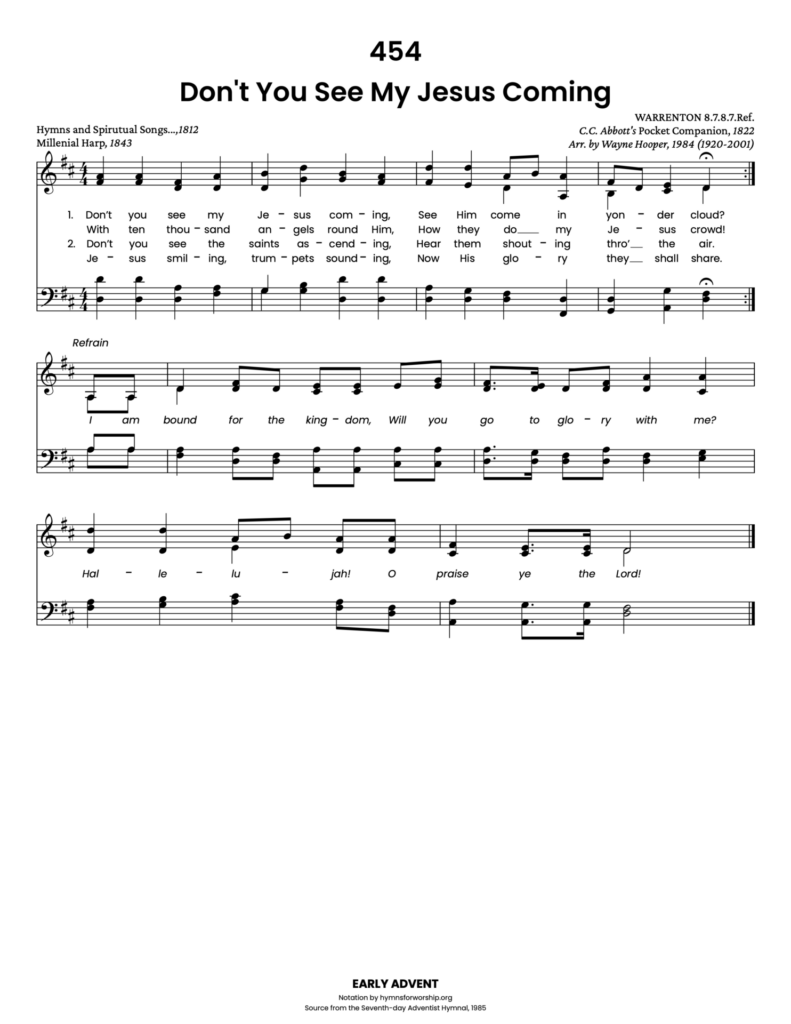
Don’t you see my Jesus coming,
See Him come in yonder cloud?
With ten thousand angels round Him,
How they do my Jesus crowd!
Get the hymn sheet in other keys here
For Worship Leaders
Make each hymn more meaningful with these helpful tools: Short, ready-to-use hymn introductions for church bulletins, multiple ways to introduce a hymn based on your worship theme and in-depth history and insights to enrich your song service.
Hymn Spotlight: Don’t You See My Jesus Coming
This lively hymn traces its roots to early 19th-century American camp meetings and revival gatherings. Believed to have been sung antiphonally—women singing the stanza’s question and men answering with the refrain—it first appeared in print in 1812, attributed to Caleb J. Taylor, though nothing is known of him. By 1822, C. C. Abbott paired the text with the tune WARRENTON and the refrain “I am bound for the kingdom.” The melody later traveled through Southern tunebooks like The Southern Harmony (1835) and The Sacred Harp (1844), sometimes set to entirely different hymn texts. The version in our hymnal comes from Joshua V. Himes’s Millennial Harp (1842, 1843), a collection used by Advent believers awaiting Christ’s return in October 1844. Wayne Hooper’s arrangement preserves the energetic character of the original, complete with the jubilant “O Hallelujah!” This spirited tune invites modern congregations to catch a glimpse of the pioneers’ heartfelt expectancy for the Second Coming.
📖 Reference: Feel free to share but please cite hymnsforworship.org when reproducing.
Introductions for Sabbath School Song Service (based on specific lesson quarterlies):
We are indebted to articles by Ellen Jane Lorenz Porter and Paul Hammond in the July 1984 issue of The Hymn for the story of this hymn, which has been classified as a revival spiritual and a camp meeting song. It is thought that it was a dialogue hymn, with the women the stanza-question and the men on the other side of the aisle giving the refrain-answer. The earliest appearance of the stanza text was in Hymns and Spiritual Songs for the Use of Christians, 1812. In this and other books, Caleb J. Taylor is given as author. Nothing about him is known. Then in 1822, C. C. Abbott matched the text with WARRENTON in his Young Convert’s Pocket Companion, with the refrain, “I am bound for the kingdom.” This tune SIO Don’t you see my Jesus coming and refrain were also used many times in later Southern tunebooks with the texts “Come, Thou of Fount Every Blessing” and “Whither Goest Thou, Pilgrim Stranger?” There have been a number of variants of the tune, such as are found in William Walker’s Southern Harmony, 1835, and The Sacred Harp, 1844 (see SDAH 363). The version Wayne Hooper (1920- ; see Biographies) used in making his arrangement for SDAH is from Joshua V. Himes’s Millennial Harp, 1842 and 1843, where it is in three parts and repeats the refrain with an extra “O Hallelujah!” thrown in between.
This little book is most likely the one from which the Adventists sang as they were looking for the Lord to come in October 1844. The tune is vigorous and singable, and should help to recapture the spirit of the singing pioneers.
📖 Reference: Companion to the Seventh-day Adventist Hymnal by Wayne Hooper and Edward E. White. Review and Herald Publishing Association, 1988.

Text
1
Don’t you see my Jesus coming,
See Him come in yonder cloud?
With ten thousand angels round Him,
How they do my Jesus crowd!
Refrain
I am bound for the kingdom,
Will you go to glory with me?
Hallelujah! O praise ye the Lord!
2
Don’t you see the saints ascending,
Hear them shouting thro’ the air.
Jesus smiling, trumpets sounding,
Now His glory they shall share.

Hymn Info
Biblical Reference
(a) Mark 8:38 (b) 1 Thess 4:17
Text Source
Hymns and Spiritual Songs, 1812
Millenial Harp, 1843
Copyright
Arrangement copyright 1984 by Wayne Hooper
Theme
EARLY ADVENT
Hymn Tune
WARRENTON
Metrical Number
8.7.8.7.Ref.
Arranged
Wayne Hooper, 1984 (1920-2001)
Tune Source
C.C. Abbott’s Pocket Companion, 1822
Recommended Reading
Miller gained a huge following which came to be called, the ‘Millerites.’ Great Tent meetings were set up, and the progressing movement saw the need to provide new hymns. Sure, they had songs that they were singing from the churches they belonged to, but none that supported the distinct messages that was being preached such as the judgment, second advent, reward of the saints and the midnight cry. As a result, hymns were compiled and the first Millerite hymnal was born.