EARLY ADVENT
SDAH 447
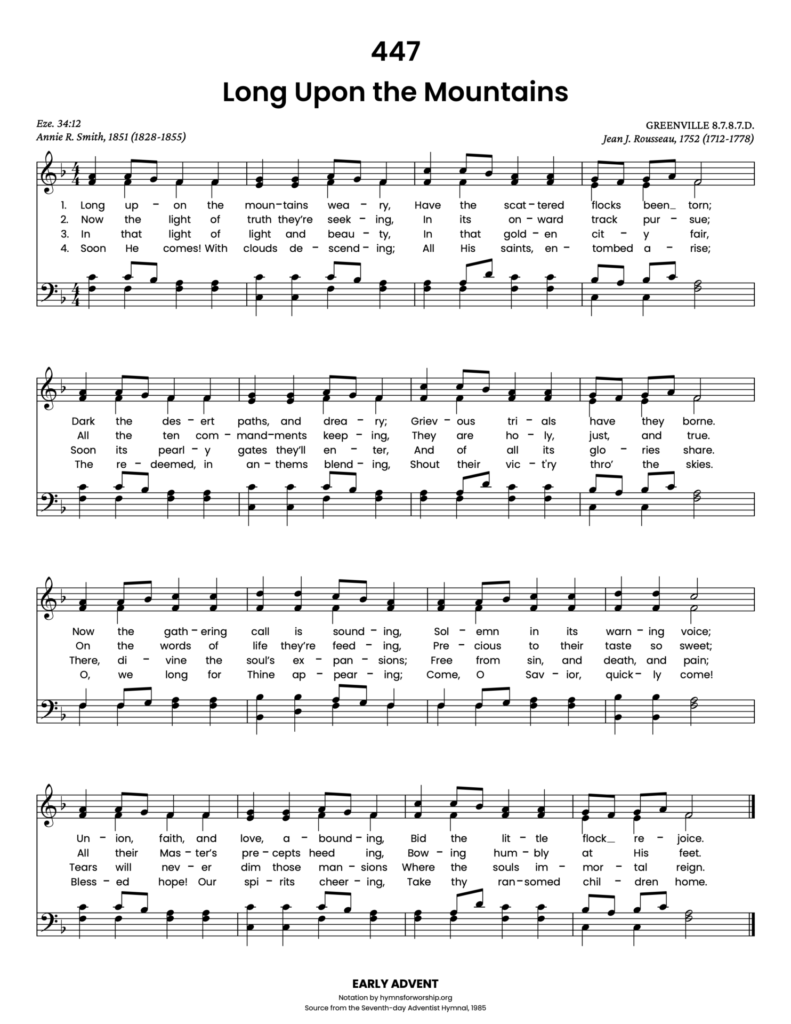
Long upon the mountains weary,
Have the scattered flocks been torn;
Dark the dessert paths, and dreary;
Grievous trials have they borne.

Get the hymn sheet in other keys here
For Worship Leaders
Make each hymn more meaningful with these helpful tools: Short, ready-to-use hymn introductions for church bulletins, multiple ways to introduce a hymn based on your worship theme and in-depth history and insights to enrich your song service.
Hymn Spotlight: Long Upon the Mountains
Annie Rebekah Smith wrote this hymn in 1851 to encourage early Advent believers scattered and discouraged after the Great Disappointment. Drawing from Ezekiel 34:12’s picture of the Shepherd gathering His sheep from “the cloudy and dark day,” it was sung at the first General Conference session in 1863. The tune GREENVILLE, composed by Jean Jacques Rousseau in 1752, brings a dignified yet tender quality to the text. For Adventists today, it is still a call to lift up our eyes—the Shepherd is coming to gather His flock.
📖 Reference: Feel free to share but please cite hymnsforworship.org when reproducing.
Introductions for Sabbath School Song Service (based on specific lesson quarterlies):
Annie Rebekah Smith (1828-1855; see SDAH 439) wrote this hymn to describe the experience of the early Seventh-day Adventist believers, and to encourage their hearts by the hope of the second coming of the Great Shepherd to gather His flock. It appeared in the Review and Herald of December 9, 1851, with the heading from Ezekiel 34:12: “So will I seek out my sheep, and will deliver them out of all places where they have been scattered in the cloudy and dark day.” Verse 6 of the same chapter speaks of the sheep being on “the mountains.” The hymn was sung at the first General Conference of Seventh-day Adventists, held at Battle Creek, Michigan, on May 20, 1863. It has been in seven previous SDA hymnals, but in no others. Annie Smith also wrote SDAH 439, “How Far From Home?” and SDAH 441, “I Saw One Weary.”
GREENVILLE was composed by Jean Jacques Rousseau in 1752 when he was living in Paris, writing some musical works but mainly philosophical and political articles. He was born June 28, 1712, in Geneva, the son of a watchmaker. He was apprenticed to this trade, but ran away across the border into Annecy in France. He became a Catholic and went to Paris in 1741. When his philosophical writings brought him into conflict with the religious authorities, he fled to Switzerland, then to England, but he returned to France in 1767. His philosophy was taken up by the French revolutionaries a few years after his death on July 3, 1778. The tune is in AABA form, scores 1, 2, and 4 being identical. Score 3 differs in that the movement ascends generally instead of descending, but the harmony is very simple.
📖 Reference: Companion to the Seventh-day Adventist Hymnal by Wayne Hooper and Edward E. White. Review and Herald Publishing Association, 1988.

Text
1
Long upon the mountains weary,
Have the scattered flocks been torn;
Dark the dessert paths, and dreary;
Grievous trials have they borne.
Now the gathering call is sounding,
Solemn in its warning voice;
Union, faith, and love, abounding,
Bid the little flock rejoice.
2
Now the light of truth they’re seeking,
In its onward track pursue;
All the ten commandments keeping,
They are holy, just, and true.
On the words of lire they’re feeding,
Precious to their taste so sweet;
All their Master’s percepts heeding,
Bowing humbly to His feet.
3
In that light of light and beauty,
In that golden city fair,
Soon its pearly gates they’ll enter,
And of all its glories share.
There, divine the soul’s expansions;
Free from sin, and death, and pain;
Tear will never dim those mansions
Where the souls immortal reign.
4
Soon He comes! With clouds descending;
All His saints, entombed arise;
The redeemed, in anthems blending,
Shout their vict’ry thro’ the skies.
O, we long for Thine appearing;
Come, O Savior, quickly come!
Blessed hope! Our spirits cheering,
Take thy ransomed children home.

Hymn Info
Biblical Reference
(a) Eze 34:12 (b) Rev 7:12; John 6:63 (c) Rev 21:21, 4 (d) Rev 1:7; 1 Thess 4:16; Rev 22:20
Author
Annie R. Smith (1828-1855)
Year Published
1851
Theme
EARLY ADVENT
Hymn Tune
GREENVILLE
Metrical Number
8.7.8.7.D.
Composer
Jean J. Rousseau (1712-1778)
Year Composed
1752
Recommended Reading
Miller gained a huge following which came to be called, the ‘Millerites.’ Great Tent meetings were set up, and the progressing movement saw the need to provide new hymns. Sure, they had songs that they were singing from the churches they belonged to, but none that supported the distinct messages that was being preached such as the judgment, second advent, reward of the saints and the midnight cry. As a result, hymns were compiled and the first Millerite hymnal was born.
The general idea when it comes to hymns is that there is a close bond between the author and the composer. That the author writes a hymn and the composer invents a tune to suit it, and then provides the harmony to accompany the tune. However, such wasn’t always the case.
Many hymns actually worked vice versa wherein authors would write verses according to existing tunes. Hundreds of hymns are sung from borrowed tunes, such as secular songs, chants, and even classical works. That being said, I went ahead and researched which hymns in the SDA Hymnal were originally classical works.