EARLY ADVENT
SDAH 446
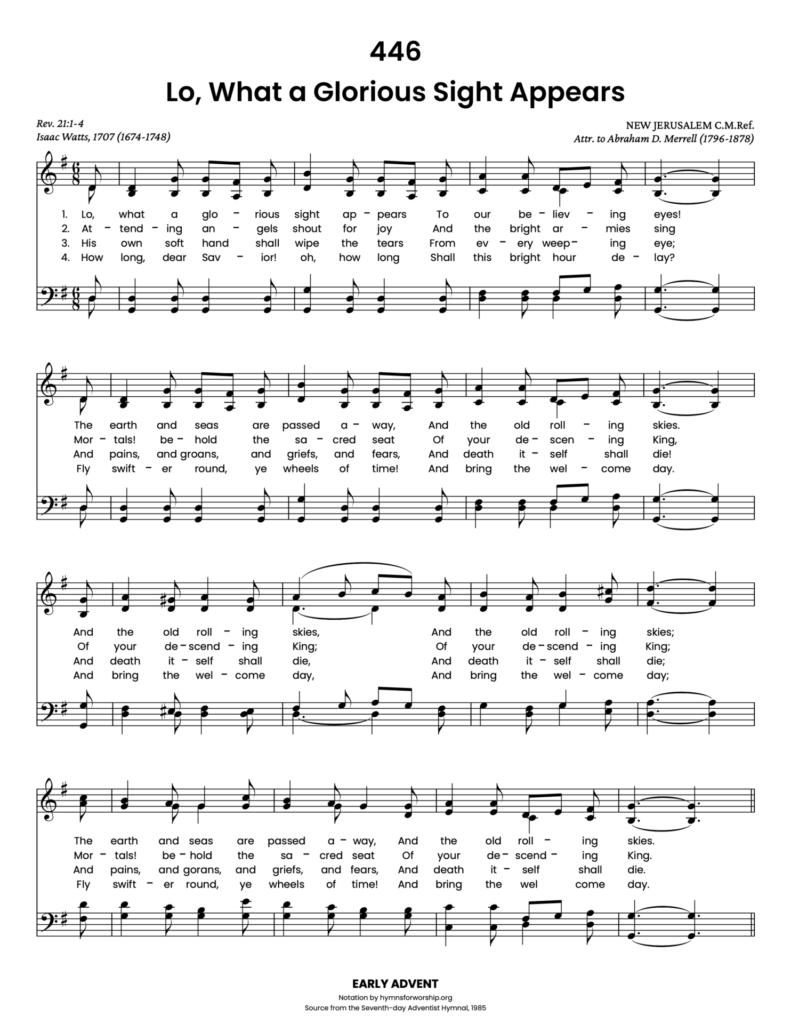
Lo, what a glorious sight appears
To our believing eyes!
The earth and seas are passed away
And the old rolling skies.
This hymn appears in:
Get the hymn sheet in other keys here
For Worship Leaders
Make each hymn more meaningful with these helpful tools: Short, ready-to-use hymn introductions for church bulletins, multiple ways to introduce a hymn based on your worship theme and in-depth history and insights to enrich your song service.
Hymn Spotlight: Lo, What a Glorious Sight Appears
One of the best-loved early Advent hymns, this Isaac Watts text (1707) paints a vision of Revelation 21’s “new heaven and new earth,” with the refrain joyfully proclaiming, “When we meet to part no more.” Sung with great fervor at Adventist camp meetings and prayer gatherings, it reflects the certainty that death itself will one day die. The tune NEW JERUSALEM, adapted from the eighteenth-century carol “The Seven Joys of Mary,” was often paired with different hymns in early American tune books. Its lively refrain captures the joy of the redeemed who will one day stand on “Canaan’s happy shore.”
📖 Reference: Feel free to share but please cite hymnsforworship.org when reproducing.
Introductions for Sabbath School Song Service (based on specific lesson quarterlies):
One of the best-loved of the early Advent hymns, this one was No. 21 in Isaac Watts’s (1674-1748; see Biographies) Hymns and Spiritual Songs, Book I, 1707. It bore the title “A Vision of the Kingdom of Christ Among Men,” and was based on Revelation 21:1-4. In SDAH’s fourth stanza, there is an allusion to Revelation 6:10. The words of the refrain are a description of the fullness of joy to be experienced when death shall be no longer, and the partings caused by death will never more take place. They are an amplification of the last line of the third stanza; “And death itself shall die.”
In the early days of Adventism this text was sung with great enthusiasm at prayer meetings and camp meetings, using two tunes, NORTHFIELD (see SDAH 533), and NEW JERUSALEM, found in the 1971 edition of the Sacred Harp. Both tunes were written by Jeremiah Ingalls (see SDAH 533), the Vermont farmer, cooper, tavern keeper, and singing teacher who compiled Christian Harmony, 1805.
However, the NEW JERUSALEM tune used in SDAH, attributed to Abraham D. Merrell in the 1911 Original Sacred Harp, had its origin in a popular carol of the eighteenth century in England, “The Seven Joys of Mary” (see The Oxford Book of Carols, No. 70). It was annually printed in broadsides with many different texts, some of them extending the “Joys” of Mary to 10 or 12. Bramley and Stainer printed this traditional music in 1871.
Typical of the camp meeting hymn of this era is the use of a standard hymn by Isaac Watts, or some other well-known text, and then the addition of a refrain. Ellen Jane Lorenz, in her delightful study of the camp meeting hymns, Glory Hallelujah, 1978, found 47 occurrences of this refrain in the early American tune books, most often with “How pleasant thus to dwell below.” She found also that at least 13 different “mother-hymns” were used with this tune and refrain. A slightly different version of this tune is in the 1971 edition of The Sacred Harp, where it is with the text “Am I a Soldier of the Cross,” and adds the “O that will be joyful” refrain. Here the tune is titled JOYFUL, credited to Abraham D. Merrell, “a Methodist minister who preached all over New England,” and arranged by the compiler, B. F. White. Merrell was born in New Hampshire in 1796 and died in 1878.
The form of the hymn SDAH uses is taken from the Seventh-day Adventist Hymns and Tunes, 1886, where the key is A-flat and no credit is given for words; the music is arranged, presumably, by one of the two musical editors, F. E. Belden or Edwin Barnes (see SDAH 6). They placed it in a section titled Miscellaneous-Old Melodies. We don’t know what tune he used, but James White included this text in his first hymnal, a little pamphlet of 53 items titled Hymns for God’s Peculiar People That Keep the Commandments of God and the Faith of Jesus. It also found a place in several subsequent hymnals he edited and published for the young church.
📖 Reference: Companion to the Seventh-day Adventist Hymnal by Wayne Hooper and Edward E. White. Review and Herald Publishing Association, 1988.

Text
1
Lo, what a glorious sight appears
To our believing eyes!
The earth and seas are passed away
And the old rolling skies.
And the old rolling skies,
And the old rolling skies;
The earth and seas are passed away,
And the old rolling skies.
Refrain
O that will be joyful, joyful, joyful!
O that will be joyful
When we meet to part no more!
When we meet to part no more
On Canaan’s happy shore;
‘Tis there we’ll meet at Jesus’ feet,
When we meet to part no more!
2
Attending angels shout for joy
And the bright armies sing-
Mortals! Behold the sacred seat
Of your descending King.
Of your descending King,
Of your descending King;
Mortals! Behold the sacred seat
Of your descending King.
3
His own soft hand shall wipe the tears
From every weeping eye;
And pains, and groans, and griefs, and fears,
And death itself shall die!
And death itself shall die,
And death itself shall die;
And pains, and groans, and griefs, and fears,
And death itself shall die.
4
How long, dear Savior! Oh, how long
Shall this bright hour delay?
Fly swifter round, ye wheels of time!
And bring the welcome day.
And bring the welcome day,
And bring the welcome day;
Fly swifter round, ye wheels of time!
And bring the welcome day.

Hymn Info
Biblical Reference
(a) Rev 21:1 (b) Rev 21:3 (c) Rev 21:4 (d) Rev 6:10
Author
Isaac Watts (1674-1748)
Year Published
1707
Theme
EARLY ADVENT
Hymn Tune
NEW JERUSALEM
Metrical Number
C.M.Ref.
Composer
Attr. to Abraham D. Merrell (1796-1878)
Recommended Reading
Miller gained a huge following which came to be called, the ‘Millerites.’ Great Tent meetings were set up, and the progressing movement saw the need to provide new hymns. Sure, they had songs that they were singing from the churches they belonged to, but none that supported the distinct messages that was being preached such as the judgment, second advent, reward of the saints and the midnight cry. As a result, hymns were compiled and the first Millerite hymnal was born.