EARLY ADVENT
SDAH 443
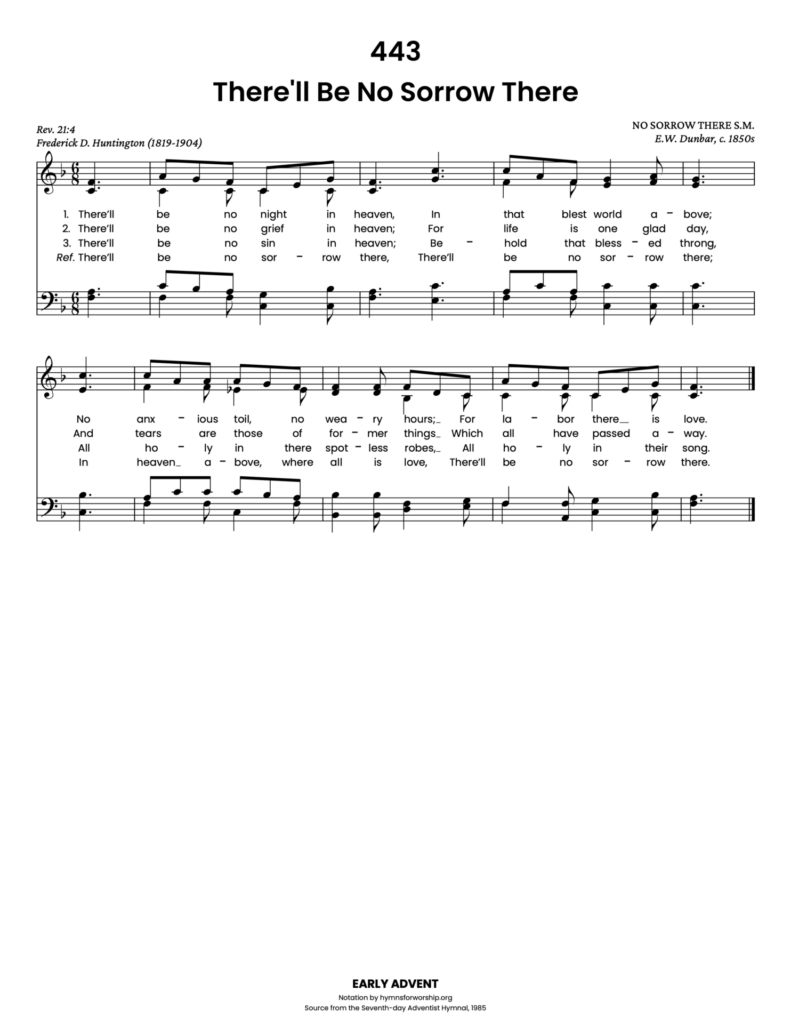
There’ll be no night in heaven,
In that blest world above;
No anxious toil, no weary hours;
For labor there is love.

Get the hymn sheet in other keys here
For Worship Leaders
Make each hymn more meaningful with these helpful tools: Short, ready-to-use hymn introductions for church bulletins, multiple ways to introduce a hymn based on your worship theme and in-depth history and insights to enrich your song service.
Hymn Spotlight: There’ll Be No Sorrow There
Rooted in the promise of Revelation 21:4, this hymn magnifies the hope of a world where death, pain, and tears are forever gone. Written by Frederick Dan Huntington—a Harvard professor, Unitarian minister, and later Episcopal bishop—it appeared in F. E. Belden’s Hymns and Tunes (1886) and Christ in Song (1908). Its tune, NO SORROW THERE, by the little-known E. W. Dunbar, carries a gentle assurance that God’s people will one day exchange earth’s sorrows for heaven’s joy. For Adventists, it is a reminder to keep our eyes fixed on the coming day when “the former things are passed away.”
📖 Reference: Feel free to share but please cite hymnsforworship.org when reproducing.
Introductions for Sabbath School Song Service (based on specific lesson quarterlies):
This is amplification of the promise in Revelation 21:4, “And God shall wipe away all tears from their eyes; and there shall be no more death, neither sorrow, nor crying, neither shall there be any more pain: for the former things are passed away.”
Frederick Dan Huntington was born May 28, 1819, at Hadley, Massachusetts, and graduated from Amherst College and Harvard Divinity School. He was a Unitarian minister in Boston, 1842-1855; professor of Christian Morals, Harvard, 1855-1859; and became a bishop of the Central New York Episcopal Church in 1869, after changing his religious affiliation to that body. He was coeditor with Frederick H. Hedge of a noted Unitarian hymnbook published in 1853, Hymns for the Church of Christ. He died July 11, 1904. Huntington contributed three original hymns to that book, but they have not found use elsewhere. This one appeared in F. E. Belden’s Hymns and Tunes, 1886, and again in his Christ in Song, 1908, but it was not included in the Church Hymnal, 1941, nor has it been used in any other American hymnbooks.
In both of these books, E. W. Dunbar is given credit for the music. He seems to have flourished in the 1850s, but nothing more is known of him. In research for another hymn, the following note was found on the title page of Stoughton Collection of Church Music, 1835: “The Stoughton [Massachusetts] Musical Society, composed of members from the towns of Stoughton, Sharon, Canton, and Randolph, was instituted A. D. 1786. First President, Elijah Dunbar, Esq.” It is possible that this is the E. W. Dunbar who composed NO SORROW THERE.
📖 Reference: Companion to the Seventh-day Adventist Hymnal by Wayne Hooper and Edward E. White. Review and Herald Publishing Association, 1988.

Text
1
There’ll be no night in heaven,
In that blest world above;
No anxious toil, no weary hours;
For labor there is love.
Refrain
There’ll be no sorrow there,
There’ll be no sorrow there;
In heaven above, where all is love,
There’ll be no sorrow there.
2
There’ll be no grief in heaven;
For life is one glad day,
And tears are those of former things
Which all have passed away.
3
There’ll be no sin in heaven;
Behold that blessed throng,
All holy in there spotless robes,
All holy in their song.

Hymn Info
Biblical Reference
(a) Rev 21:25 (b) Rev 21:4
Author
Frederick D. Huntington (1819-1904)
Hymn Tune
EARLY ADVENT
Hymn Tune
NO SORROW THERE
Metrical Number
S.M.
Composer
E.W. Dunbar
Year Composed
c. 1850s
Recommended Reading
Miller gained a huge following which came to be called, the ‘Millerites.’ Great Tent meetings were set up, and the progressing movement saw the need to provide new hymns. Sure, they had songs that they were singing from the churches they belonged to, but none that supported the distinct messages that was being preached such as the judgment, second advent, reward of the saints and the midnight cry. As a result, hymns were compiled and the first Millerite hymnal was born.