EARLY ADVENT
SDAH 441
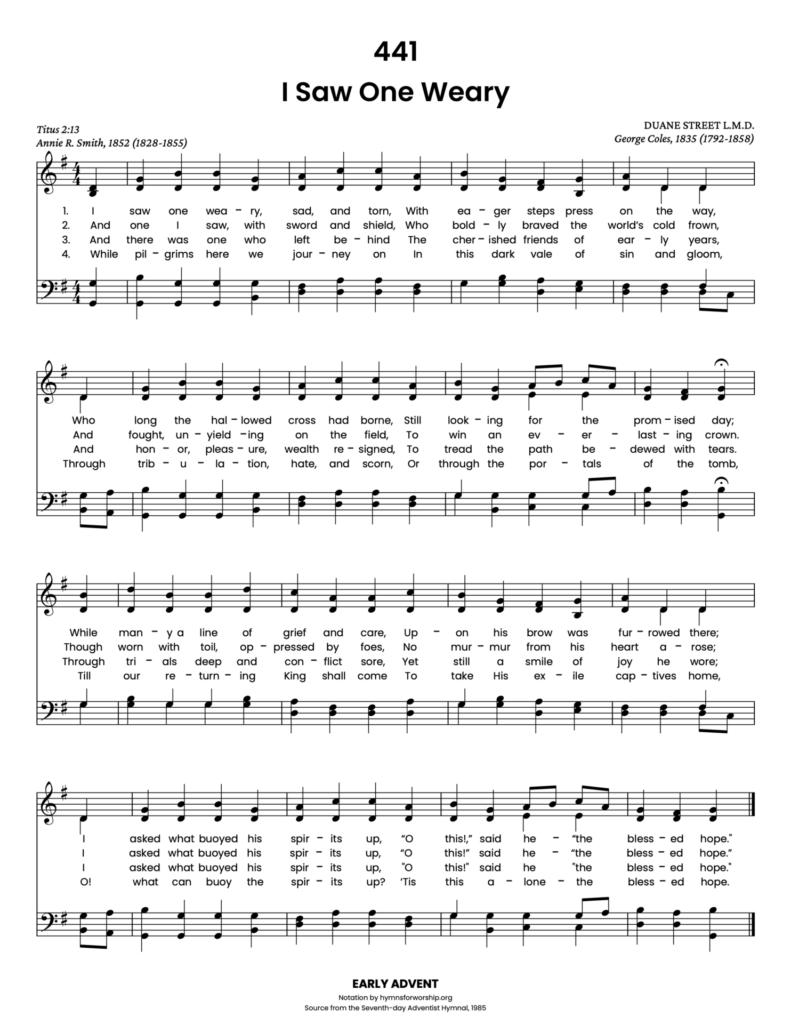
I saw one weary, sad, and torn,
With eager steps press on the way,
Who long the hallowed cross had born,
Still looking for the promised day;
Get the hymn sheet in other keys here
For Worship Leaders
Make each hymn more meaningful with these helpful tools: Short, ready-to-use hymn introductions for church bulletins, multiple ways to introduce a hymn based on your worship theme and in-depth history and insights to enrich your song service.
Hymn Spotlight: I Saw One Weary
Written in 1852 by Annie R. Smith, this hymn honors the steadfast faith of early Adventist pioneers who labored for the gospel despite poverty, fatigue, and hardship. Each stanza paints a portrait of a faithful worker pressing on toward the “blessed hope” of Christ’s return. Whether it speaks of Joseph Bates, James White, or Annie’s own journey, its message is the same—God sustains His servants until the day they rest in Him. May it inspire us to endure with courage, our eyes fixed on the soon-coming King.
📖 Reference: Feel free to share but please cite hymnsforworship.org when reproducing.
Introductions for Sabbath School Song Service (based on specific lesson quarterlies):
The first three stanzas of this hymn, written in 1852, refer to three outstanding personalities in the early history of the Seventh-day Adventist Church. The author, Annie Rebekah Smith (1828-1855; see SDAH 439), was converted by Joseph Bates (1792-1872), who is referred to in the first stanza. He was a former sea captain who gave all his wealth to the promulgation of the gospel of the imminent second advent of Christ. He always signed his letters “Yours in the blessed hope,” a constant reminder of the promise recorded in Titus 2:13, “Looking for that blessed hope, and the glorious appearing of the great God and our Saviour Jesus Christ.”
The second stanza is a word picture of James Springer White (1821- Facing poverty, incessant labor, fanaticism, and other hardships, his courage 1881), the virtual leader by pen and voice of the church in its early struggles, remained steadfast because of his firm hope in the second advent of Christ. He and his wife, Ellen, pioneered the development of the church against much
opposition.
The third stanza has often been thought to refer to John Nevins Andrews (1828-1883), who became the first missionary to be sent by the church from North America to Europe. At the time of writing this hymn, however, he was not so well known. Nor could the stanza apply to Uriah Smith (see SDAH 602), Annie’s brother, for he was not then a Sabbathkeeper. Annie’s mother, Rebekah, stated that in this third stanza Annie had encapsulated her own experience, but for the sake of consistency-and perhaps to avoid any suggestion of pride or self-assertiveness, which were foreign to her charac- ter-she used masculine pronouns. Annie was quite willing for the stanza to apply to whomever it might fit. The hymn, written at Rochester, New York, first appeared on the front page of the Review and Herald of August 19, 1852, under the title “The Blessed Hope.” Annie Smith also wrote SDAH 439, “How Far From Home?” and SDAH 447, “Long Upon the Mountains.”
DUANE STREET was composed in 1835 by George Coles (1792- 1858), a Methodist minister. It was named to commemorate the Duane Street church in New York, where he served.
📖 Reference: Companion to the Seventh-day Adventist Hymnal by Wayne Hooper and Edward E. White. Review and Herald Publishing Association, 1988.

Text
1
I saw one weary, sad, and torn,
With eager steps press on the way,
Who long the hallowed cross had born,
Still looking for the promised day;
While many a line of grief and care,
Upon his brow was furrowed there;
I asked what buoyed his spirits up,
“O this,” said he– “the blessed hope.”
2
And one I saw, with sword and shield,
Who boldly braved the world’s cold frown,
And fought, unyielding, on the field,
To win an everlasting crown.
Though worn with toil, oppressed by foes,
No murmur from his heart arose;
I asked what buoyed his spirits up,
“O this!” said he– “the blessed hope.”
3
And there was one who left behind
The cherished friends of early years,
And honor, pleasure, wealth re-signed,
To tread the path bedewed with tears.
Through trials deep and conflict sore,
Yet still a smile of joy he wore;
O! what can bouy the spirit up?
‘Tis this alone– the blessed hope.”
4
While pilgrims here we journey on
In this dark vale of sin and gloom,
Through tribulation, hate, and scorn,
Or through the portals of the tomb,
Till our returning King shall come
To tkae His exile captives home,
O! what can bouy the spirits up?
‘Tis this alone– the blessed hope.

Hymn Info
Biblical Reference
(a) Tit 2:13
Author
Annie R. Smith (1828-1855)
Year Published
1852
Theme
EARLY ADVENT
Hymn Tune
DUANE STREET
Metrical Number
L.M.D.
Composer
George Coles (1792-1858)
Year Composed
1835
Recommended Reading
Miller gained a huge following which came to be called, the ‘Millerites.’ Great Tent meetings were set up, and the progressing movement saw the need to provide new hymns. Sure, they had songs that they were singing from the churches they belonged to, but none that supported the distinct messages that was being preached such as the judgment, second advent, reward of the saints and the midnight cry. As a result, hymns were compiled and the first Millerite hymnal was born.