EARLY ADVENT
SDAH 440
How cheering is the Christian’s hope,
While toiling here below!
It buoys us up while this passing through
This wilderness of woe,
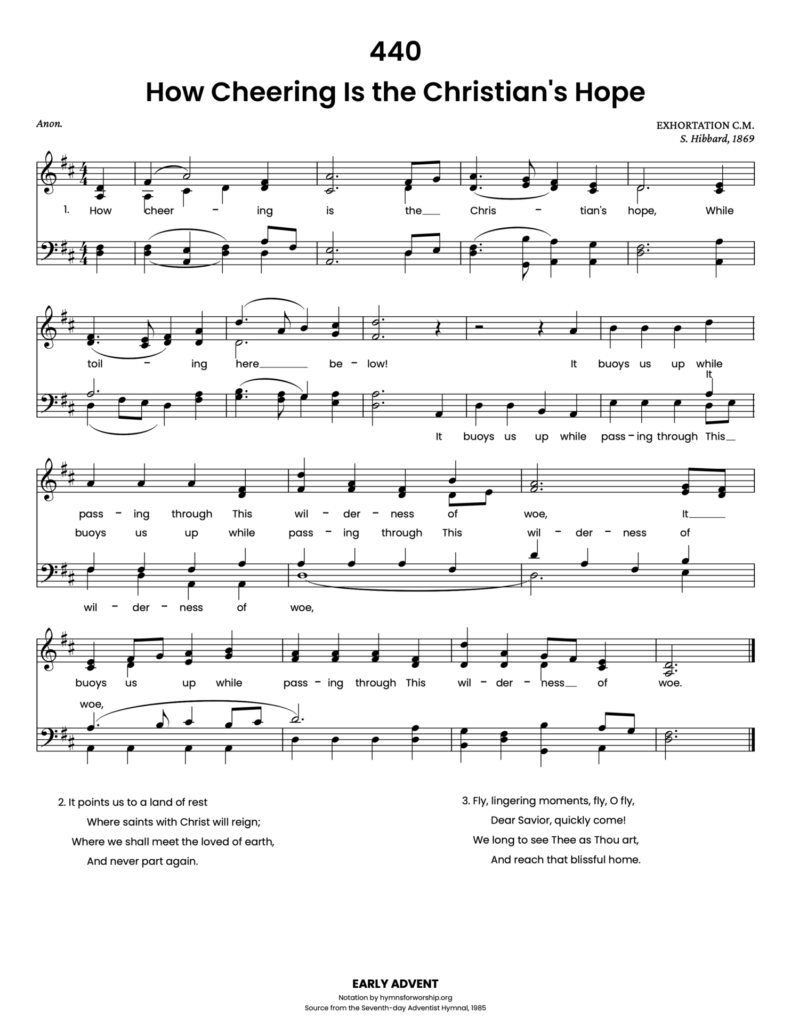
Get the hymn sheet in other keys here
For Worship Leaders
Make each hymn more meaningful with these helpful tools: Short, ready-to-use hymn introductions for church bulletins, multiple ways to introduce a hymn based on your worship theme and in-depth history and insights to enrich your song service.
Hymn Spotlight: How Cheering Is the Christian’s Hope
First sung by Millerite Adventists before 1844, this hymn overflows with anticipation for the land where sorrow is no more. Its bright fuguing tune, once a favorite in early American singing schools, invites every voice to join in the joyful proclamation of eternal life through Christ. Long cherished among Seventh-day Adventists—especially in parts of the Caribbean—it reminds us that no matter how dark the journey, our destination is a place of unending peace and gladness.
📖 Reference: Feel free to share but please cite hymnsforworship.org when reproducing.
Introductions for Sabbath School Song Service (based on specific lesson quarterlies):
The first appearance of this hymn was in Phineas A. Smith’s Second Advent Hymnbook, Rochester, New York, 1850, one of the books used by the Millerite Adventists who believed the Lord would come in October 1844. The text and tune were wedded in an SDA book by James White in Hymns and Tunes for Those Who Keep the Commandments of God and the Faith of Jesus, 1869. The Seventh-day Adventists and the Advent Christian Church seem to be the only denominations that continued to use the hymn after 1844. However, Ellen Jane Lorenz, noted author and researcher in hymnology, found the tune in 17 early American tunebooks. In most of them S. Hibbard, or variant spellings of that name, was given as composer. A variety of hymn texts was used, including “On Jordan’s Stormy Banks,” “O for a Thousand Tongues,” “O for a Heart to Praise My God,” “There Is a Land of Pure Delight,” and “When I Can Read My Title Clear.” The book Tribute of Praise bore a footnote: “Not suited for congregational use.” Sacred Lute referred to the tune as “Old Folk’s Tune.” At any rate, the tune was very popular in mid-eighteenth century. We have found no information about Bessie Doolittle or S. Hibbard.
The hymn is an expression of the hope of the Christian for eternal life in a land that is empty of earth’s sorrow. There are three other stanzas stressing the same theme of contrast between this present world and the world to come. SDAH has stanzas 1, 2, and 6 of the original.
EXHORTATION is a good example of the fuguing tune so prevalent in this era, brought into American sacred music largely by the New England singing-school teacher and composer, William Billings. The fuguing tunes were greatly enjoyed for about 50 years, then they slowly went out of style, except among the Sacred Harp singers in the South, where they are alive and well and are being sung with the same fervor as when first written (see notes on BEACH SPRING, SDAH 363). For the first section of the fuguing tune, all parts usually sing together in straight four-part harmony. Then, beginning with the bass, all four parts take a turn at the melody, entering one at a time, one measure apart. After entrance, each part goes off on its own, or holds one note for a while, then all join together for harmony at the finish.
In the preface to his The Continental Harmony, 1794, Billings gives us an idea of his enthusiasm for the style: “It has more than twenty times the power of the old slow tunes, each part straining for mastery and victory. The audience is entertained and delighted, their minds surpassingly agitated and extremely fluctuated, sometimes declaring for one part and sometimes for another. Now the solemn bass demands their attention; next the manly tenor, now the volatile treble. Now here, now there, now here again. O ecstatis! Rush on, you sons of harmony.” Most of the southern tune books had from 20 to 70 songs each in this style.
While the above description seems to indicate that these tunes were sung by a specially trained group, yet the joy of singing this one can come to any congregation that will take a little time and effort to be familiar with the parts and join in.
As the SDAH Committee was considering this hymn, it came to their attention that it is used almost like a theme song in some parts of the Caribbean area.
📖 Reference: Companion to the Seventh-day Adventist Hymnal by Wayne Hooper and Edward E. White. Review and Herald Publishing Association, 1988.

Text
1
How cheering is the Christian’s hope,
While toiling here below!
It buoys us up while this passing through
This wilderness of woe,
2
It bouys us up while this passing through
This wilderness of woe,
It buoys us up while passing through
This wilderness of woe.
3
It points us to a land of rest,
Where saints with Christ will reign;
Where we shall meet the loved of earth,
And never part again.
4
Fly, lingering moments, fly, O, fly,
Dear Savior, quickly come!
We long to see Thee as Thou art,
And reach that blissful home.

Hymn Info
Biblical Reference
(a) Tit 2:13 (b) Rev 20:4 (c) Rev 22:20; 1 John 3:2
Author
Anonymous
Theme
EARLY ADVENT
Hymn Tune
EXHORTATION
Metrical Number
C.M.
Composer
S. Hibbard
Year Composed
1869
Recommended Reading
Miller gained a huge following which came to be called, the ‘Millerites.’ Great Tent meetings were set up, and the progressing movement saw the need to provide new hymns. Sure, they had songs that they were singing from the churches they belonged to, but none that supported the distinct messages that was being preached such as the judgment, second advent, reward of the saints and the midnight cry. As a result, hymns were compiled and the first Millerite hymnal was born.