EARLY ADVENT
SDAH 438
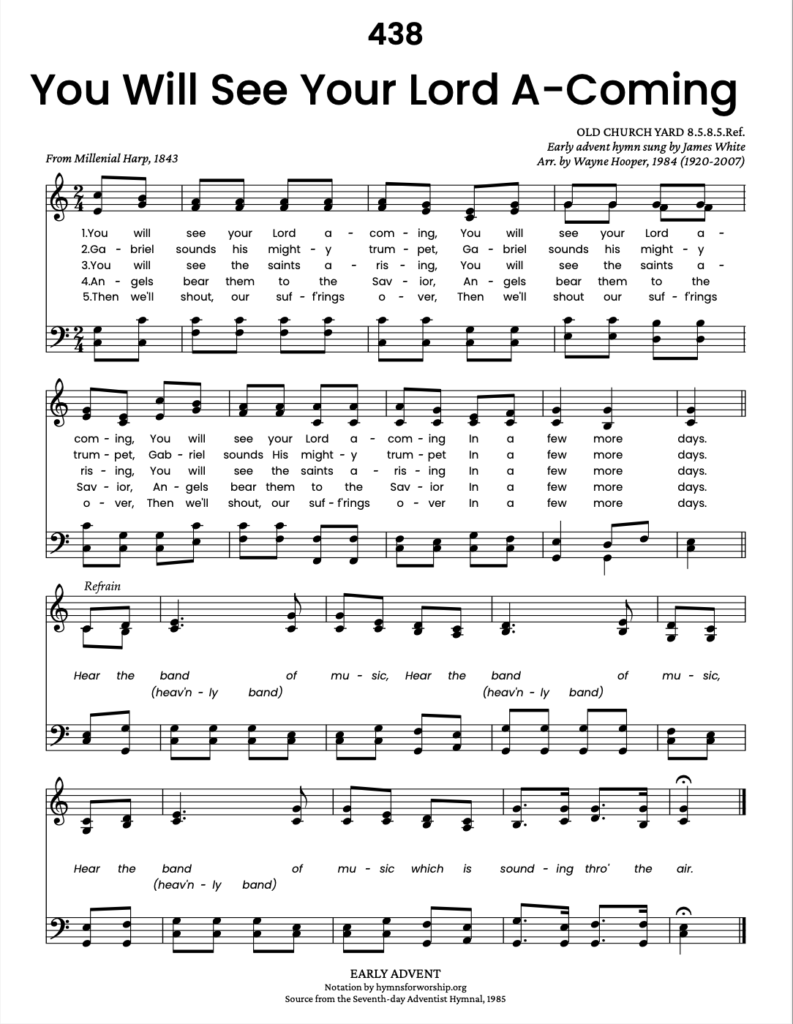
You will see your Lord a-coming,
You will see your Lord a-coming,
You will see your Lord a-coming
In a few more days.
Get the hymn sheet in other keys here
For Worship Leaders
Make each hymn more meaningful with these helpful tools: Short, ready-to-use hymn introductions for church bulletins, multiple ways to introduce a hymn based on your worship theme and in-depth history and insights to enrich your song service.
Hymn Spotlight: You Will See Your Lord A-Coming
First sung by the Millerites in the 1840s, this simple yet stirring song rang out in camp meetings, revival gatherings, and even at cemetery hillsides where believers awaited Christ’s return. James White often used it to open meetings, its repeated lines and haunting melody holding audiences in reverent stillness. Rooted in the Advent hope, it called hearers to be ready for “that great day” when Christ will come with the sound of heavenly music. Today, its preservation in our hymnal is a living link to the early Advent movement’s passion for the soon coming of Jesus.
📖 Reference: Feel free to share but please cite hymnsforworship.org when reproducing.
Introductions for Sabbath School Song Service (based on specific lesson quarterlies):
This song was one of the best known and loved of those that were sung by the Millerites. This was a group led by preacher William Miller, who not only believed in the second coming of Christ as a literal event but set the date for it to happen, first in 1843, then in October 1844. The song was sung by some at cemeteries where the Millerites gathered to be near deceased friends and relatives, hoping to ascend with them to heaven following their resurrection.
The first appearance of this lengthy hymn of nine stanzas was in Joshua Himes’ Millennial Harp, 1843. (See reprint of this on page 436; the music is in two-part harmony, and the original text has “While the old church yards hear the band of music which is sounding through the air.”) James White, one of the early pioneers of the Seventh-day Adventist Church, was a good singer and used the power of song in his public meetings. In his book Life Incidents, he tells of using this song in the year 1843:
“Litchfield Plains [Maine] was my next place of labor. The house was crowded the first evening. In fact, it was with difficulty that I found my way to the pulpit. To call the people to order, the first words they heard from me were in singing,
You will see your Lord a coming,
You will see your Lord a coming,
You will see your Lord a coming,
In a few more days,
While a band of music,
While a band of music,
While a band of music,
Shall be chanting through the air.
“The reader certainly cannot see poetic merit in the repetition of these simple lines. And if he has never heard the sweet melody to which they were attached, he will be at a loss to see how one voice could employ them so as to hold nearly a thousand persons in almost breathless silence. But it is a fact that there was in those days a power in what was called Advent singing, such as was felt in no other. It seemed to me that not a hand or foot moved in all the crowd before me till I had finished all the words of this lengthy melody. Many wept, and the state of feeling was most favorable for the introduction of the grave subject for the evening. The house was crowded three times each day, and a deep impression was made upon the entire community.”
G. B. Haining remembered hearing White sing the song, and 50 years later he wrote from memory these words for the Ellen G. White Estate in Washington, D.C.:
Chorus:
1. When the heavenly, heavenly music
Will go sounding through the air.
2. Have you given your heart to Jesus
For that great day?
3. Don’t delay your preparation
for that great day.
4. Will you spurn His offered pardon
For that great day?
5. Then you’ll wish you’d been converted
In that great day.
6. Then you’ll cry for the rocks and mountains
In that great day.
7. Then you’ll hear the trumpet sounding
in that great day.
It was this version that Wayne Hooper used to make his published choral arrangement and the one found in Advent Youth Sing, 1977.
Still another version, with a different set of words, can be found in The Seventh-day Adventist Hymn and Tune Book, 1886, known as Hymns and Tunes, under the title “Choir of Angels.” Whereas all the other versions consist of one line repeated three times for each stanza, here all four lines are different.
Ellen Jane Lorenz, in her Glory, Hallelujah! the Story of the Campmeeting Spiritual, Abingdon, 1978, says the tune carried the name THE OLD CHURCH YARD or THE OLD GRANITE STATE, and was sung by the famous “Singing Hutchinson Family” of New Hampshire. It was published mainly in Adventist hymnbooks from 1842 and onward.
The hymnal committee asked Wayne Hooper (1920- ; see Biographies) to base this present arrangement on the original melody found in Millennial Harp, 1843, in order to preserve this song that has so much significance in the history of the SDA Church.
📖 Reference: Companion to the Seventh-day Adventist Hymnal by Wayne Hooper and Edward E. White. Review and Herald Publishing Association, 1988.

Text
1
You will see your Lord a-coming,
You will see your Lord a-coming,
You will see your Lord a-coming
In a few more days.
Refrain:
Hear the band of music,
Hear the band of music,
Hear the band of music
which is sounding thro’ the air.
2
Gabriel sounds his mighty trumpet,
Gabriel sounds his mighty trumpet,
Gabriel sounds his mighty trumpet
In a few more days.
3
You will see the saints arising,
You will see the saints arising,
You will see the saints arising
In a few more days.
4
Angels bear them to the Savior,
Angels bear them to the Savior,
Angels bear them to the Savior
In a few more days.
5
Then we’ll shout, our suff’ring over,
Then we’ll shout, our suff’ring over,
Then we’ll shout, our suff’ring over
In a few more days.

Hymn Info
Biblical Reference
(a) Luke 21:27 (b) 1 Cor 15:52 (c) 1 Thess 4:17
Text Source
from Millennial Harp, 1843
Copyright
Arrangement copyright 1984 by Wayne Hooper
Theme
EARLY ADVENT
Hymn Tune
OLD CHURCH YARD
Metrical Number
8.8.8.5.Ref.
Arranged
Wayne Hooper, 1984 (1920-2001)
Tune Source
Early Advent hymn sung by James White