DOCTRINES >> ETERNAL LIFE
SDAH 429
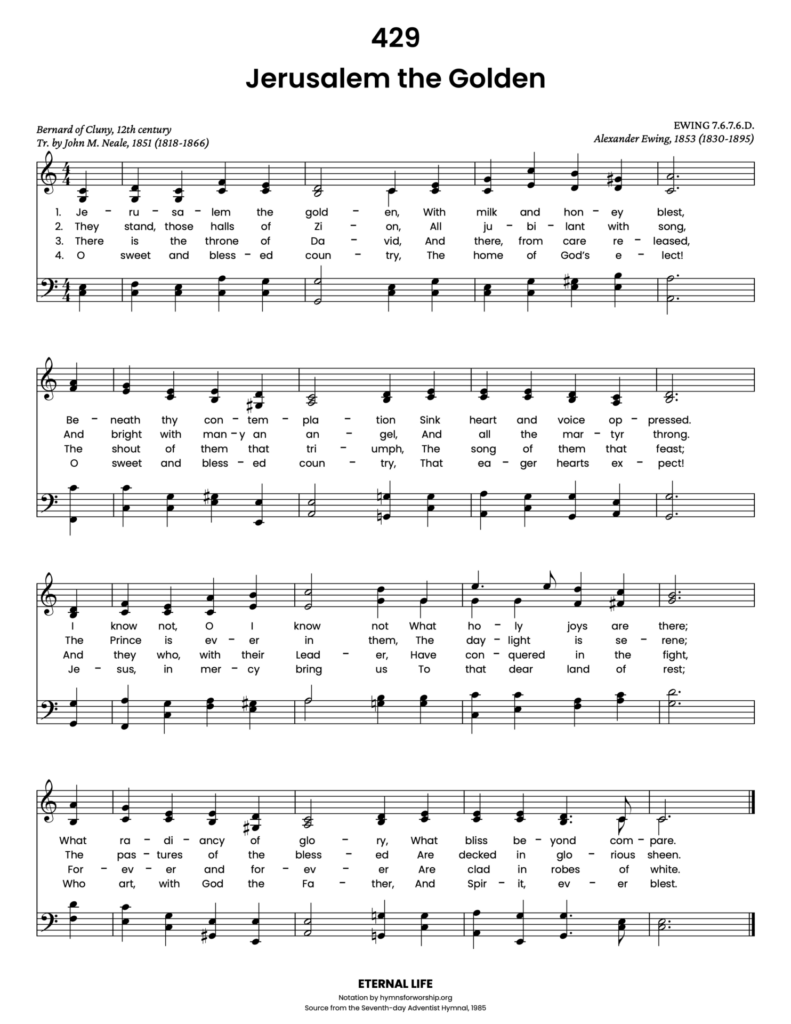
Jerusalem the golden,
With milk and honey blest,
Beneath thy contemplation
Sink heart and voice oppressed.
Get the hymn sheet in other keys here
For Worship Leaders
Make each hymn more meaningful with these helpful tools: Short, ready-to-use hymn introductions for church bulletins, multiple ways to introduce a hymn based on your worship theme and in-depth history and insights to enrich your song service.
Hymn Spotlight: Jerusalem the Golden
Drawn from Bernard of Cluny’s sweeping 12th-century poem De Contemptu Mundi—a vivid contrast between the corruption of earth and the glory of heaven—this hymn overflows with longing for the New Jerusalem. John Mason Neale’s 19th-century translation captures the joy, peace, and perfect fellowship awaiting God’s redeemed. Set to Alexander Ewing’s soaring tune, it lifts our eyes beyond the struggles of this life to the radiant city where sorrow, pain, and death are no more. For every pilgrim pressing on in faith, it is a song of homecoming and eternal hope.
📖 Reference: Feel free to share but please cite hymnsforworship.org when reproducing.
Introductions for Sabbath School Song Service (based on specific lesson quarterlies):
Bernard of Cluny was born of English parents, it is said, in Morlaix in Brittany, northern France. Others say that the name of this town was misspelled and that he was born at Morlaàs, which is in the extreme south of France. Bernard lived in the twelfth century; his birth and death dates are not known. He entered the monastery of Cluny, near Lyon, France, founded in A.D. 910, and remained there for the rest of his life. Life in the monastery was luxurious compared with the poverty and misery in the outside world. That fact, and the corruption and evil of this present world as compared with the glories of the New Jerusalem, led Bernard, in about A.D. 1145, to write a satire on the state of the world.
His poem extended to almost 3,000 lines. Entitled “De Contemptu Mundi” (On Disdain of the World), it was written in an unusual meter, dactylic hexameters. A dactyl is a foot of three syllables; long, short, short; and hexameter is six of these, although one of them can be a spondee (two long syllables) or a trochee (long, short). Bernard said that he believed that only the inspiration of the Spirit of God enabled him to write the poem in this meter. It was, of course, in Latin, and begins: Hóra novissima, témpora péssima súnt; vigilémus (the accents have been supplied), which means “recent times are the worst times; let us watch.”
Various translators have retained this meter, for example, Samuel W. Duffield in 1867:
These are the latter times,
These are not better times;
Let us stand waiting.
Or Jackson Mason in 1860:
Earth very evil is;
Time through the last of his
Journeys is hasting.
Or Gerard Moultrie in 1865:
Here we have many fears,
This is a vale of tears,
The land of sorrow;
Tears are there none at all
In that celestial hall,
In life’s bright morrow.
A similar meter and lilt, but not always in hexameters, occur in some of Tennyson’s lines in his “Charge of the Light Brigade”:
Their’s not to reason why,
Their’s but to do or die,
Noble six hundred.
In 1849 John Mason Neale (1818-1866; see Biographies) translated about 200 lines from Bernard’s poem, calling it “The Rhythm of the Heavenly Country.” It appeared in his Medieval Hymns, 1851, and from it are taken this hymn and also the hymns “Brief Life Is Here Our Portion,” “The World Is Very Evil,” and SDAH 424, “For Thee, O Dear, Dear Country.” There were 43 stanzas, mostly of eight lines each; the SDAH hymn begins with stanza 29.
EWING is named after its composer, Alexander Ewing who composed it in 1853 especially for the words of SDAH 424, “For Thee, O Dear, Dear Country.” It was originally in 3/4 time, but in 1861 in Hymns Ancient and Modern it was changed to the present rhythm. The range in the soprano is unusually great, namely, an octave and a third, from middle C to E. Ewing was a member of the Aberdeen Harmonic Choir. He handed his new composition to the conductor, William Carnie, to try out, and it was an immediate success.
Ewing was born on January 3, 1830, at Old Machar in Aberdeenshire, Scotland. He studied law at first, but turned to music. He went to Heidelberg to study and was a good pianist, cellist, and cornetist. However, music was still only a hobby. When the Crimean War broke out in 1853 he served at Constantinople and rose to the rank of lieutenant-colonel. He later served in the Chinese campaigns of 1860-1862. From 1867 to 1869 he commanded a regiment in Fredericton, New Brunswick, Canada. He was also assistant cathedral organist, choir member, and conductor of a choral society there. Then he served for 10 years in south Australia. He retired in 1889 to Taunton in Somerset, England, and died there on July 11, 1895. He wrote five anthems, some part-songs, and madrigals, but only this one hymn tune.
📖 Reference: Companion to the Seventh-day Adventist Hymnal by Wayne Hooper and Edward E. White. Review and Herald Publishing Association, 1988.

Text
1
Jerusalem the golden,
With milk and honey blest,
Beneath thy contemplation
Sink heart and voice oppressed.
I know not, O I know not
What holy joys are there;
What radiancy of glory,
What bliss beyond compare.
2
They stand, those hall of Zion,
All jubilant with song,
And bright with many an angel,
And all the martyr throng.
The Prince is ever in them,
The daylight is serene;
The pastures of the blessed
Are deck in glorious sheen.
3
There is the throne of David,
And there, from care released,
The shout of them that triumph,
The song of them that feast;
And they who, with their Leader,
Have conquered in the fight,
Forever and forever
Are clad in robes of white.
4
O sweet and blessed country,
The home of God’s elect!
O sweet and blessed country,
That eager hearts expect!
Jesus, in mercy bring us
To that dear land of rest;
Who art, with God the Father,
And Spirit, ever blest.

Hymn Info
Biblical Reference
(a) Rev 21:2; Ex 3:8 (c) Luke 1:32; Eccl 10:19; Rev 3:5
Author
Bernard of Cluny
Translator / Paraphrase
John M. Neale, 1851 (1818-1866)
Year Published
12th century
Hymn Tune
EWING
Metrical Number
7.6.7.6.D.
Composer
Alexander Eing (1830-1895)
Year Composed
1853