DOCTRINES >> ETERNAL LIFE
SDAH 423
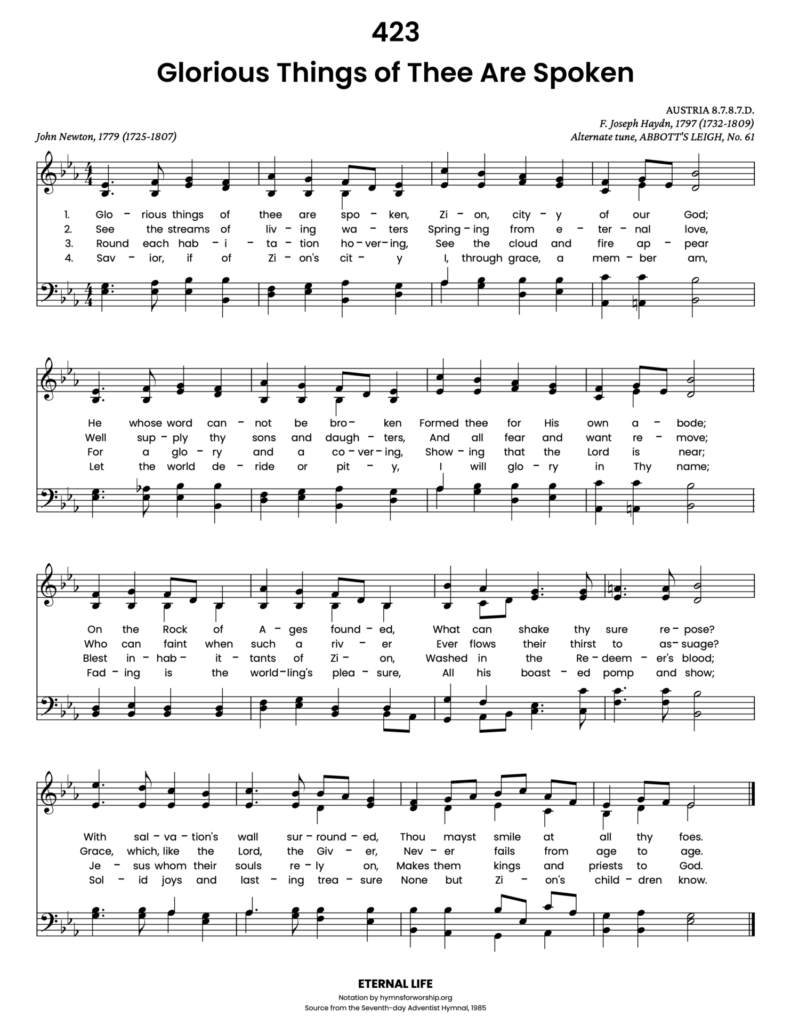
Glorious things of thee are spoken,
Zion, city of our God;
He whose word cannot be broken
Formed thee for His own abode;
Get the hymn sheet in other keys here
For Worship Leaders
Make each hymn more meaningful with these helpful tools: Short, ready-to-use hymn introductions for church bulletins, multiple ways to introduce a hymn based on your worship theme and in-depth history and insights to enrich your song service.
Hymn Spotlight: Glorious Things of Thee Are Spoken
John Newton’s 1779 hymn paints a majestic picture of Zion—the city of God—rooted in the promise of Isaiah 33:20–21. Using rich biblical imagery, it celebrates the security, blessing, and glory found only in Christ’s kingdom. Set to Haydn’s stirring tune AUSTRIA, originally written as Austria’s national anthem, the hymn calls believers to rejoice in their heavenly citizenship and live as faithful citizens of the New Jerusalem.
📖 Reference: Feel free to share but please cite hymnsforworship.org when reproducing.
Introductions for Sabbath School Song Service (based on specific lesson quarterlies):
This hymn by John Newton (1725-1807; see Biographies) appears in the Olney Hymns, 1779, under the title “Zion, or the City of God,” with the reference of Isaiah 33:20, 21. The eight lines omitted are the last halves of the original third and fourth stanzas, so SDAH’s third stanza consists of the first halves of the original third and fourth stanzas.
AUSTRIA was composed by Franz Joseph Haydn (1732-1809; see SDAH 96) specifically for words written by Lorenzo Leopold Haschka as the first national anthem for Austria. The words were “Gott erhalte Franz den Kaiser” (God Save the Emperor Francis). On his visits to London, Haydn had been greatly impressed by the British national anthem and its effect upon the people. He was stimulated to write this stirring tune, which was first played in Vienna on the emperor’s birthday, February 12, 1797. The theme was later used by Haydn in the variations in the slow movement of his string quartet in C, Opus 76, No. 3 (Emperor Quartet). It is quite possible that Haydn had heard the melody in his childhood days at Rohrau, a town on a tributary of the river Danube, for it is a Croatian folk song.
📖 Reference: Companion to the Seventh-day Adventist Hymnal by Wayne Hooper and Edward E. White. Review and Herald Publishing Association, 1988.

Text
1
Glorious things of thee are spoken,
Zion, city of our God;
He whose word cannot be broken
Formed thee for His own abode;
On the Rock of Ages founded,
What can shake thy sure repose?
With salvation’s wall surrounded,
Thou mayest smile at all thy foes.
2
See the streams of living waters
Springing from eternal love,
Well supply thy sons and daughters,
And all fear and want remove;
Who can faint when such a river
Ever flows their thirst to assuage?
Grace, which, like the Lord, the Giver,
Never fails from age to age.
3
Round each habitation hovering,
See the cloud and fire appear
For a glory and a covering,
Showing that the Lord is near;
Blest inhabitants of Zion,
Washed in the Redeemer’s blood;
Jesus, whom their souls rely on,
Makes them kings and priests to God.
4
Savior, if of Zion’s city
I, through grace, a member am,
Let the world deride or pity,
I will glory in Thy name;
Fading is the worldling’s pleasure,
All his boasted pomp and show;
Solid joys and lasting treasure
None but Zion’s children know.

Hymn Info
Biblical Reference
(a) Ps 87:3; Matt 16:18; Isa 60:18 (b) Rev 22:1 (c) Ex 13:21; Rev 1:5; Rev 5:10 (d) Ps 105:3; 1 John 2:17
Author
John Newton (1725-1807)
Year Published
1779
Hymn Tune
AUSTRIA
Metrical Number
8.7.8.7.D.
Composer
F. Joseph Haydn (1732-1809)
Year Composed
1797
Alternate Tune
ABBOT’S LEIGH, SDAH 61
Theme
ETERNAL LIFE
Recommended Reading
The general idea when it comes to hymns is that there is a close bond between the author and the composer. That the author writes a hymn and the composer invents a tune to suit it, and then provides the harmony to accompany the tune. However, such wasn’t always the case.
Many hymns actually worked vice versa wherein authors would write verses according to existing tunes. Hundreds of hymns are sung from borrowed tunes, such as secular songs, chants, and even classical works. That being said, I went ahead and researched which hymns in the SDA Hymnal were originally classical works.