DOCTRINES >> RESURRECTION OF THE SAINTS
SDAH 418
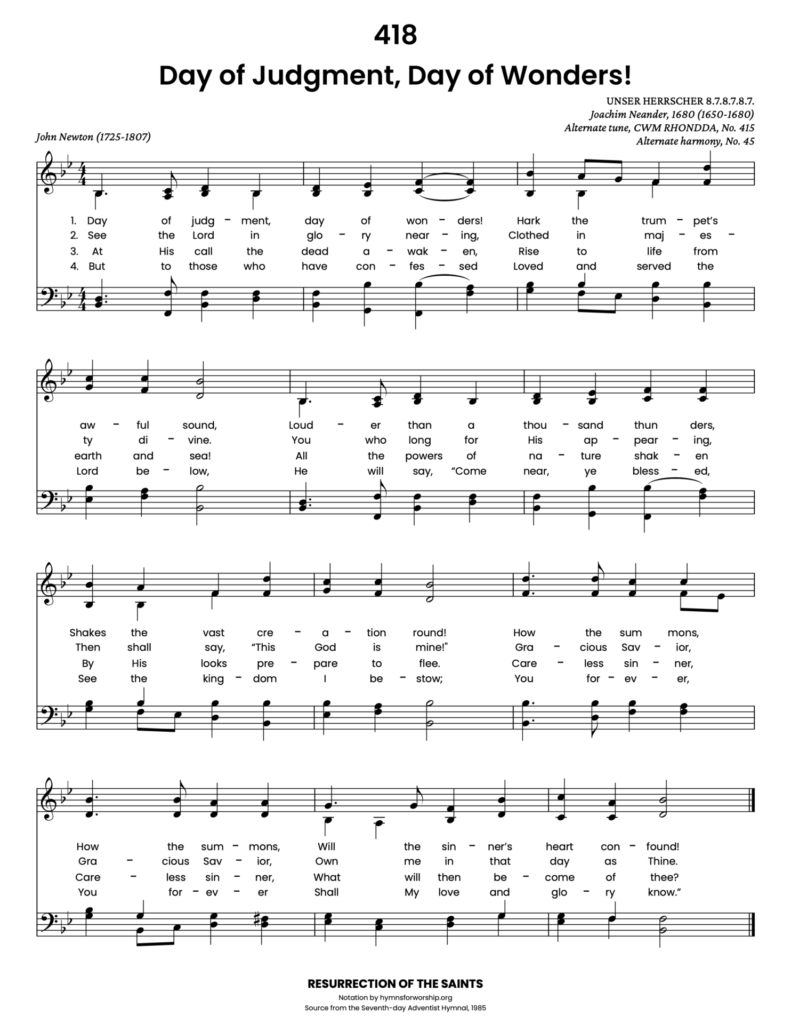
Day of judgement, day of wonders!
Hark the trumpet’s awful sound,
Louder than a thousand thunders,
Shakes the vast creation round.
Get the hymn sheet in other keys here
For Worship Leaders
Make each hymn more meaningful with these helpful tools: Short, ready-to-use hymn introductions for church bulletins, multiple ways to introduce a hymn based on your worship theme and in-depth history and insights to enrich your song service.
Hymn Spotlight: Day of Judgment! Day of Wonders!
John Newton’s paraphrase of the ancient Latin hymn Dies Irae paints a vivid picture of the final day when Christ returns in glory and judgment. Rooted in the solemn warnings of Scripture, it calls both the righteous and the unprepared to consider eternity. Sung to Joachim Neander’s majestic tune UNSER HERRSCHER, this hymn reminds us that the “great day of the Lord” is certain—and that now is the time to stand in Christ, ready to welcome Him with joy when He appears in the clouds of heaven.
📖 Reference: Feel free to share but please cite hymnsforworship.org when reproducing.
Introductions for Sabbath School Song Service (based on specific lesson quarterlies):
Dating from c. 1225, the Latin hymn “Dies Irae” is based on Zephaniah 1:14, 15: “The great day of the Lord is near. That day is a day of wrath, a day of clouds and thick darkness.” John Julian, in his Dictionary of Hymnology, 1907, tells of the universal acceptance of this hymn: “The hold which this sequence [words or stanzas following the regular prescribed reading of the Mass service] has had It has been translated upon the minds of men has been very great… It has been translated into many languages, those in German numbering about 90, and those in English about 160. In Great Britain and America no hymnbook of any note has appeared in the past hundred years without the ‘Dies Irae’ being directly or indirectly represented therein. . . . Daniel, a German writer,… says, ‘Even those to whom the hymns of the Latin church are almost entirely unknown, certainly know this one.””
Literally hundreds of composers down through the centuries have been challenged to set these dramatic words to music. As evidence that interest in the subject of the judgment has been waning, the SDAH Committee found, in the hymnbooks used by major denominations today, only one version of this hymn on the judgment-“The Day Is Surely Drawing Near,” in Lutheran Book of Worship, 1978. (The Episcopal Hymnal 1940 has a translation beginning “Day of wrath! O day of mourning.”)
Under the date of June 1775, this entry appears in the diary of John Newton (1725-1807; see Biographies): “Sunday, 26th, spoke in the evening from a hymn on the day of judgment.” Previously he had mentioned the hymn, and said it took him two days to write. It was first published in Olney Hymns, 1779, which he worked on with poet William Cowper (see SDAH 107).
The great British hymnologist Samuel Duffield, in his English Hymns, 1888, tells how the hymn might have been written: “John Newton sailed from Liverpool in August 1750 as commander of a staunch ship. . . . Having since he was taken to sea by his father (a sea captain), in his eleventh year. By leisure, he now revived his studies, which had been practically suspended the help of a Latin dictionary he attacked the classics, and mastered Horace, Juvenal, Livy, Caesar, and Sallust. He added to this list in the space of two or three voyages, and read Terence, Virgil, Cicero, and such modern writers as Englishman and Buchanan. . . . It must have been in some such manner that he gradually fell in with the Latin hymns-at least with the ‘Dies Irae,’ for the present hymn is nothing if not a paraphrase of that grand sequence.”
The tune UNSER HERRSCHER, also used for SDAH 45, “Open Now Thy Gates of Beauty,” was written by Joachim Neander (1650-1680; see Biographies), for the German text “Unser Herrscher, unser König” (Our Ruler, Our King) and published in the original edition of his works entitled Alpha and Omega, 1680. There were 19 of his melodies in that book. In some hymnals this tune is variously called NEANDER, MAGDEBURG, or EPHESUS.
📖 Reference: Companion to the Seventh-day Adventist Hymnal by Wayne Hooper and Edward E. White. Review and Herald Publishing Association, 1988.

Text
1
Day of judgment, day of wonders!
Hark the trumpet’s awful sound,
Louder than a thousand thunders,
Shakes the vast creation round!
How the summons, How the summons
Will the sinner’s heart confound!
2
See the Lord in glory nearing,
Clothed in majesty divine,
You who long for His appearing,
Then shall say, “This God is mine!”
Gracious Savior, Gracious Savior,
Own me in that day as Thine.
3
At His call the dead awaken,
Rise to life from earth and sea!
All the powers of nature shaken
By His looks prepare to flee.
Careless sinner, Careless sinner,
What will then become of thee?
4
But to those who have confessed
Loved and served the Lord below,
He will say, “Come near, ye blessed,
See the kingdom I bestow;
You forever, You forever
Shall My love and glory know.”

Hymn Info
Biblical Reference
(a) Heb 10:27; 1 Cor 15:52 (b) Isa 25:9 (c) Rev 20:12, 13; Matt 24:29 (d) Matt 25:34
Author
John Newton (1725-1807)
Hymn Tune
UNSER HERRSCHER
Metrical Number
8.7.8.7.8.7.
Composer
Joachim Neander (1650-1680)
Year Composed
1680
Alternate Tune and Harmony
CWM RHONDDA, SDAH 415; Alternate harmony SDAH 45