DOCTRINES >> COMMUNION
SDAH 406
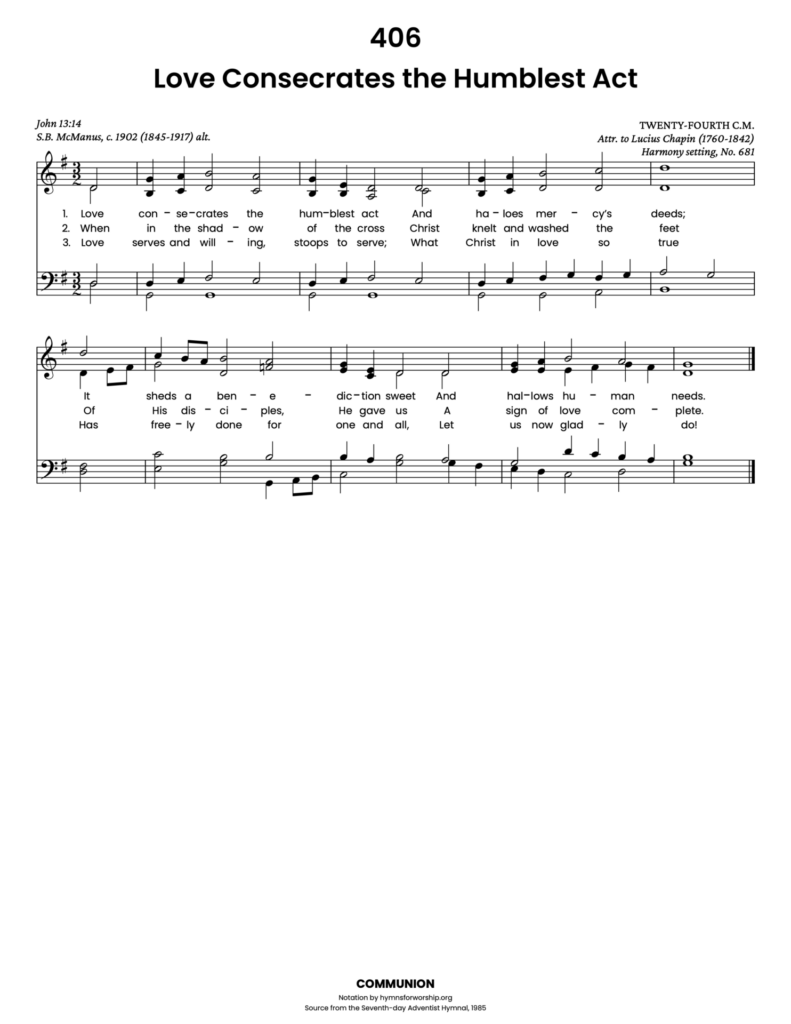
Love consecrates the humblest act
And haloes mercy’s deeds;
It sheds a benediction sweet
And hallows human needs.
Get the hymn sheet in other keys here
For Worship Leaders
Make each hymn more meaningful with these helpful tools: Short, ready-to-use hymn introductions for church bulletins, multiple ways to introduce a hymn based on your worship theme and in-depth history and insights to enrich your song service.
Hymn Spotlight: Love Consecrates the Humblest Act
The ordinance of humility, or foot-washing, is a cherished part of the Seventh-day Adventist Communion service. Through this simple act, we follow Christ’s example in John 13, setting aside pride and self to serve one another. This hymn, first published by the Mennonite Church in 1902, beautifully captures the spirit of selfless service and love that transforms even the smallest deed into an offering to God.
Set to the heartfelt tune TWENTY-FOURTH, a gem of early American hymnody, the melody’s folk-like sincerity invites us to reflect on the sacredness of simple, Christ-like actions. In a world where greatness is often equated with power, this hymn reminds us that true greatness is found in humble service, done in the name of Jesus.
📖 Reference: Feel free to share but please cite hymnsforworship.org when reproducing.
Introductions for Sabbath School Song Service (based on specific lesson quarterlies):
G.B. McManus, the writer of this hymn about foot washing, was a devout Methodist. Its first publication was by Mennonites, and its presence in SDAH can be credited to Lutherans, who included it in their Lutheran Book of Worship, 1978. However, Seventh-day Adventists are the very few who are not content merely to sing about Christ washing the disciples’ feet; they regularly follow His counsel in John13:14-17. The ordinance of humility is a very meaningful Communion service-a time for putting aside differences, a time to tell a person of our love and appreciation, and a time to show our willingness to be a servant.
This text was first published by the Mennonite church, Elkhart, Indiana, in Church and Sunday School Hymnal, 1902. SDAH uses the somewhat altered version from Lutheran Book of Worship, 1978, and we are indebted to the companion to that volume for the following biographical sketch.
MELODY. C. M.
There is
land of pure delight,
Where saints immortal reign;
Infinite day
excludes the night, And pleasures banish pain.
Two-part version of TWENTY-FOURTH as it appears in Joshua Leavitt’s Christian Lyre. Notice the sharped leading tone in the second line.
Silas Bettes McManus was born September 17, 1845, at Rootstown, Ohio. On the Bettes side, his grandfather was a captain in the Revolu- tionary War and his grand- mother was a French woman who knew General Lafayette. In 1863 the McManus family moved to Marsh Brook Farm near Lima, Indiana, where Silas lived the rest of his life. He studied medicine at Ft. Wayne Medical College and the University of Michigan, but before entering practice, he gave it up to become an author, writing for several magazines and newspapers. For two years he was a state senator, earning a reputation for his honesty in representing the interests of his constituents. His deep love for the country life was seen in his Rural Rhymes, 1898. He died at Marsh Brook, April 15, 1917.
The tune TWENTY-FOURTH (also known as PRIMROSE) is called by Erik Routley “one of the finest Common Meter tunes [8.6.8.6.] down” (The Music of Christian Hymns, 1981). It appeared in Wyeth’s Repository of Sacred Music, Part Second, 1813, where it was credited to Chapin, and set to Watts’s “Salvation! Oh, the Joyful Sound.” Several of the Southern shaped-note tune books have included it-William Walker’s Southern Harmony, 1835; Carden’s Missouri Harmony, 1837; and B. F. White’s Sacred Harp, 1844, the present edition of which says it was composed by Amzi Chapin. Recent scholarship seems to indicate that it belongs to his brother, Lucius, born in 1760 in Springfield, Massachusetts, to a family that went all the way back to Samuel Chapin, who came over from England in 1636. In 1775 young Lucius was a fifer in the Continental Army in Boston. He enlisted the following year, fighting in several historic battles. He was with Washington in the terrible winter of 1777 to 1778 at Valley Forge, suffering frostbite that caused him lifelong problems. After the war, he entered a career as a singing school teacher, conducting classes in the New England states. In 1787 he moved to the Shenandoah Valley, Virginia, where he taught in several counties and, as a devout Presbyterian, generally promoted the cause of sacred music. The year 1794 found him on the move again, this time to Vernon, Kentucky. He stayed there for 40 years, but he did some traveling to neighboring states, teaching and singing. It is thought possible that one of his students was Ananias Davisson, the compiler of Kentucky Harmony, 1816. Chapin died December 24, 1842. The Chapin brothers, Amzi and Lucius, were accomplished musicians of their time and made a strong contribution to the hymn singing of this period in America.
It is easy to recognize the melodic and harmonic similarity of this tune to NEW BRITAIN, which SDAH uses for “Amazing Grace,” No. 108.
📖 Reference: Companion to the Seventh-day Adventist Hymnal by Wayne Hooper and Edward E. White. Review and Herald Publishing Association, 1988.

Text
1
Love consecrates the humblest act
And haloes mercy’s deeds;
It sheds a benediction sweet
And hallows human needs.
2
When in the shadow of the cross
Christ knelt and washed the feet
Of His disciples, He gave us
A sign of love complete.
3
Love serves and willing, stoops to serve;
What Christ in love so true
Has freely done for one and all,
Let us now gladly do!

Hymn Info
Biblical Reference
(b) John 13:14
Author
S.B. McManus (1845-1917)
Year Published
c. 1902
Performance Suggestions
Unison
Copyright
Setting copyright 1978 Lutheran Book of Worship. Used by permission of Augsburg Publishing House.
Hymn Tune
TWENTY-FOURTH
Metrical Number
C.M.
Composer
Attr. to Lucius Chapin (1760-1842)
Alternate Tune Harmony
SDAH 681