DOCTRINES >> COMMUNION
SDAH 403
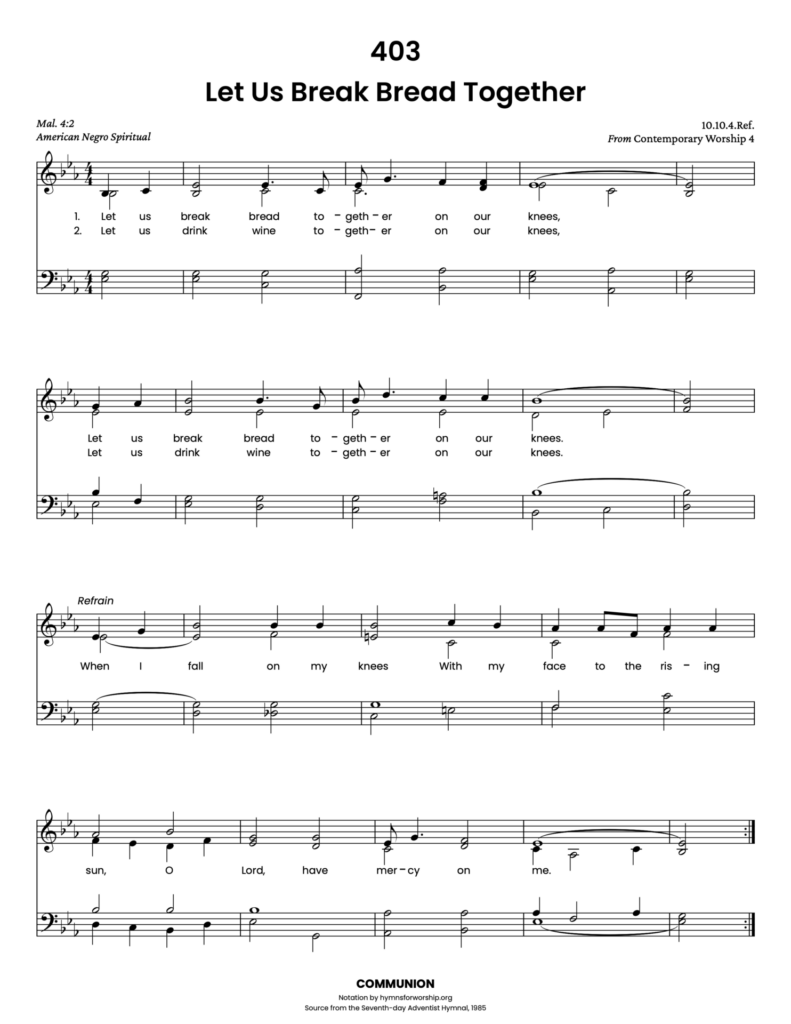
Let us break bread together on our knees,
let us break bread together on our knees.
When I fall on my knees with my face to the rising sun,
O Lord, have mercy on me.
Get the hymn sheet in other keys here
For Worship Leaders
Make each hymn more meaningful with these helpful tools: Short, ready-to-use hymn introductions for church bulletins, multiple ways to introduce a hymn based on your worship theme and in-depth history and insights to enrich your song service.
Hymn Spotlight: Let Us Break Bread Together
This beloved spiritual traces its roots to the secret gatherings of enslaved African Americans, where it may have served as a signal for worship in hiding. Later adapted as a Communion hymn, its poetic imagery—kneeling in the morning sun, breaking bread, and drinking the wine—symbolizes humble surrender and joyful fellowship with Christ. As Ellen White reminds us, at the Lord’s table we are to bask not in sorrow but in the saving light of the Sun of Righteousness. May this hymn draw us into deeper communion with our Redeemer.
📖 Reference: Feel free to share but please cite hymnsforworship.org when reproducing.
Introductions for Sabbath School Song Service (based on specific lesson quarterlies):
In the days of slavery in the United States, Blacks were often forbidden to have their own gatherings, but many did so anyway in secret. Miles Mark Fisher, in his Negro Slave Songs in the United States, 1953, says that this is one of the songs they used as a signal to convene a secret meeting. The first two stanzas were added after the Civil War, making it a Communion hymn.
The Bible uses the sun as a symbol of God: “For the Lord God is a sun and shield” (Ps. 84:11); “But unto you that fear my name shall the Sun of righteousness arise with healing in his wings” (Mal. 4:2). Ellen G. White that Jesus used the sun as a symbol of Himself: “It was morning; the sun had just risen above the Mount of Olives, and its rays fell with dazzling brightness on the marble palaces, and lighted up the gold of the Temple walls, when Jesus, pointing to it, said, ‘I am the light of the world’ ” (The Desire of Ages, pp. 463, 464). She also used the sun as a symbol in her comments on the Lord’s Supper: “As the Lord’s disciples gather about His table, they are not to remember and lament their shortcomings. in the shadow of the cross, but in its saving light. They are to open the soul They are not to stand to the bright beams of the Sun of Righteousness” (Ibid., p. 659).
Ordinarily, we do not partake of the bread and wine, emblems of Christ’s body and blood, on our knees in the service. Seldom do we sing praise songs on our knees, nor gather for the Communion service early in the morning. All of these expressions are poetic imagery and need to be understood and appreciated in the same way as with the graphic imagery in all hymns and poetry.
The arrangement of the music was made by Leland Sateren (1913- ; see SDAH 407) and first appeared in Contemporary Worship 4: Hymns for Baptism and Holy Communion, 1972. In 1978 it was included in Lutheran Book of Worship.
📖 Reference: Companion to the Seventh-day Adventist Hymnal by Wayne Hooper and Edward E. White. Review and Herald Publishing Association, 1988.

Text
1
Let us break bread together on our knees,
let us break bread together on our knees.
When I fall on my knees with my face to the rising sun,
O Lord, have mercy on me.
2
Let us drink wine together on our knees,
let us drink wine together on our knees.
When I fall on my knees with my face to the rising sun,
O Lord, have mercy on me.
3
Let us praise God together on our knees,
let us praise God together on our knees.
When I fall on my knees with my face to the rising sun,
O Lord, have mercy on me.

Hymn Info
Biblical Reference
Mal 4:2; (a) Acts 2:46
Text Source
American Negro Spiritual
Copyright
Arrangement copyright 1972 Contemporary Worship 4: Hymns for Baptism and Holy Communion. Used by permission of Augsburg Publishing House.
Metrical Number
10.10.4.Ref.
Tune Source
from Contemporary Worship 4