GOSPEL >> Salvation & Redemption
SDAH 336
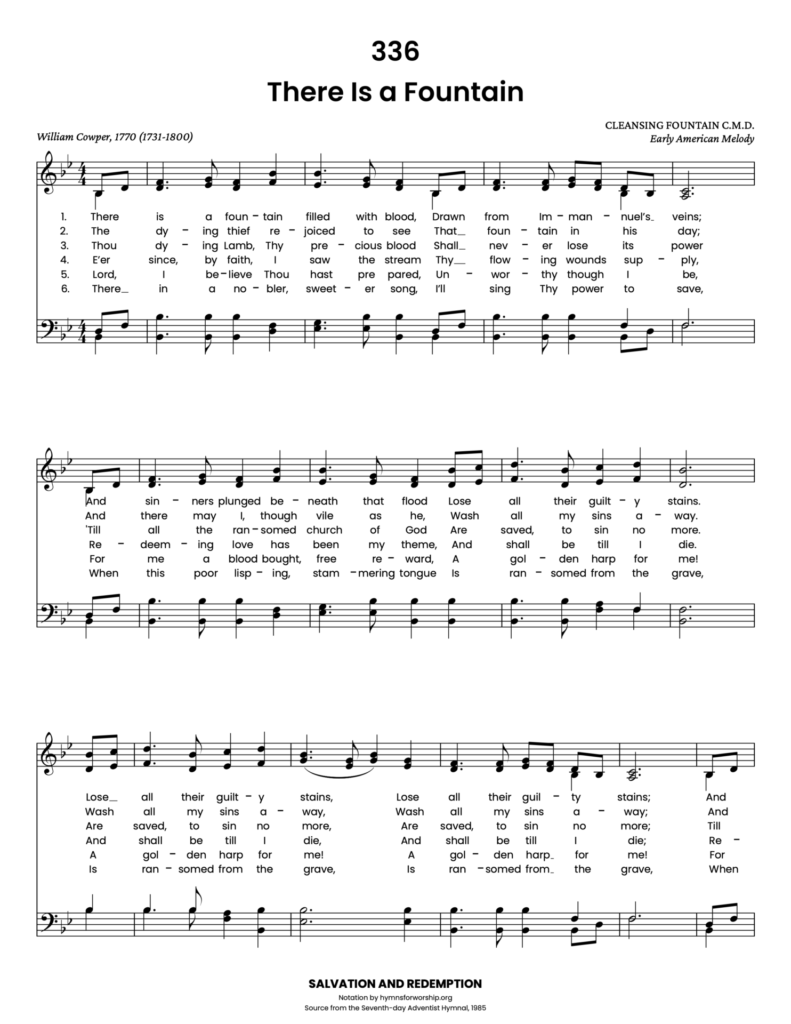
There is a fountain filled with blood drawn from Emmanuel’s veins;
And sinners plunged beneath that flood lose all their guilty stains.
Lose all their guilty stains, lose all their guilty stains;
And sinners plunged beneath that flood lose all their guilty stains.
This hymn appears in:
Get the hymn sheet in other keys here
For Worship Leaders
Make each hymn more meaningful with these helpful tools: Short, ready-to-use hymn introductions for church bulletins, multiple ways to introduce a hymn based on your worship theme and in-depth history and insights to enrich your song service.
Hymn Spotlight: There Is a Fountain
William Cowper wrote this deeply personal hymn in 1770, following a period of mental anguish. Titled “Praise for the Fountain Opened,” it reflects his healing and renewed faith in Christ’s cleansing blood, drawn from Zechariah 13:1. The original seven stanzas trace Cowper’s spiritual journey—from guilt to assurance, from brokenness to confident praise. The tune, CLEANSING FOUNTAIN, is a pentatonic melody (using just five notes), giving it a plaintive, folk-like character that resonates with heartfelt simplicity. As we sing, we are invited to join Cowper in celebrating God’s grace that washes away all sin—past, present, and future.
📖 Reference: Feel free to share but please cite hymnsforworship.org when reproducing.
Introductions for Sabbath School Song Service (based on specific lesson quarterlies):
William Cowper (1731-1800; see SDAH 107) wrote this hymn of seven stanzas in 1770, after an attack of temporary insanity. It appeared in Richard Conyers’ in Collection of Psalm and Hymns, 1772, and then later as No. LXXIX in Olney Hymns, 1779. The last half of the sec0nd stanza as originally written shows Cowper’s recovery from his illness and his supreme confidence in God’s saving power. His words are in the past tense and express his spiritual experience at the time:
And there have I, as vile as he,
Wash’d all my sins away.
A change in the last line from “I’ll sing. . . when this . . . tongue lies silent in the grave” was made to accord with the doctrine of the unconscious sleep of death before the resurrection. Stanza 6 is Cowper’s fifth, and stanza 5 is his sixth, which mentions the “golden harp” and thus leads naturally into the omitted stanza, which is:
‘Tis strung, and tun’d, for endless years,
And form’d by power divine;
To sound in God the Father’s ears
No other name but Thine.
The title of the hymn was “Praise for the Fountain Opened,” which is based on the words “There shall be a fountain opened . . . for sin and for uncleanness” (Zech. 13:1). Cowper also wrote SDAH107, “God Moves in Mysterious Way,” and SDAH 315, “O for a Closer Walk!)
CLEANSING FOUNTAIN, an early American pentatonic melody, uses only 5 notes of the ordinary eight-note scale. If transposed to the correct key, it can be played entirely on the black notes of the piano. Pentatonic tunes omit the fourth and seventh notes of the well-known octave and are typical of many Scottish airs, e.g., “Loch Lomond.” They are also common in African melodies and hence in tunes used by, and popular among, North American negroes, for example: “Nobody knows the trouble I see.” Examples of such tunes in SDAH are BRADBURY, No. 190; I LOVE THEE, No. 236; and the unnamed tune for No. 279
📖 Reference: Companion to the Seventh-day Adventist Hymnal by Wayne Hooper and Edward E. White. Review and Herald Publishing Association, 1988.

Text
1
There is a fountain filled with blood drawn from Emmanuel’s veins;
And sinners plunged beneath that flood lose all their guilty stains.
Lose all their guilty stains, lose all their guilty stains;
And sinners plunged beneath that flood lose all their guilty stains.
2
The dying thief rejoiced to see that fountain in his day;
And there may I, though vile as he, wash all my sins away.
Wash all my sins away, wash all my sins away;
And there may I, though vile as he, wash all my sins away.
3
Thou dying Lamb, Thy precious blood shall never lose its power
Till all the ransomed church of God are saved, to sin no more.
Are saved, to sin no more, are saved, to sin no more;
Till all the ransomed church of God are saved, to sin no more.
4
E’er since, by faith, I saw the stream Thy flowing wounds supply,
Redeeming love has been my theme, and shall be till I die.
And shall be till I die, and shall be till I die;
Redeeming love has been my theme, and shall be till I die.
5
Lord, I believe Thou hast prepared, unworthy though I be,
For me a blood-bought free reward, a golden harp for me!
A golden harp for me! A golden harp for me!
For me a blood-bought free reward, a golden harp for me!
6
There in a nobler, sweeter song, I’ll sing Thy power to save,
When this poor lisping, stammering tongue is ransomed from the the grave.
Is ransomed from the grave, is ransomed from the grace;
When this poor lisping, stammering tongue is ransomed from the the grave.

Hymn Info
Biblical Reference
(a) Zech 13:1 (b) Luke 23:42 (e) Rev 14:2
Author
William Cowper (1731-1800)
Year Published
1770
Hymn Tune
CLEANSING FOUNTAIN
Metrical Number
C.M.D.
Tune Source
Early American Melody
Theme
SALVATION & REDEMPTION
Watch
Cowper was privileged to be born into the home of people who were members of the highest ranks of England’s societies. His father was a chaplain to King George II while his mother was a member of a prominent family of English royalty.
He had obvious talents in poetry, translating and letter writing, while a student at Westminster Abbey. But his father pushed him into a law career, a career in which he utterly disdained.