JESUS CHRIST >> SECOND ADVENT
SDAH 200
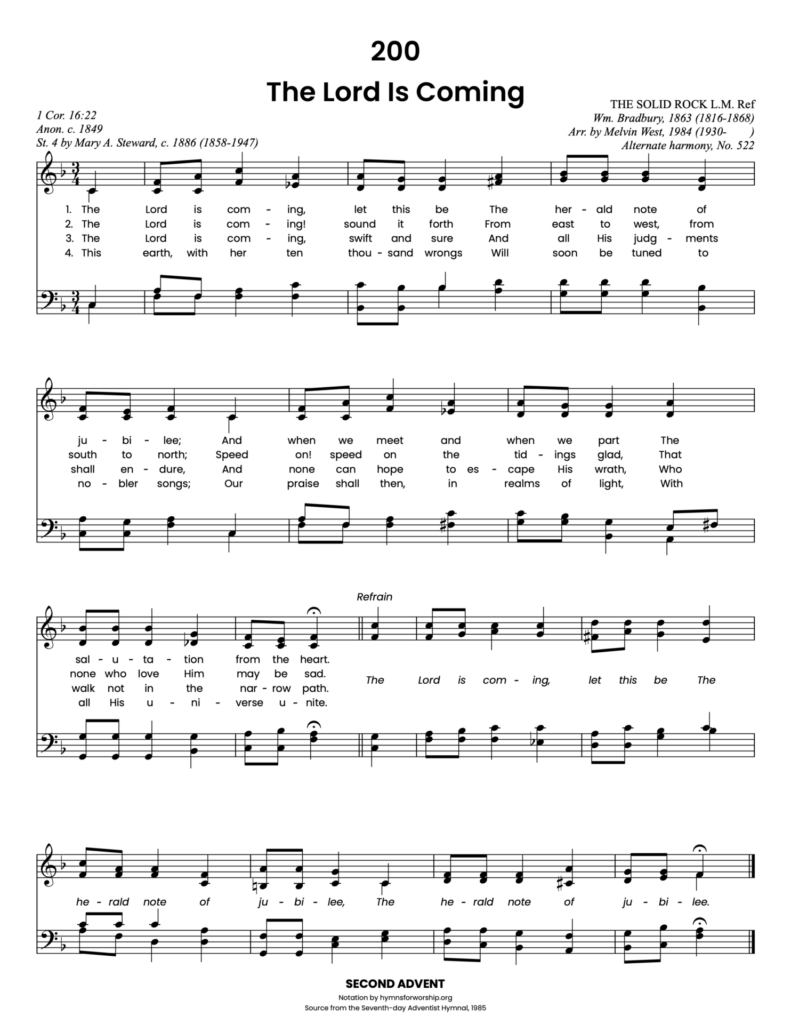
The Lord is coming, let this be
The herald note of jubilee;
And when we meet and when we part
The salutation from the heart.
Get the hymn sheet in other keys here
For Worship Leaders
Make each hymn more meaningful with these helpful tools: Short, ready-to-use hymn introductions for church bulletins, multiple ways to introduce a hymn based on your worship theme and in-depth history and insights to enrich your song service.
Hymn Spotlight: The Lord Is Coming
An early Adventist favorite, this hymn was often sung with the greeting “Maranatha!”—the Lord is coming. First published by James White in 1855, it captures the joyful anticipation of Christ’s return.
The current pairing with the familiar tune THE SOLID ROCK reinforces the hymn’s steady hope.
As we await His return, may this hymn keep us watching, praying, and ready to meet our King.
📖 Reference: Feel free to share but please cite hymnsforworship.org when reproducing.
Introductions for Sabbath School Song Service (based on specific lesson quarterlies):
The Son of man regains what Adam lost. It also suggests that He shares common ground with humanity. The title Son of man points to His bond with humankind. From the broad context of the Scriptures, we can infer that the Son of man not only represents His people in the heavenly tribunal, but He also can identify with them because He partakes of their human nature (Heb. 2:14, Heb. 4:15). We also should note that the Son of man of Daniel 7 must be identified with the Prince of the Host (Dan. 8:11), the “man clothed in linen” (Dan. 10:5), and Michael (Dan. 10:13, Dan. 12:1). To conclude, the Son of man of Daniel 7 is clearly the Messiah Jesus Christ, who comes to the presence of God the Father as a representative of the saints (1 John 2:1) on the antitypical day of atonement. (Lesson 8, 1st Quarter 2020 – Wednesday, The Coming of the Son of Man, 2/19/2020)
When God commanded Moses to build a sanctuary, He made this promise: “I will walk among you, and will be your God, and ye shall be My people.” (Leviticus 26:11, 12). The coming of Christ to be with God’s people is the message of the services in the sanctuary that was built by Moses. What a great day it will be for God’s people when this promise will be fulfilled at the second coming of Jesus to be with all of God’s people forever. (Lesson 11, 2nd Quarter 2021 -Sunday, Relationships, 6/6/2021)
We are told that the early Adventist believers would greet each other with the word Maranatha, which means “The Lord is coming” (see 1 Cor. 16:22). This seems to be borne out by the lines from the first stanza, “And when we meet and when we part, the salutation from the heart.” James White (1821–1881) included this anonymous poem in his second little hymnal, Hymns for Those Who Keep the Commandments of God and the Faith of Jesus, 1855, printed on the steam press at Rochester, New York. (The first hymnal he edited was in 1849.) Evidently this hymn was much loved among the Advent believers, for it is found in nearly every SDA hymnal printed since then.
In the original were also these stanzas:
- The Lord is coming! saints rejoice!
We soon shall hear His glorious voice,
Majestic, uttered from afar,
As on He hastes His conquering car.
- The Lord is coming! vengeful, dire
Are all His judgments and His ire,
And none can hope t’ escape His wrath,
Who walk not in the narrow path.
- The Lord is coming! seas retire!
Ye mountains melt to liquid fire!
Ye oceans cease to ebb and flow!
His stately steppings ye should know.
- The Lord is coming! who shall stand?
Who shall be found at His right hand?
He that hath the white garments on
That Christ our righteous King hath won.
- The Lord is coming: watch and pray!
Watch ye, and haste unto the day;
So shalt thou then escape the snare,
And Christ’s eternal glory share.
The fourth stanza in SDAH is the second stanza of another hymn by Mary A. Steward (1858–1947) that had the same title, “The Lord Is Coming,” No. 885 in the Seventh-day Adventist Hymn and Tune Book, 1886, most often referred to as Hymns and Tunes.
The Seventh-day Adventist Encyclopedia gives the following account of Mary A. Steward: “Chief compiler and editor of the first Index to the Writings of Ellen G. White. She was a daughter of a pioneer SDA minister, T. M. Steward, and was educated at Battle Creek College. In 1880 she joined the staff of the Review and Herald as a proofreader; in 1892 she went to work for Dr. J. H. Kellogg; about the year 1900 she became one of Mrs. White’s office assistants, going with her to Tennessee, where she remained to teach at Graysville Academy and to work in the proofroom of the Southern Publishing Association. In 1906 she rejoined the staff of Mrs. White and remained there until Mrs. White died [1915]. Afterward she worked as copy editor at the Review and Herald until 1937.”
It is not known what tune the pioneers used for this Long Meter hymn. The Church Hymnal, 1941, carried over WARRINGTON from Hymns and Tunes, but according to a survey of pastors, it never really caught on and was seldom sung. The committee decided to wed this historic text to the well-known tune THE SOLID ROCK, which is also retained for use with the text “My Hope Is Built on Nothing Less” (see SDAH 522). The tune is by William B. Bradbury (1816–1868; see Biographies).
This harmonization is by Melvin West (1930– ; see Biographies). For variety in performance, sing two or three stanzas with the accompanist playing SDAH 522. Then on the final stanza, ask all to sing in unison on the melody while the accompanist plays West’s harmonization for SDAH 200; as a descant, the sopranos sing the alto part an octave higher.
Stanza:
1 – 1 Corinthians 16:22

Text
1
The Lord is coming, let this be
The herald note of jubilee;
And when we meet and when we part
The salutation from the heart.
Refrain:
The Lord is coming, let this be
The herald note of jubilee,
The herald note of jubilee.
2
The Lord is coming, sound it forth
From east to west, from south to north;
Speed on! Speed on the tidings glad,
That none who love Him may be sad.
3
The Lord is coming, swift and sure
And all His judgments shall endure,
And none can hope to escape His wrath,
Who walk not in the narrow path.
4
This earth, with her ten thousand wrongs
Will soon be tuned to nobler songs;
Our praise shall then, in realms of light,
With all His universe unite.

Hymn Info
Biblical Reference
(r) 1 Cor 16:22
Author
Anonymous; St. 4 by Mary A. Steward (1858-1947)
Year Published
1886
Copyright
Arrangement copyright 1984 by Melvin West
Hymn Tune
THE SOLID ROCK
Metrical Number
L.M.Ref.
Composer
Wm. B. Bradbury (1816-1868)
Alternate Harmony
SDAH 522
Recommended Reading
The original writer of this poem is anonymous. It was written around 1849 but it first appeared in the 1852 hymnal, Hymns for Second Advent Believers, which James White compiled. Apparently, the words were loved and well-received among the Adventists that it was found in every SDA hymnal printed since then. The original poem has eight stanzas.
The original writer of this poem is anonymous. It was written around 1849 but it first appeared in the 1852 hymnal, Hymns for Second Advent Believers, which James White compiled. Apparently, the words were loved and well-received among the Adventists that it was found in every SDA hymnal printed since then. The original poem has eight stanzas.