JESUS CHRIST >> LOVE OF CHRIST FOR US
SDAH 194
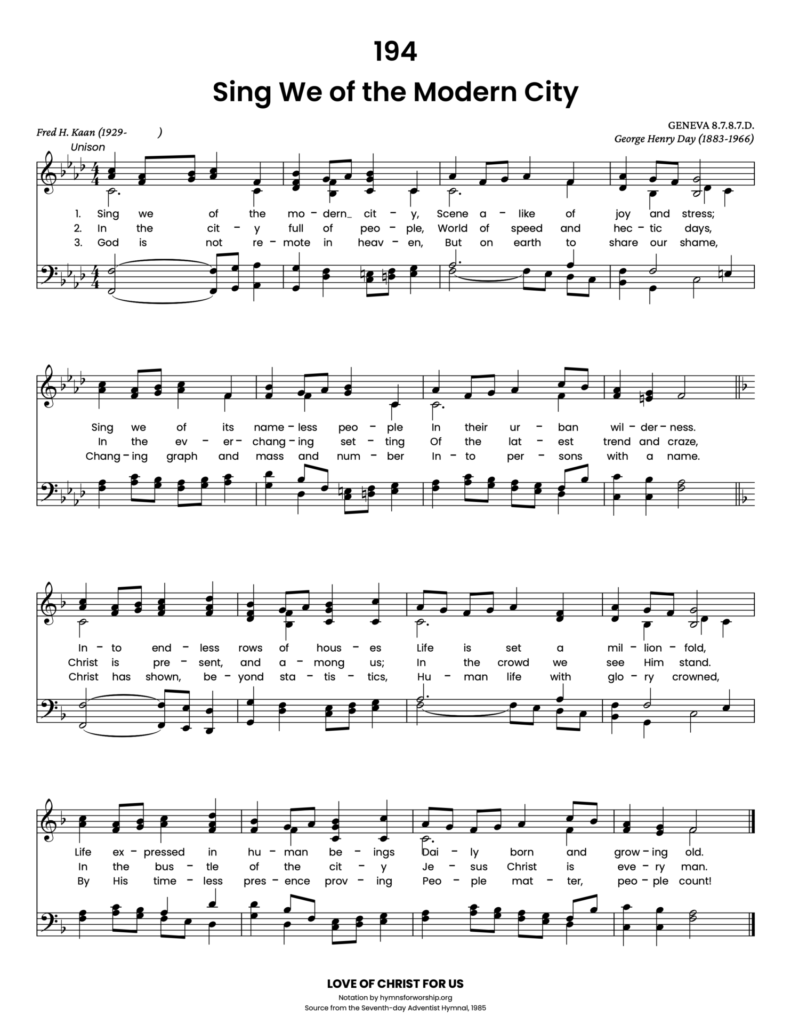
Sing we of the modern city,
Scene alike of joy and stress;
Sing we of its nameless people
In their urban wilderness.
Get the hymn sheet in other keys here
For Worship Leaders
Make each hymn more meaningful with these helpful tools: Short, ready-to-use hymn introductions for church bulletins, multiple ways to introduce a hymn based on your worship theme and in-depth history and insights to enrich your song service.
Hymn Spotlight: Sing We of the Modern City
This contemporary hymn by Fred Kaan draws attention to Christ’s presence in today’s world. Written in response to the hymn “Sing We of the Golden City,” it highlights Christ’s concern for suffering humanity in urban life. The tune GENEVA by George H. Day, steady and thoughtful, anchors the hymn’s call to compassion. May this hymn stir us to reflect Christ’s care to those in need around us.
📖 Reference: Feel free to share but please cite hymnsforworship.org when reproducing.
Introductions for Sabbath School Song Service (based on specific lesson quarterlies):
This is one of the most famous hymns written by Frederik Herman Kaan (1929– ; see Biographies), contemporary Congregational minister of England. He wrote it as a negative reaction to Felix Adler’s hymn written in 1904, “Sing We of the Golden City.” Kaan felt that while we should not ignore the glorious promise of the heavenly city of the future, we should direct our attention also to the modern earthly cities and their multiple problems. The hymn dwells on a favorite theme of his, “The Humanity of Christ.” Not only was He human, but He chooses to make His presence felt among us in the lives we live, here and now. Not only was He an historical Jesus, but a Savior who cares about us in the present tense. What this hymn is all about might be summed up in the final phrase, “People matter people count!”
This intensely personal touch is inherent in the gospel. Jesus said that “the very hairs of your head are all numbered. … Ye are of more value than many sparrows” (Luke 12:7). He also related the parable of the one lost sheep in the flock of 100, the one lost coin from the 10 pieces of silver (Luke 15:4, 8).
The tune is named for Geneva, New York, where George Henry Day was organist and choirmaster at Trinity Church for 31 years. Born September 13, 1883, in New York City, Day studied with E. S. Barnes (see SDAH 142), and became a fellow of the American Guild of Organists. After earning degrees at the New York University and New York College of Music, he received the D. Mus. from Lincoln and Jefferson University in 1923. His experience included the post of organist at churches in New York City; Wilmington, Delaware; and Rochester, New York. He was very active, serving in several positions in the AGO. His 400 publications include three cantatas, anthems, organ pieces, and hymn tunes. He died at Geneva, New York, on November 23, 1966.
GENEVA was composed in 1940, and first appeared in the Episcopal Hymnal 1940, with the text “Not Alone for Mighty Empire,” by William Pierson Merrill. With this same text it is in Lutheran Book of Worship, 1978. A quick look at the architecture of Day’s tune gives the impression that all four of the lines are basically the same music. However, the change of key from A-flat to F minor halfway through makes the same melody come alive again as fresh and new.
Stanza:
2 – John 1:26

Text
1
Sing we of the modern city,
Scene alike of joy and stress;
Sing we of its nameless people
In their urban wilderness.
Into endless rows of houses
Life is set a millionfold,
Life expressed in human beings
Daily born and growing old.
2
In the city full of people,
World of speed and hectic days,
In the ever-changing setting
Of the latest trend and craze,
Christ is present, and among us;
In the crowd we see Him stand.
In the bustle of the city
Jesus Christ is every man.
3
God is not remote in heaven,
But on earth to share our shame,
Changing graph and mass and number
Into persons with a name.
Christ has shown, beyond statistics,
Human life with glory crowned,
By His timeless presence proving
People matter, people count!

Hymn Info
Biblical Reference
(b) John 1:26
Author
Fred H. Kaan (1929-2009)
Performance Suggestions
Unison
Copyright
Words copyright 1968.by Hope Publishing Co., Carol Stream, IL 60188. All rights reserved. Used by permission. Music from The Hymnal 1940, copyright by The Hymnal 1940, copyright by The Church Pension Fund. Used by permission.
Hymn Tune
GENEVA
Metrical Number
8.7.8.7.D.
Composer
George Henry Day (1883-1966)