JESUS CHRIST >> PRIESTHOOD
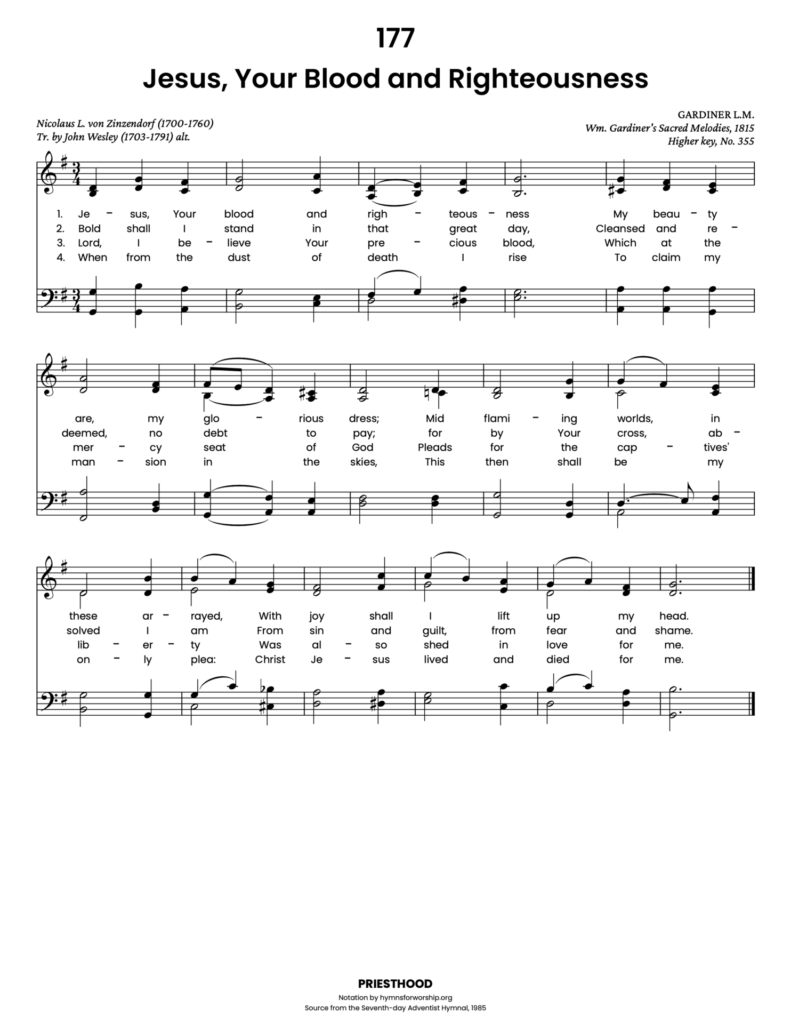
SDAH 177
Jesus, your blood and righteousness
My beauty are, my glorious dress;
Mid flaming worlds, in these arrayed,
With joy shall I lift up my head.
Get the hymn sheet in other keys here
For Worship Leaders
Make each hymn more meaningful with these helpful tools: Short, ready-to-use hymn introductions for church bulletins, multiple ways to introduce a hymn based on your worship theme and in-depth history and insights to enrich your song service.
Hymn Spotlight: Jesus, Your Blood and Righteousness
A powerful testimony of faith in Christ’s atonement, this hymn by Count Zinzendorf was translated by John Wesley and published in 1740. Originally spanning 33 stanzas, it is a rich meditation on the believer’s assurance in Jesus’ righteousness. The melody, adapted from Beethoven, lends solemn strength to the profound words. In our own walk, may we rest in this assurance: “Jesus, Thy blood and righteousness / My beauty are, my glorious dress.”
📖 Reference: Feel free to share but please cite hymnsforworship.org when reproducing.
Introductions for Sabbath School Song Service (based on specific lesson quarterlies):
Originally 33 stanzas long, this hymn was written in 1739 while Zinzendorf was returning to Saxony from a missionary journey to St. Thomas, West Indies. Published that same year in the eighth appendix to his Gesangbuch Herrnhut(Herrnhut Hymnbook), it came to the attention of John Wesley. Wesley’s translation into English preserved 24 of the stanzas, first printed in his Hymns and Sacred Poems, 1740. His title was “The Believer’s Triumph”; SDAH uses Wesley’s stanza 1, lines 1 and 3 of stanza 2, lines 1 and 2 of stanza 7, and stanza 12.
Count Nicholaus Ludwig von Zinzendorf was born May 26, 1700, in Dresden, Germany, to a wealthy family of nobility who were determined that he would be a nobleman, involved in politics. Educated in Pietism (personal devotional religion) by his grandmother and at the University of Halle, he set his heart on becoming a preacher. Dutifully he studied law at the University of Wittenberg, then at age 19 he traveled all over Europe, observing different kinds of religion. He came to the conclusion that the best of all was a personal religion, or, as he called it, “Christianity of the heart.” In Düsseldorf he was deeply impressed by a picture of the thorn-crowned Christ that bore underneath the words “What hast thou done for Me?” Returning home, Zinzendorf accepted the position of councilor of state at the court of Saxony. He held prayer meetings at his large house and wrote hymns especially for these occasions.
In 1722 he met a carpenter of the Moravian Brethren, who because of persecution in Bohemia had fled to Saxony for religious freedom. Sympathetic with the suffering of these persecuted Christians, Zinzendorf gave them refuge on his beautiful estate and helped them build a village named “Herrnhut”—the “Lord’s Shelter.” In 10 years their number grew to 600, and Zinzendorf enthusiastically joined in their activities of organizing, printing tracts and hymnbooks, and engaging in missionary work. In 1734 he decided to become a minister; he received a license to preach from the theological faculty at the University of Tübingen, and was consecrated as a bishop of the Moravian Brethren in 1737.
Opposed by the Lutherans, Zinzendorf was banned by an edict of 1737 on charges of preaching false doctrine. He used this setback as an opportunity, and traveled widely, preaching and establishing Moravian colonies in Germany, Holland, England, and America. He arrived in Bethlehem, Pennsylvania, on Christmas Day, 1741. He founded the colony that is still there, which has a strong and famous musical tradition. When the ban was lifted, in 1747 he was able to return to his estate, and continued to direct the affairs of the Moravian Brethren. All his wealth was devoted to religious work, and he died a poor man at Herrnhut on May 9, 1760.
With Zinzendorf (who wished not to be called Count but a “plain, Lutheran preacher”), writing hymns was a passion. He wrote the first of some 2,000 at age 12, and the last one came from his pen just a few days before his death. The many hymnbooks he edited and published were taken by devout Moravian missionaries all over the world; their influence on later hymnody has been significant.
John Benjamin Wesley, born June 17, 1703, at Epworth rectory, Lincolnshire, England, was educated at Oxford University; he earned the B.A. in 1724 and an M.A. in 1727. After becoming a fellow of Lincoln College, he went back to Epworth and assisted in his father’s parish. In 1729 he accepted a teaching position at Oxford, where, with his brother Charles Wesley (see Biographies), he became the leader of the Holy Club, also known as Oxford Methodists because of their disciplined approach to Bible study and devotional life. Under sponsorship of the Society for the Propagation of the Gospel, John and Charles went as missionaries to Savannah, Georgia. On the ship they met a group of Moravian missionaries and were deeply impressed with their piety and fervor. After returning to London, John started a church in an old foundry building, the beginning of the Methodist Church.
Learning the power of hymn singing from the Moravians, Wesley studied German in order to translate and use their hymns in English. (While at Savannah, in 1737 he printed Collection of Psalms and Hymns, the first hymnal ever used in an Anglican church.) It was under his editing, organizing, and publishing the hymns of his brother, Charles, that hymnody became the most powerful evangelizing influence England ever knew.
A most amazing man, John Wesley traveled more than a quarter of a million miles, mostly on horseback; preached some 40,000 sermons; and was ordained by the Anglicans, he could not preach in their churches, for he had a burden to preach the gospel to the poor, the drunken, and the outcasts of society, whose presence was not welcomed in the Anglican churches. Taking as his motto “The world is my parish,” he became an itinerant preacher. Although not wishing to break with the Church of England, he was forced to organize his followers and ultimately to ordain those capable to be Methodist preachers. He wrote a few original hymns, but his work in this field is best known by some 30 translations he made from French, Spanish, and German. His other hymn in SDAH is No. 519, “Give to the Winds Your Fears.” He died in London on March 2, 1791.
William Gardiner, born March 15, 1769, in Leicester, England, worked in his father’s business, manufacturing stockings. But his hobby of music took most of his interest. On trips to Germany he met Haydn, Beethoven, and Mozart. It is said that at one meeting he gave Haydn a pair of stockings from his own plant, into which the opening bars of the tune AUSTRIA (see SDAH 423) were woven! His book in three volumes, Music and Friends, 1838–1853, is an account of all these adventures. He was the first to introduce the music of Beethoven into England. From 1812 to 1838 he published two editions of Sacred Melodies, with tunes adapted from the great composers and put to the finest of the sacred poems. It was his hope to replace both the old and new versions of the psalms then in use in the church. These six volumes became a prime source for later hymnal editors and compilers, among them the notable Lowell Mason (see Biographies). He died at age 84 in Leicester on November 16, 1853.
GARDINER, also known as GERMANY, FULDA, WALTON, BEETHOVEN, and MELCHIZEDEC, was credited to a Beethoven “subject.” In The Hymnal 1940 Companion Leonard Ellinwood has pointed out that the Allegretto ma non troppo movement of Beethoven’s Piano Trio, Opus 70, No. 2 (1809), “bears marked resemblance to the beginning and end of Gardiner’s tune.” SDAH uses this tune two more times, for Nos. 355 and 376. Another tune from Gardiner’s Sacred Melodies is LYONS for “O Worship the King,” SDAH 83, which Routley says Gardiner adapted from a tune in one of Michael Haydn’s masses. He also arranged CREATION (SDAH 96).
Stanza:
1 – 1 Corinthians 1:30
Psalm 3:3
2 – John 8:10
3 – Romans 5:11
4 – John 5:25

Text
1
Jesus, Your blood and righteousness
My beauty are, my glorious dress;
Mid flaming worlds, in these arrayed,
With joy shall I lift up my head.
2
Bold shall I stand in that great day,
Cleansed and redeemed, no debt to pay;
For by Your cross absolved I am
From sin and guilt, from fear and shame.
3
Lord, I believe your precious blood,
Which at the mercy seat of God
Pleads for the captives’ liberty,
Was also shed in love for me.
4
When from the dust of death I rise
To claim my mansion in the skies,
This then shall be my only plea:
Christ Jesus lived and died for me.

Hymn Info
Biblical Reference
(a) 1 Cor 1:30; Ps 3:3 (b) John 8:10 (c) Rom 5:11 (d) John 5:25
Author
Nicholas L. von Zinzendorf (1700-1760)
Translator
John Wesley (1703-1791) alt.
Hymn Tune
GARDINER
Metrical Number
L.M.
Tune Source
Wm. Gardiner’s Sacred Melodies, 1815
Alternate key
Higher key, SDAH 355
Theme
PRIESTHOOD
Recommended Reading
Somehow I cannot relate to a filthy rag until I had to change a toddler’s diaper. Smelly, yucky and nasty. Ironically, that’s exactly how my righteousness look like. Maybe even worse. But what I cannot come to grasp with is God. Why in His High, Almighty, All-Powerful state would send His son –equally preeminent as He –would stoop down so low to clean me up. Take all my slime and grime and muck. And dress me in brand spanking new clothes called, His Righteousness. What I done to deserve it? Nothing.
For 38 years, the males of the Zinzendorf family bore the title “Count”, which denoted a high-ranking status among the nobility. Among many other responsibilities, they were mainly known to accompany the emperor or represent the emperor as a delegate to different parts of the country as well as foreign lands. Thus, when Nikolaus Ludwig was born, he inherited at birth the name Count Zinzendorf.