JESUS CHRIST >> BIRTH
SDAH 138
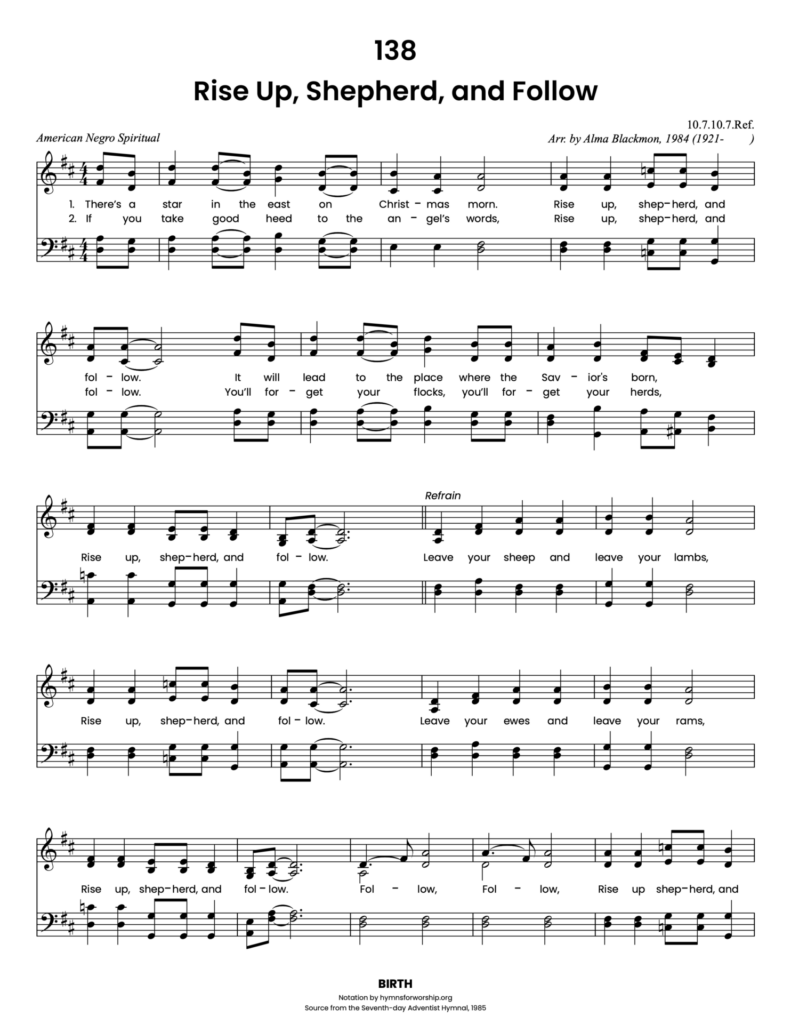
There’s a star in the east on Christmas morn.
Rise up, shepherd, and follow.
It will lead to the place and where the Saviour’s born,
Rise up, shepherd, and follow.
Get the hymn sheet in other keys here
For Worship Leaders
Make each hymn more meaningful with these helpful tools: Short, ready-to-use hymn introductions for church bulletins, multiple ways to introduce a hymn based on your worship theme and in-depth history and insights to enrich your song service.
Hymn Spotlight: Rise Up, Shepherd, and Follow
Few spirituals speak of Christ’s birth—but this one does so with striking power. “Rise Up, Shepherd, and Follow” invites us to leave behind all we have and follow the star, like the shepherds of old. Though not found in early hymn collections, its message echoes Jesus’ call to seek the greatest Treasure of all—Himself. In it, we hear the deep hope of the disinherited, the poor, and the captive, recognizing Jesus as One who came not in privilege, but in humility, for all people.
As we sing, may we too rise up—and follow.
📖 Reference: Feel free to share but please cite hymnsforworship.org when reproducing.
Introductions for Sabbath School Song Service (based on specific lesson quarterlies):
Few of the Negro spirituals have to do with the nativity of Christ. This has given rise to some speculation. James Weldon Johnson, noted Negro historian and poet, felt that the reason lay in the fact that Christmas Day was a day of special license, having no religious significance to the slaves. On the other hand, Howard Thurman in his article “The Meaning of Spirituals,” published in the International Library of Negro Life and History, offers that, in relating the Bible stories concerning the birth of Jesus, great caution was exhibited in teaching the meaning of this event to the poor and the captive. Why? It is of primary significance that Jesus was born of poor parentage, so poor that His parents could not afford to offer a lamb for the sacrifice but had to use doves instead. It is also noteworthy that Jesus was not a Roman citizen. He was a Jew who lived under Roman rule. He was of low status because of His race. Similarly, the African slave was not a citizen of America. One can imagine the heartening and revitalizing effect that Christianity would have offered the slave, also poor and of a hated race, if Jesus had been introduced to him as the hope of the disinherited and the captive!
Nevertheless, there are a few Christmas spirituals that have evolved and that point out the meaning of the birth of Jesus. “Rise Up, Shepherd, and Follow” is one of these. It captures the same spirit inherent in the parables of the pearl of great price and the treasure hidden in the field, as its words enjoin the believer to leave all his possessions-his sheep, his lambs, his ewes, his rams-and to follow the star to the place where he can find the true Pearl, the greatest Treasure of all, Jesus!
This is not one of those spirituals that can be found in the standard collections, nor is it in the first-line index of the Dictionary of American Hymnody. The arrangement is by Alma Blackmon (1921- ; see SDAH 69), who furnished the above commentary. She also arranged SDAH 305, “Give Me Jesus,” and 580, “This Little Light of Mine.”
Stanza:
1 – Matthew 2:2
2 – Luke 2:15

Text
1
There’s a star in the east on Christmas morn.
Rise up, shepherd, and follow.
It will lead to the place and where the Saviour’s born,
Rise up, shepherd, and follow.
Refrain:
Leave your sheep and leave your lambs,
Rise up, shepherd, and follow.
Leave your ewes and leave your rams,
Rise up, shepherd, and follow.
Follow, follow,
Rise up shepherd, and follow.
Follow the star of Bethlehem,
Rise up, shepherd, and follow.
2
If you take good heed to the angel’s words,
Rise up, shepherd, and follow.
You’ll forget your flocks,
you’ll forget your herds,
Rise up, shepherd, and follow.

Hymn Info
Biblical Reference
(a) Matt 2:2 (b) Luke 2:15
Text Source
American Negro Spiritual
Copyright
Arrangment copyright 1984 by Alma Blackmon
Metrical Number
10.7.10.7.Ref.
Arranged
Alma Blackmon, 1984 (1921-2009)
Theme
BIRTH OF JESUS CHRIST