GOD THE FATHER >> POWER OF GOD IN NATURE
SDAH 96
The spacious firmament on high,
With all the blue, ethereal sky,
And spangled heavens, a shining frame,
Their great Original proclaim.
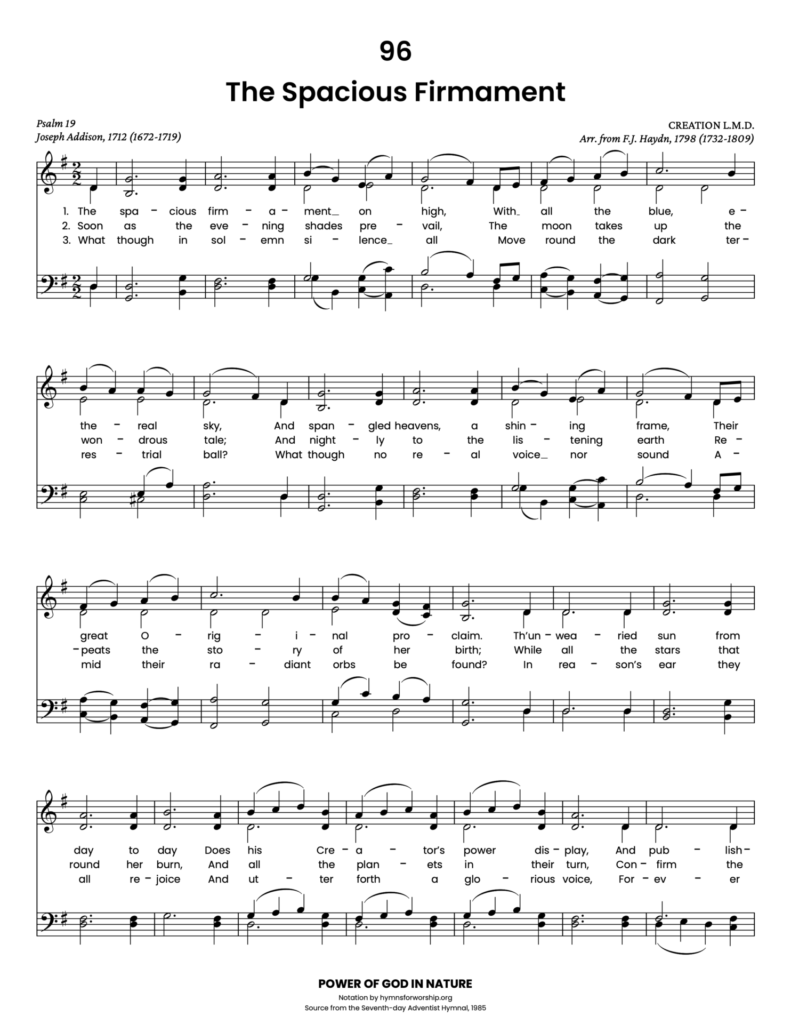
Get the hymn sheet in other keys here
For Worship Leaders
Make each hymn more meaningful with these helpful tools: Short, ready-to-use hymn introductions for church bulletins, multiple ways to introduce a hymn based on your worship theme and in-depth history and insights to enrich your song service.
Hymn Spotlight: The Spacious Firmament
Joseph Addison’s 1712 hymn is a poetic meditation on Psalm 19, inspired by his essay in The Spectator on strengthening faith through contemplating God’s creation. Addison, a statesman and literary figure, saw the heavens as a testimony to God’s power and wisdom. His hymn beautifully captures the awe and wonder of the natural world as a reflection of divine glory.
The tune CREATION is adapted from Franz Joseph Haydn’s oratorio of the same name, specifically The Heavens Are Telling. A prolific composer, Haydn was known for dedicating his works to God’s glory.
As we sing, may this hymn remind us to look beyond the sky and see the hand of our Creator in all things.
📖 Reference: Feel free to share but please cite hymnsforworship.org when reproducing.
Introductions for Sabbath School Song Service (based on specific lesson quarterlies):
In The Spectator of August 23, 1712, Joseph Addison contributed “An Essay on the Proper Means of Strengthening and Confirming Faith in the Mind of Man,” in which he suggested that faith could best be strengthened by retiring from the hustle and bustle of life and quietly meditating on the wonderful works of God. He then referred to the first verse of the nineteenth psalm, saying that David had some “very beautiful strokes of poetry to this purpose in that exalted strain.” Then follow these three stanzas, which paraphrase the first four verses of the psalm.
Joseph Addison was born on May 1, 1672, at Milston, Wiltshire, England, the son of an Anglican clergyman. He graduated from Magdalen College, Oxford, with a B.A. in 1691, and an M.A. in 1693. He trained to follow his father’s profession but turned instead to literature and politics. He held important positions in government, being a commissioner of appeals in 1704, under-secretary of state 1706, and a member of Parliament from 1708 until his death. From 1709 to 1711, he was secretary to the lord lieutenant of Ireland. In 1714, he was appointed chief secretary to Ireland and in 1716, lord commissioner of trade.
Addison is best known, however, for his literary contributions. His essays appeared in The Tatler from 1709, and in 1711, he collaborated with his friend Sir Richard Steele to bring out The Spectator, which contained many of Addison’s essays and also many original hymns. Both Isaac Watts and John Wesley regarded highly his literary style and content. He resigned his political office in 1718 because of failing health. He died at Holland House, Kensington, London, on June 17, 1719, and was buried in Westminster Abbey.
CREATION is an arrangement from the oratorio of this name, composed in 1798 by Franz Joseph Haydn. It is an adaptation of the first part of “The Heavens Are Telling.”
Haydn was born at Rohrau, 25 miles southeast of Vienna, Austria, on March 31, 1732, and was educated at the Roman Catholic choir school of St. Stefan’s Cathedral in Vienna for nearly 10 years. In 1749, he was expelled and was forced to support himself by playing in street bands, teaching, and occasionally writing music. He composed his first mass in 1750 and composed a series of string quartets published in 1755. In 1761, he was appointed director of music at the house of Prince Paul Anton Esterházy, remaining there until 1791, when the grandson of his patron dismissed most of the musicians of the household. Haydn went to England for two years, and the University of Oxford awarded him the D. Mus. degree. He returned to Vienna in 1792, went back to England in 1794, and finally to Vienna in 1795, where he stayed until his death on May 31, 1809.
He composed more than 100 symphonies, 80 string quartets, 100 works for chamber music, 60 sonatas for piano, 16 masses, 22 operas, and 4 oratorios. He always prefaced his scores with the words “In nomine Domini” (in the name of the Lord) and concluded them with “Laus Deo” (praise go to God). Haydn also composed the tune for SDAH 423, AUSTRIA.
The first arrangement of this melody for the words is found in Sacred Melodies, 1812, by William Gardiner (1770–1853; see SDAH 177).
Stanza:
1 – Psalm 19:1, 4
3 – Psalm 19:3

Text
1
The spacious firmament on high,
With all the blue, ethereal sky,
And spangled heavens, a shining frame,
Their great Original proclaim.
Th’unwearied sun from day to day
Does his Creator’s power display,
And publishes to every land
The work of an Almighty hand
2
Soon as the evening shades prevail,
The moon takes up the wondrous tale;
And nightly to the listening earth
Repeats the story of her birth;
While all the stars that round her burn,
And all the planets in their turn,
Confirm the tidings as they roll,
And spread the truth from pole to pole
3
What though in solemn silence all
Move round the dark terrestrial ball?
What though no real voice nor sound
Amid their radiant orbs be found?
In reason’s ear they all rejoice
And utter forth a glorious voice,
Forever singing as they shine,
“The hand that made us is divine.”

Hymn Info
Biblical Reference
(a) Ps 19:1, 4 (c) Ps 19:3
Author
Joseph Addison (1672-1719)
Year Published
1712
Hymn Tune
CREATION
Metrical Number
L.M.D.
Tune Source
Arr. from F.J. Haydn (1732-1809) / 1798
Theme
POWER OF GOD IN NATURE
Recommended Reading
The general idea when it comes to hymns is that there is a close bond between the author and the composer. That the author writes a hymn and the composer invents a tune to suit it, and then provides the harmony to accompany the tune. However, such wasn’t always the case.
Many hymns actually worked vice versa wherein authors would write verses according to existing tunes. Hundreds of hymns are sung from borrowed tunes, such as secular songs, chants, and even classical works. That being said, I went ahead and researched which hymns in the SDA Hymnal were originally classical works.