GOD THE FATHER >> Majesty & Power of God
SDAH 84
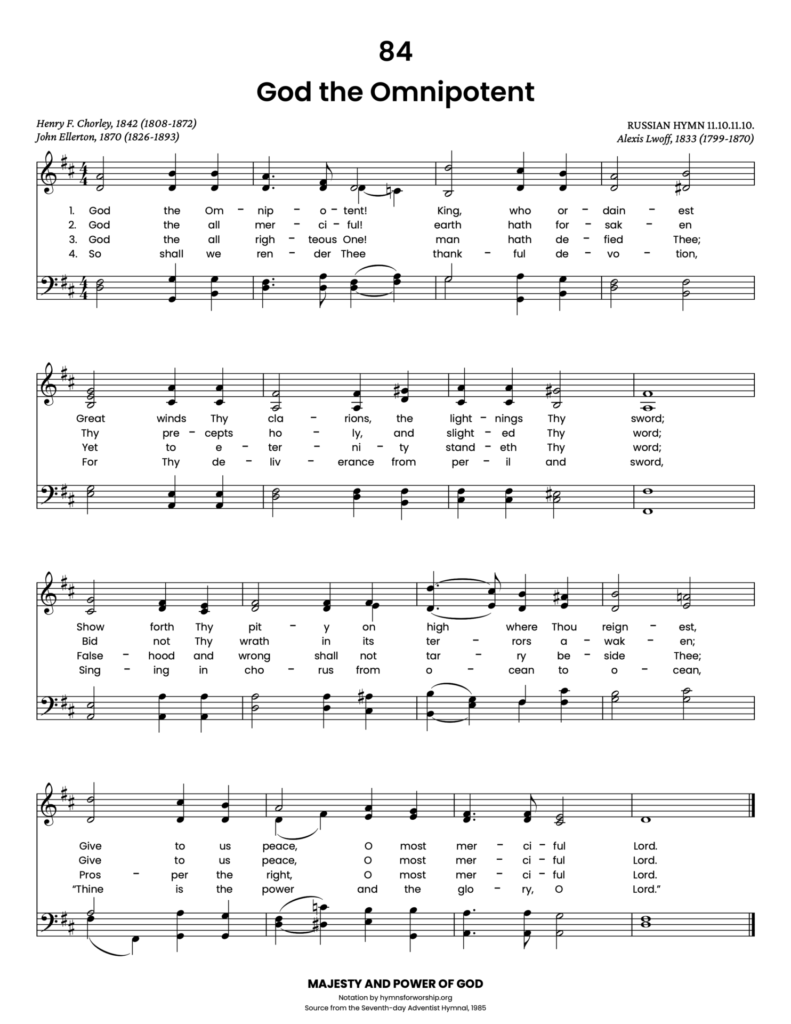
God the Omnipotent! King, who ordainest
Great winds Thy clarions, the lightnings Thy sword;
Show forth Thy pity on high where Thou reignest,
Give to us peace, O most merciful Lord.
Get the hymn sheet in other keys here
For Worship Leaders
Make each hymn more meaningful with these helpful tools: Short, ready-to-use hymn introductions for church bulletins, multiple ways to introduce a hymn based on your worship theme and in-depth history and insights to enrich your song service.
Hymn Spotlight: God the Omnipotent
Originally composed as the Russian national anthem, the tune for this hymn was written in 1833 by Alexis Feodorovich Lvov (1798–1870) at the request of Czar Nicholas I. After its adoption as God Save the Czar, the melody gained popularity across Europe and was later paired with the words of Henry Fothergill Chorley (1808–1872), who wrote the hymn In Time of War in 1842. John Ellerton later revised the text, and the SDAH version is a composite of their work.
This powerful hymn calls upon God’s sovereignty in times of crisis, pleading for His mercy and righteousness to reign over the nations. As we sing, may we be reminded that true peace and justice come only through His almighty power.
📖 Reference: Feel free to share but please cite hymnsforworship.org when reproducing.
Introductions for Sabbath School Song Service (based on specific lesson quarterlies):
The tune of this hymn was composed before the words and had its origin in a request from the czar of Russia, Nicholas I, for a national anthem for his own country, to replace the tune of the British national anthem, “God Save the King.” The czar had just visited Austria and Prussia and asked Alexis Feodorovich Lvov, who had accompanied him on his journey, to write a tune for an anthem. In November 1833, on returning to his quarters late one night, Lvov wrote out a tune on the spur of the moment and asked a friend to supply some words. The emperor, the empress, and the grand duke Michael went to the court chapel the next morning and heard the new anthem played by the orchestra and sung by the choir, together and separately. The emperor expressed his warm approval and adopted the new hymn, “God Save the Czar,” as the Russian national anthem.
The tune first appeared as an English hymn tune in John Pyke Hullah’s (1812–1884) Part Music, 1842, to the words “God the all terrible! King who ordainest,” written by Henry Fothergill Chorley and entitled “In Time of War.” The hymn was imitated by John Ellerton (1826–1893; see SDAH 56) in his Select Hymns for Church and Home, 1871. The present SDAH hymn is a composite one.
Lvov was born in Tallinn, Estonia, on June 5, 1798, and studied music as an engineer and joined the army in 1818, ultimately becoming a major-general adjutant to the czar; he retired in 1836. He then succeeded his father as musical director in the imperial chapel. He was an excellent violinist and led a famous string quartet that visited many places in Europe. Lvov composed several operas, a string quartet, a violin concerto, violin fantasias, and choral music. He also edited a collection of old Russian chants. He retired in 1867 because of deafness and died on December 28, 1870, at Romanovo, near Kovno (Kaunas), in Lithuania.
Chorley was born on December 15, 1808, at Blackley Hurst, a country house near Wigan, Lancashire, and was a Quaker. He was educated at the Royal Institution in Liverpool and after a short time in business discovered his literary talent. He joined the staff of the London Athenaeum in 1831 and remained there for more than 35 years as a writer, musical editor, and book reviewer. His visit to Germany in 1849 led to a lasting friendship with Mendelssohn, with whom he entered into considerable correspondence, and also an acquaintance with Chopin. He also wrote novels and many songs for opera and was musical critic for The Times daily newspaper. He died on February 15, 1872, at Westminster, London.
Stanza 84
1 – Revelation 19:6
Revelation 104:3
Revelation 29:11
2 – Psalm 103:17
3 – Psalm 119:137
4 – Matthew 6:13

Text
1
God the Omnipotent! King, who ordainest
Great winds Thy clarions, the lightnings Thy sword;
Show forth Thy pity on high where Thou reignest,
Give to us peace, O most merciful Lord.
2
God the all merciful! earth hath forsaken
Thy precepts holy, and slighted Thy word;
Bid not Thy wrath in its terrors awaken;
Give to us peace, O most merciful Lord.
3
God the all righteousness One! man hath defied Thee;
Yet to eternity standeth Thy word;
Falsehood and wrong shall not tarry beside Thee;
Prosper the right, O most merciful Lord.
4
So shall we render Thee thankful devotion,
For Thy deliverance from peril and sword,
Singing in chorus from ocean to ocean,
“Thine is the power and the glory, O Lord.”

Hymn Info
Biblical Reference
(a) Rev 19:6; 104:3; 29:11 (b) Ps 103:17 (c) Ps 119:137 (d) Matt 6:13
Author
Henry F. Chorley (1808-1872), John Ellerton (1826-1893)
Hymn Tune
RUSSIAN HYMN
Metrical Number
11.10.11.10.
Composer
Alexis Lwoff (1799-1870)
Year Composed
1833
Theme
MAJESTY & POWER OF GOD