GOD THE FATHER >> Love of God
SDAH 78
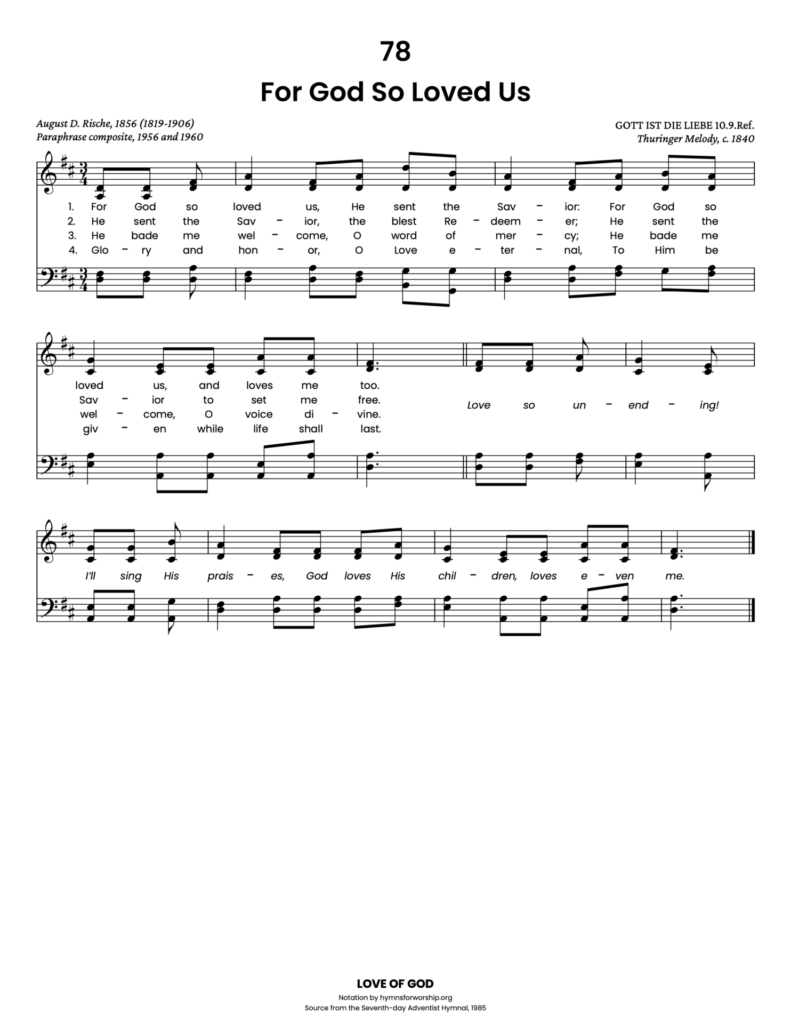
For God so loved us,
He sent the Savior:
For God so loved us,
and loves me too.
Get the hymn sheet in other keys here
For Worship Leaders
Make each hymn more meaningful with these helpful tools: Short, ready-to-use hymn introductions for church bulletins, multiple ways to introduce a hymn based on your worship theme and in-depth history and insights to enrich your song service.
Hymn Spotlight: For God So Loved Us
This beloved children’s hymn comes from a German Lutheran tradition and was written by August Diedrich Rische (1819–1906). A theologian, pastor, and hymn collector, Rische spent much of his life in ministry and hymnody, serving as a tutor, pastor, and editor of church publications in Germany. The hymn paraphrases John 3:16, reminding us of God’s immense love for humanity. After appearing in a German-American hymnal in 1873, it was later translated into English and preserved in Mennonite hymnals.
The melody, GOTT IST DIE LIEBE, likely originated as a folk tune. Its gentle, memorable phrases make it a favorite among children and adults alike.
As we sing, may we reflect on the depth of God’s love and respond with joyful hearts.
📖 Reference: Feel free to share but please cite hymnsforworship.org when reproducing.
Introductions for Sabbath School Song Service (based on specific lesson quarterlies):
Like today’s lesson, this hymn tells us that God’s love for us was expressed through His Son Jesus Christ. (Lesson 5, 4th Quarter 2020 – Sunday, Revealing the Father, 10/25/2020)
Our lesson talks about the greatness of God’s love to His people that He even sent His only Son to die for our sins that all may have eternal life with Him. This hymn prompt us to remember that Love that only God can offer. (Lesson 10, 1st Quarter 2021 -Sunday, Isaiah’s Testing Truth, 2/28/2021)
The version here printed of this old familiar children’s hymn is from The Memonite Hymnal, 1969, and information about it comes from that book and its companion volume. The words were written by August Diedrich Rische, who was born in Minden, near Hanover, Northwest Germany, in 1819. He studied theology at the University of Halle, near Leipzig. In 1844 he became a private tutor and in 1851 was pastor in Schwindendorf, in the state of Mecklenburg. In 1900 he was a member of the bishop’s consistory court in Ludwigslust, also in Mecklenburg. For 10 years he was editor of Sunday papers in Mecklenburg and published song collections. He died in 1906.
The hymn appeared in a German Lutheran hymnal in America in 1873. After translation into English, it was used in only three successive Mennonite hymnals. The composition paraphrase was made and appeared in The Youth Hymnary, 1956, and the The Hymn Book, 1969 (Canadian Mennonite Brethren).
It is thought that the early source of the tune was a folk song. The tune name GOTT IST DIE LIEBE comes from the first line of the German original. In Deutscher Liederhort authors Erk and Boehme list a version of this song. The German hymnal Gesangbuch Der Mennoniten, 1965, indicates “Meiningen,” 1840, but the editors of that book give no further documentation.
Stanza:
1 – John 3:16
2 – Isaiah 49:26
3 – Isaiah 49:10
4 – Revelation 5:13
R – Jeremiah 31:3

Text
1
For God so loved us,
He sent the Savior:
For God so loved us,
And loves me too.
Refrain
Love so unending!
I’ll sing His praises,
God loves His children,
Loves even me.
2
He sent the Savior,
The blest Redeemer;
He sent the Savior
To set me free.
3
He bade me welcome,
O word of mercy;
He bade me welcome,
O voice divine.
4
Glory and honor,
O Love eternal,
To Him be given
While life shall last.

Hymn Info
Biblical Reference
(a) John 3:16 (b) Isa 49:26 (c) Isa 49:10 (d) Rev 5:13 (r) Jer 31:3
Author
August D. Rische (1819-1906)
Paraphrase
Paraphrase composite, 1956 and 1960
Year Published
1856
Hymn Tune
GOTT IST DIE LIEBE
Metrical Number
10.9.Ref.
Tune Source
Thuringer melody
Year Composed
c. 1840
Theme
LOVE OF GOD