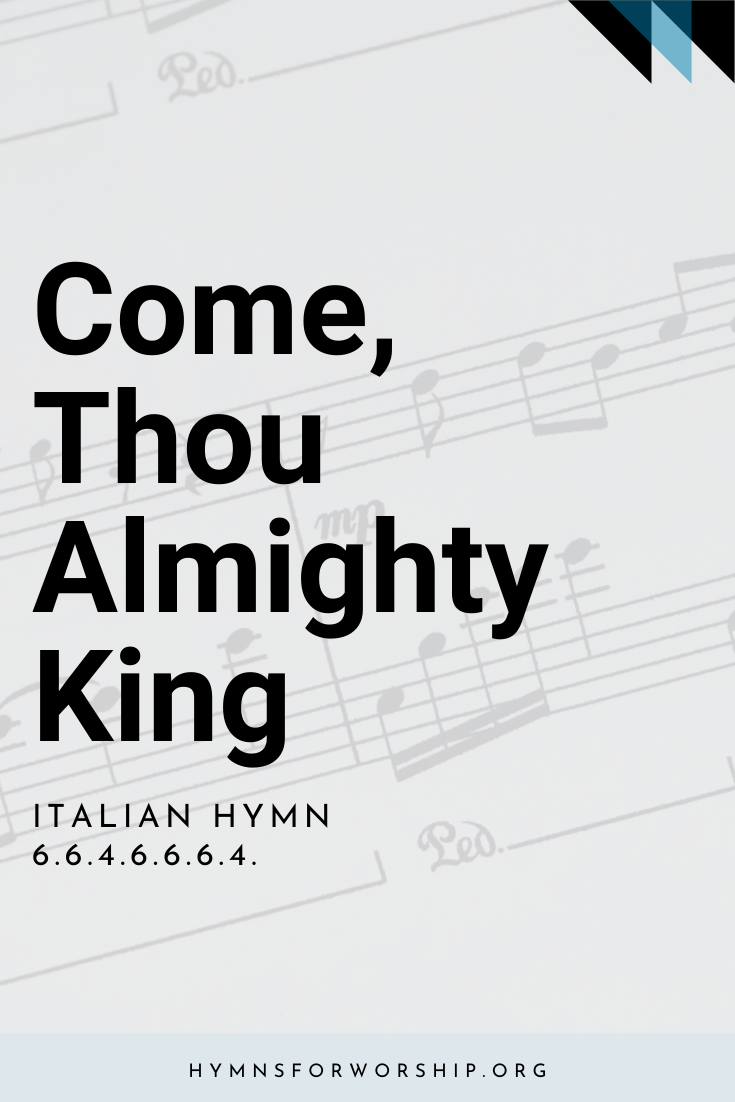
TRINITY
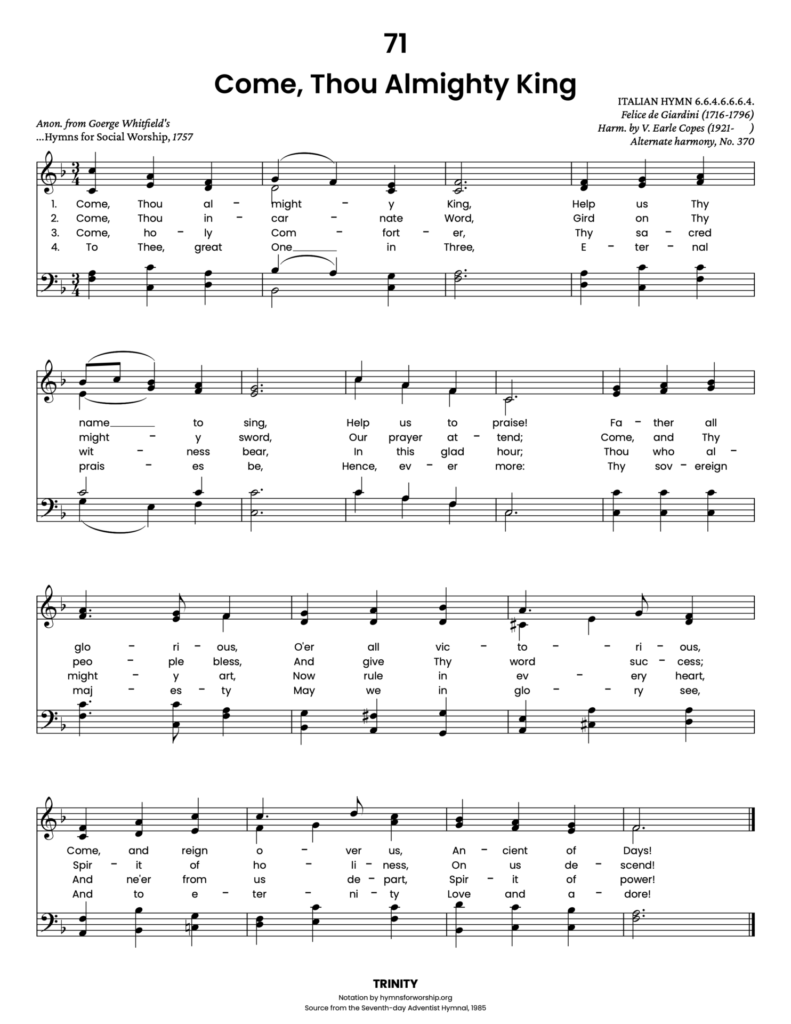
SDAH 71
Come, Thou almighty King,
Help us Thy name to sing,
Help us to praise!
Father all glorious,
This hymn appears in:
Get the hymn sheet in other keys here
For Worship Leaders
Make each hymn more meaningful with these helpful tools: Short, ready-to-use hymn introductions for church bulletins, multiple ways to introduce a hymn based on your worship theme and in-depth history and insights to enrich your song service.
Hymn Spotlight: Come, Thou Almighty King
The author of this beloved Trinitarian hymn remains unknown, though it was first published in 1757 alongside a hymn by Charles Wesley. Each stanza calls upon a different Person of the Godhead—Father, Son, and Holy Spirit—before concluding with a declaration of praise to the “One in Three.” Its strong and prayerful text has made it a cherished opening hymn for worship.
Felice de Giardini (1716–1796) composed the majestic tune, ITALIAN HYMN, at the request of Selina, Countess of Huntingdon. A noted violinist and composer, Giardini spent much of his career in London before his final years in Moscow, where he passed away. His melody, also known as MOSCOW, beautifully supports the hymn’s theme of divine majesty and unity.
As we sing, may our voices rise in adoration to the Father, Son, and Holy Spirit, the King of glory and grace!
📖 Reference: Feel free to share but please cite hymnsforworship.org when reproducing.
Introductions for Sabbath School Song Service (based on specific lesson quarterlies):
The heavenly court scene of Daniel 7:9–14 depicts the central event of the chapter. The books; the Ancient of Days on the throne; and the Son of man, surrounded by heavenly clouds (Dan. 7:13) as He comes into the presence of the Ancient of Days, portray a scene of judgment in heaven. For the saints, who have been persecuted by the little horn, the judgment means vindication, salvation, and restoration. We should bear in mind that the judgment of the living will take place only when the time of probation closes and the seven last plagues begin to be poured on Babylon (Revelation 15, Revelation 16). But most important, we must not fear the judgment because the “Son of Man” is our representative in the heavenly tribunal. Thus, rather than condemnation, the heavenly judgment will bring us vindication and deliverance. (Lesson 8, 1st Quarter 2020 – Tuesday, The Court Was Seated, 2/17/2020)
These words are sometimes attributed to Charles Wesley because the hymn appeared in 1757 on the same tract as one written by him and published by George Whitefield. However, it is not claimed by Wesley, nor does it appear in the older Methodist hymnals, so it remains anonymous. It is a real trinitarian hymn, for the stanzas speak respectively of Father, Son, and Spirit, and then conclude with “One in Three.”
ITALIAN HYMN was composed by Felice de Giardini at the special request of Selina, Countess of Huntingdon, for these words. When it was published by Martin Madan (see SDAH 211) in 1769 in his Collection of Psalm and Hymn Tunes Never Published Before, it was named “Hymn to the Trinity.” The same tune is used for SDAH 370, “Chrsit for the World.”
Giardini was born in Turin, Italy, on April 12, 1716; at Milan Cathedral he studied singing, clavier, and harmony. Later he studied violin and played in the opera orchestras in Rome and Naples. He visited Germany in 1748 and about two years later went to London, where he spent more than 30 successful years, teaching, performing, and conducting. From 1784 to 1790 he was in Naples, but he went back to London to start a comic opera compony. When this venture in England failed, he then went to Moscow, where he received a disappointing reception; he died there on December 17, 1796. He composed many operas, 12 violin concertos, much chamber music, and three other tunes in Martin Madan’s Collection. His tune here is variously called MOSCOW, after the city where he died, and ITALIAN HYMN, after the land of his birth.
The arrangement is by Vicar Earle Copes, who was born August 12, 1921, at Norfolk, Virginia. His B.A. is from Davidson College, North Carolina, his M.S.M. and B.D. from Union Theological Seminary, New York City. After further study at the University of Texas, he has held these positions: minister of music for churches in Texas; professor of organ and church music at Hendrix College, Arkansas, and Cornell College, Iowa; and music editor, Methodist General Board of Education, Nashville. Since 19667 he has been head of the Department of Organ and Church Music at Birmingham Southern College, Alabama, and minister of music at Canterbury Methodist Church, Birmingham. He was the founder and editor of the Methodist magazine Music Ministry. More than 25 anthems and numerous articles in professional journals have come from his pen; he was a special consultant to the committee that produced the Methodist Hymnal, 1964. He also arranged SDAH 89, OLD 113th.
Stanza:
1 – Daniel 7:22
2 – John 14:16
3 – Matthew 6:10

Text
1
Come, Thou almighty King,
Help us Thy name to sing,
Help us to praise!
Father all glorious,
O’er all victorious,
Come, and reign over us,
Ancient of Days!
2
Come, Thou incarnate Word,
Gird on Thy mighty sword,
Our prayer attend;
Come, and Thy people bless,
And give Thy Word success;
Spirit of holiness,
On us descend!
3
Come, holy Comforter,
Thy sacred witness bear,
In this glad hour:
Thou who almighty art,
Now rule in every heart,
And ne’er from us depart,
Spirit of power!
4
To Thee, great One in Three,
Eternal praises be,
Hence, evermore:
Thy sovereign majesty
May we in glory see,
And to eternity
Love and adore!

Hymn Info
Biblical Reference
(a) Dan 7:22 (b) John 14:16 (c) Matt 6:10
Text Source
Anonymous from George Whitfield’s Hymns for Social Worship
Year Published
1757
Copyright
Arrangement copyright 1964 by Abingdon Press. Used by permission.
Hymn Tune
ITALIAN HYMN
Metrical Number
6.6.4.6.6.6.4.
Composer
Felice de Giardini (1716-1796)
Harmonized
V. Earle Copes (1921-2014)
Alternate Harmony
SDAH 370
Theme
TRINITY